Madagascar periwinkle
The mistake with Madagascar periwinkle (Catharanthus roseus) is treating it like a seasonal bouquet: it is an evergreen subshrub with stems that turn woody, and in a pot it needs consistent light, careful watering, and a spot out of pets' reach.


Stem and leaf structure
Grown indoors, this is a branching evergreen subshrub 30-60 cm tall. Young plants have softer, more herbaceous shoots; with age, the stem turns woody and the internodes become shorter.
The leaves grow in opposite pairs and are lance-shaped, with short petioles and wedge-shaped bases. The leaf blade is dark green and glossy, with smooth margins, 2.5-8 cm long and up to 3.5 cm wide; a white midrib is clearly visible on the upper surface.
- branching shoots
- opposite leaves
- glossy leaf blades
- white midrib
- gradual woodiness of the stem
These features help distinguish the plant from herbaceous annuals, with which it is often confused in seasonal arrangements.
Origin and name
The species is native to Madagascar. In the wild, it grows in the south and east of the island, mainly along the edges of tropical rainforests, where there is more light than beneath a closed canopy.
The informal Ukrainian name meaning "pink periwinkle" is linked to older horticultural usage and the name Vinca rosea, under which the plant was long known in cultivation. Modern taxonomy places it in the separate genus Catharanthus, not Vinca.
Light and placement
Its origins at forest edges explain its need for a bright spot without abrupt changes in conditions. Indoors, the plant maintains compact growth and sets more buds where it receives enough light throughout the day.
Avoid deep shade: stems become stretched and flowering declines. If the pot is moved to a much brighter spot, acclimate it gradually, as the delicate leaf blades respond quickly to stress.
Watering and potting mix
The taproot system has a long main root measuring 25-35 cm and numerous lateral roots. Young roots are described as lacking root hairs, so the plant tolerates damage during repotting or water stagnating in the potting mix poorly.
Water to maintain even moisture without leaving the potting mix soggy. The species comes from moist forest edges, but it is not a wetland plant, and its roots need access to air.
- a loose potting mix
- drainage holes in the pot
- gentle firming after planting
- steady, moderate moisture
- no stagnant water
When repotting, do not bury the root collar or disturb the root system unnecessarily.
Flowers and fruit
The flowers are about 3 cm in diameter, with a corolla of five petals fused into a tube. Pink-red forms have a purple corolla throat; cultivated varieties also include white flowers with red or yellow throats.
In favorable conditions, the plant flowers from summer to late fall. The fruit consists of two sickle-shaped follicles up to 5 cm long and 3 mm thick; the seeds are small and black.
Toxicity and alkaloids
The plant is toxic to cats and dogs. Do not place it where pets can chew the leaves or stems, as its tissues contain biologically active alkaloids.
More than 80 alkaloids have been described in the species, including compounds used as pharmaceutical raw materials. This does not make the houseplant suitable for self-medication: a potted ornamental plant and a medicine are different things.
Propagation and replacement
Propagate from seeds or cuttings. Growing from seed is convenient for producing several plants, while cuttings are used to preserve the traits of a particular form.
Because the stems turn woody with age, the plant is sometimes replaced with young plants grown from cuttings. This approach helps maintain a compact appearance without heavily disturbing the old root system.
- Light
- bright indirect light
- Watering
- moderate
- Soil
- loose, well-drained
- Difficulty
- moderate
- Cats and dogs
- toxic
- Size indoors
- 30-60 cm
- Leaves indoors
- 2.5-8 cm
- Native range
- Madagascar
Care
Madagascar periwinkle behaves not like a short-lived bouquet but like an evergreen subshrub with a sensitive root system. Indoors, its main requirements are sufficient light, moderate moisture, and a spot out of pets' reach.
- Light
- Provide bright indirect light. A bright spot suits its origins at forest edges; in deep shade, stems weaken and flowering declines.
- Temperature
- Keep room temperature steady. No exact range is specified; this evergreen subshrub needs steady conditions without sudden chilling or temperature swings.
- Watering
- Water moderately. Keep the potting mix slightly moist, but do not let water stagnate around the taproot and lateral roots.
- Soil
- Use a loose, well-drained potting mix. Roots need access to air; dense, wet potting mix increases the risk of root problems.
- Feeding
- Feed during active growth. Feed during active growth and flowering; excess fertilizer is undesirable for the roots.
- Support
- No support needed. The shoots are those of a subshrub, and the stem turns woody with age, so a separate support is usually unnecessary.
- Leaves
- Inspect leaves regularly. The glossy leaf blades readily show loss of turgor, yellowing, or other signs of stress from watering or light conditions.
- Repotting
- Repot as needed. Repot carefully to avoid damaging the taproot and its numerous lateral roots.
Botany
3 ill.- Family
- Apocynaceae
- Genus
- Catharanthus
- Species
- Catharanthus roseus
- Author and year
- (L.) G.Don


Madagascar periwinkle belongs to the family Apocynaceae and the genus Catharanthus. It is an evergreen subshrub with branching shoots, opposite lance-shaped leaves, and a conspicuous white midrib on the upper surface of the leaf blade.
It has a taproot system: the main root reaches 25-35 cm and has numerous lateral roots. The pale yellow roots have a strong, distinctive smell, and young roots are described as lacking root hairs.
The species is native to Madagascar, where it is associated with the edges of tropical rainforests. Its flowers are ornamental, but the plant is also biologically valuable for its indole alkaloids, some of which have formed the basis of pharmaceutical research.
How it differs from similar plants
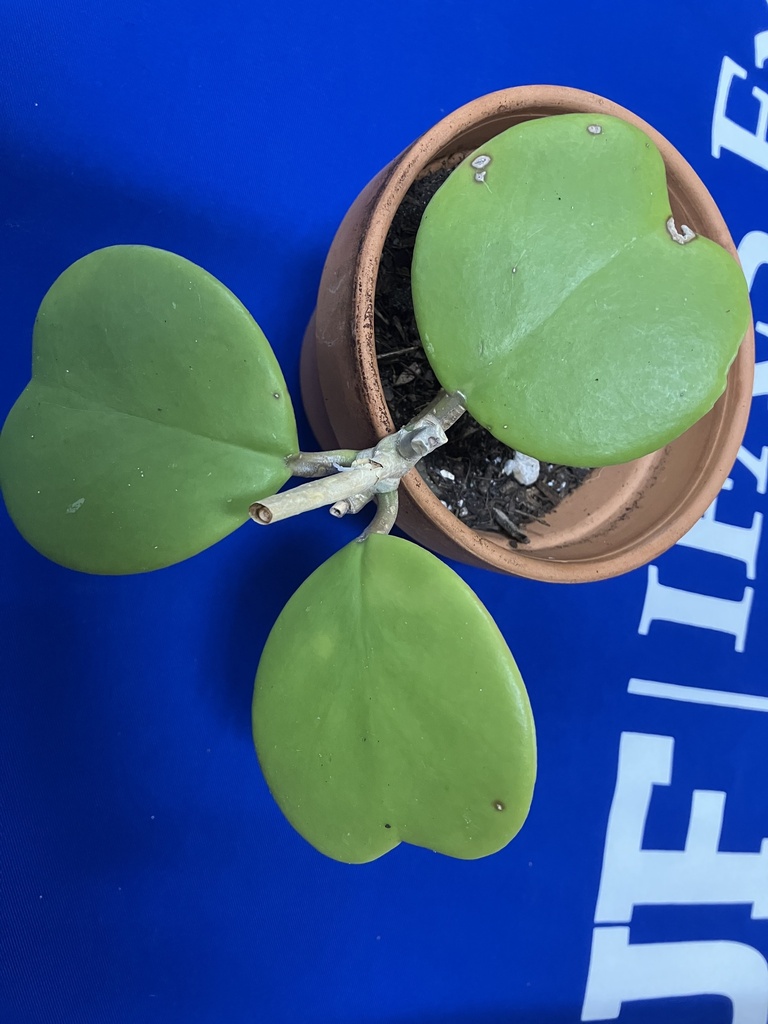
Wax plant Hoya carnosa
- Madagascar periwinkle grows as a 30–60 cm subshrub with stems that turn woody, while hoya is an epiphytic vine with fleshy oval leaves.
Brazilian jasmine Mandevilla sanderi
- Dipladenia is distinguished by its twining woody stems and need for support, while Madagascar periwinkle is described as a 30–60 cm subshrub.
Oleander Nerium oleander
- Oleander grows much taller indoors—up to 2 m—and has narrow, leathery leaves with a pale midrib, while Madagascar periwinkle stays at 30–60 cm.
Frequently asked questions
- Can I keep it at home if I have a cat?
- No. The plant is toxic to cats and dogs, so keep the pot out of pets' reach.
- Why are the leaves turning yellow?
- The most common causes are watering problems, stagnant water around the roots, or an abrupt change in light.
- Is it an annual or a perennial?
- Botanically, it is a perennial evergreen subshrub, although it is often grown as a seasonal plant in gardens.
- How do I propagate Madagascar periwinkle?
- The species is propagated from seeds and cuttings; cuttings preserve the traits of a particular form.
- Can the leaves be used medicinally?
- No. The plant contains alkaloids and is toxic; medicines are produced from controlled raw materials, not from a houseplant.