Money tree
Dark green, palmately compound leaves on long stalks are the main identifying feature of the money tree (Pachira aquatica). Indoors, it is grown as a small tree with a distinctive crown.
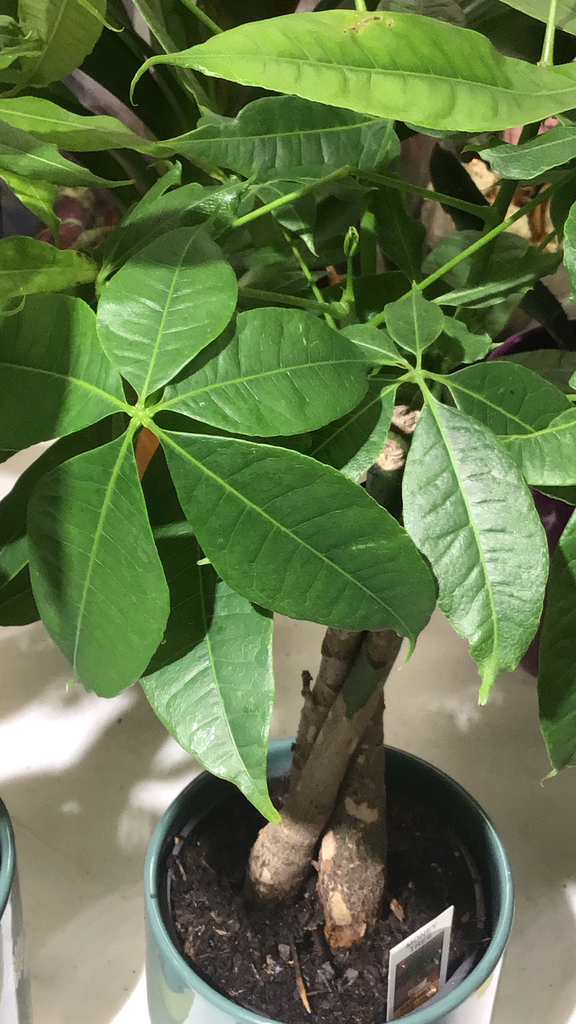


Leaf and trunk structure
The leaves are palmately compound: several lance-shaped leaflets spread from a single point, giving the crown an airy yet dense appearance. The leaf blades are leathery and dark green, with a distinct sheen in good light.
In the wild, this is an evergreen tree with distinctive stilt roots. Indoors, the trunk and upper crown are usually more noticeable than the roots: these are the plant's main ornamental features.
- palmately compound leaves
- lance-shaped leaflets
- dark green color
- leathery leaf blades
- woody trunk
Origin and natural habitat
The species is native to Central and South America. In its natural habitat, money tree grows in wet areas along lagoons and rivers, where water and organic deposits create heavy, nutrient-rich soil.
| Habitat feature | What it means for the plant |
|---|---|
| Wet areas | The root system is not adapted to prolonged dryness |
| Clay soils with organic matter | The growing medium needs to retain moisture without turning sour |
| Lagoon and river shores | The plant responds better to stable conditions than to sudden changes |
It is sold as Pachira aquatica and under a Ukrainian trade name meaning "money tree": the first is a rendering of the Latin species name, while the second refers to leaf shape and cultural associations rather than botany.
Light and placement
The large, dark green leaf blades hold their shape better in a bright spot without intense overheating. In deep shade, growth usually slows and the internodes may lengthen.
- a bright spot near a window
- filtered sunlight without overheating
- protection from cold drafts
Position the pot so the crown does not touch cold glass or sit in a stream of hot air. Turn the plant from time to time so different sides face the light source and the crown grows evenly.
Watering and potting mix
Coming from wet habitats does not mean the pot should stay constantly wet. Indoors, waterlogged potting mix is more dangerous than briefly allowing the top layer to dry.
- water after the surface of the potting mix dries
- empty water from the saucer
- use a moisture-retentive but well-aerated potting mix
- choose a stable pot for the woody trunk
- firm the mix gently after repotting
The potting mix needs to retain some moisture while allowing air to reach the roots. If the mix stays wet for a long time, the roots function less effectively, and this quickly shows in the leaves.
Flowers and fruit
In the wild, money tree produces white or yellowish flowers in large, branching flower clusters. These can reach 35 cm in length, so this is not a small indoor floral display but part of a mature tree's development.
The fruit is described as an elongated, rounded, olive-colored berry that becomes woody. It contains rounded seeds; the seeds are the part used as food, both from wild and cultivated trees.
| Plant part | Description |
|---|---|
| Flower cluster | Branching, up to 35 cm |
| Fruit | Olive-colored berry, 10-25 cm |
| Seeds | Rounded, contained inside the fruit |
Common problems
Most visible changes begin with the leaves: they turn yellow, lose firmness or fall off. This is how the plant responds when moisture, light and root health are out of balance.
- yellowing leaves from overwatering
- wilting after prolonged drying out
- stretched shoots in shade
- dry leaf edges from dry air
- a crown leaning toward the light source
Look for the problem in the pot as well as on the leaves. If the potting mix is compacted, smells sour or takes a long time to dry, the cause is more often related to the roots than to a lack of nutrients.
- Light
- bright indirect light
- Watering
- avoid prolonged drying out
- Soil
- moisture-retentive potting mix
- Difficulty
- moderate
- Cats and dogs
- safe
- Leaves indoors
- palmately compound leaves
- Native range
- Central and South America
Care
Money tree comes from wet habitats, but in a pot it needs even moisture and air around its roots, not waterlogged conditions. The main risk indoors is the combination of low light and constantly wet potting mix.
- Light
- Provide bright indirect light. Keep it near a bright window where direct sun through the glass will not overheat the leaves.
- Temperature
- Keep consistently warm. Sudden chills and cold drafts are unsuitable for a plant from humid tropical regions.
- Watering
- Water when the surface dries. The potting mix should not remain completely dry for long, but water must not sit in the saucer.
- Soil
- Use a loose, moisture-retentive mix. In the wild, it grows in clay soils rich in organic matter; in a pot, good aeration is also important.
- Feeding
- Feed moderately during active growth. Feed only during active growth; excess nutrients will not make up for too little light or root problems.
- Support
- Support is usually unnecessary. The woody trunk supports the crown on its own, but a heavy pot helps prevent tipping.
- Leaves
- Wipe dust off the leaves. The large leaf blades collect dust, which makes the leaf surface less efficient.
- Repotting
- Repot when the roots are crowded. Repot into a stable pot without burying the base of the trunk or compacting the mix too much.
Botany
4 ill.- Family
- Malvaceae
- Genus
- Pachira
- Species
- Pachira aquatica
- Author and year
- Aubl.

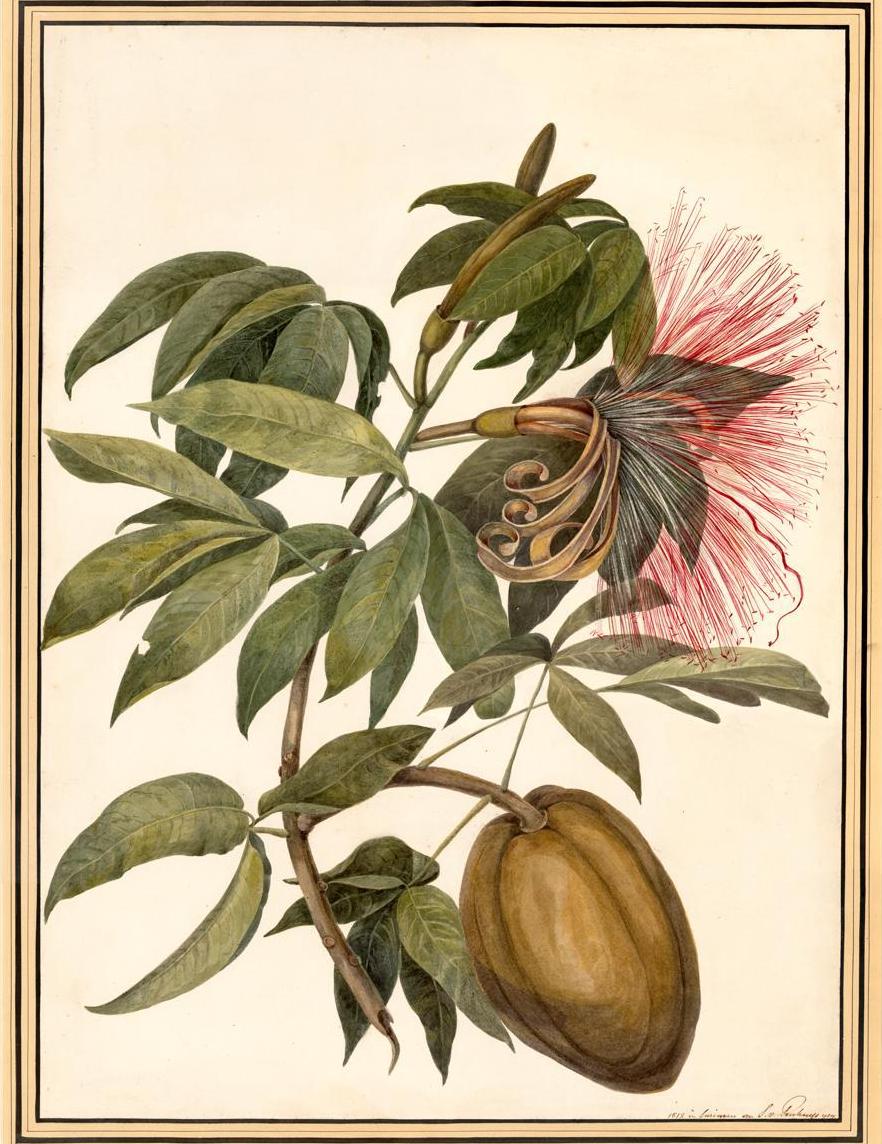


Money tree (Pachira aquatica) belongs to the family Malvaceae. It is an evergreen tree that can reach 18 m in height in the wild and develops distinctive stilt roots.
The leaves are leathery, dark green and palmately compound, with lance-shaped leaflets. This structure makes the crown recognizable even without flowers.
The species occurs in wet areas of Central and South America, including along rivers and lagoons. In mangrove landscapes, it grows not as a true mangrove but as a tree of wet coastal areas.
How it differs from similar plants
Chinese hibiscus Hibiscus rosa-sinensis
- Money tree looks like a small tree with a distinctive crown and palmately compound leaves, while hibiscus is described as a shrub that forms buds on young shoots.
Spineless yucca Yucca gigantea
- Yucca has stiff, sword-shaped leaves, while money tree has palmately compound leaves on long stalks.
Corn plant Dracaena fragrans
- Dracaena is recognizable by rosettes of elongated leaves at the tips of woody stems, while money tree has palmately compound leaves that form a distinctive small-tree crown.
Frequently asked questions
- Why are the leaves turning yellow?
- The most common causes are overwatering, compacted potting mix or too little light. Check whether water is sitting in the saucer.
- Is it safe for cats and dogs?
- Yes, money tree is safe for cats and dogs. If a pet chews the leaves, move the plant to prevent damage to the crown.
- How often should I water it?
- Water after the top layer of potting mix dries. Water must not collect around the roots.
- Does it flower indoors?
- The species has large white or yellowish flower clusters, but indoors it is more often grown for its leaves and trunk.
- Why are the leaves falling off?
- Leaves may fall after the plant dries out too much, is overwatered or experiences a sudden change in conditions. First check the moisture in the potting mix and the light.
- Is Pachira aquatica called "money tree" in Ukrainian?
- It is sold under that name, but the Ukrainian name meaning "money tree" more often refers to the jade plant. The braided trunk of Pachira aquatica is a nursery technique, not its natural growth form.


