Chinese hibiscus
Pruning is often put off in the belief that the shrub will develop buds sooner without it. In fact, Chinese hibiscus (Hibiscus rosa-sinensis) blooms on new growth, while long, older branches are more likely to produce leaves than flowers.


Shrub and flower structure
Grown indoors, this is an evergreen perennial shrub or small tree. Sources give a height of up to 4.5 m for the species, but indoors its size is usually controlled by pruning and pot size.
The leaves are arranged alternately and are oval or egg-shaped, with a glossy, dark green surface and toothed edges. The flowers grow singly from the leaf axils on long stalks; cultivated forms include red, orange, and pink flowers.
- evergreen shrub or small tree
- glossy dark green leaves
- toothed leaf edges
- single flowers in the leaf axils
- staminal tube projecting from the flower
A distinctive feature of the flower is its fused stamen filaments. They form a tube through which the style passes, with the stigma projecting above it; this detail makes the flower easy to recognize up close.
Origin and name
Chinese hibiscus is of cultivated origin, probably from tropical Asia. It is not a “wild species with a clearly defined native range,” but a long-established ornamental plant grown and selected for its large flowers.
The Ukrainian name meaning “Chinese rose” arose from the resemblance of the large flowers to garden roses and the species' long-standing association with an Asian origin. Botanically, the plant is not a rose: it belongs to the family Malvaceae, while true roses belong to a different group of plants.
| Botanical classification | genus Hibiscus, family Malvaceae |
|---|---|
| Origin | of cultivated origin, probably tropical Asia |
| Use | ornamental houseplant and greenhouse plant |
Light and seasonal placement
The plant needs plenty of light, but direct summer sun on a balcony can damage its leaves. Indoors, east- or southeast-facing windowsills provide enough light without exposing the foliage to the harshest rays all day.
In the warm season, the pot can be moved onto a balcony if the spot is protected from midday sun. In fall, as temperatures drop, bring the plant indoors and gradually reduce watering and feeding.
| Season | Placement |
|---|---|
| Spring | bright windowsill after repotting and pruning |
| Summer | balcony or room out of direct sun |
| Fall | back indoors, with reduced watering |
| Winter | bright spot protected from cold |
A sudden change in conditions can affect the buds and leaves. When moving the plant from a balcony indoors, it is better to do so before a sharp drop in temperature rather than afterward.
Watering and humidity
In summer, the soil should not dry out completely: a lack of water quickly affects the buds. A constantly wet root ball is equally harmful, as overwatering causes leaves to turn brown and fall off.
On hot, sunny days, mist the leaves with warm water that has been left to stand. Do this in the morning, or allow enough time for the leaves to dry before nightfall; misting is not advisable in a cool room.
- water generously in summer without leaving standing water
- water in winter once the soil has dried somewhat
- use warm water that has been left to stand for misting
- let the leaves dry before nightfall after misting
- do not mist in a cold room
Dry air near radiators weakens the plant and creates favorable conditions for spider mites. In winter, consistent lighting, moderate watering, and clean leaves matter more than frequent feeding.
Pruning, repotting, and feeding
Repot young plants in March — April. Use clay, loam, peat, well-rotted manure, and sand for the potting mix; for large, mature specimens, you can replace the top layer of soil instead of repotting the whole plant.
After repotting, prune the shoots to encourage side branching. Flowers form on new growth, so without regular pruning, branches become long and flowering declines or stops altogether.
- repot young plants in spring
- replace the top layer of soil in large specimens
- prune the shoots after repotting
In summer, feed the plant with fertilizer for flowering houseplants every 7-10 days. Reduce feeding in fall, and in winter feed no more than once every 3-4 weeks.
Flowering and bud drop
Each flower lasts only a short time — a day or two. With consistent care, new buds can appear from early spring until winter, so the display depends on a steady supply of new flowers rather than the longevity of any single bloom.
Flower drop is most often linked to the soil drying out, a sudden temperature change, or a lack of nutrients. If there are no buds, check the lighting, feeding, and whether the shoots were pruned in spring.
- soil drying out
- sudden temperature change
- lack of nutrients
- long, unpruned shoots
- insufficient light
Buds are sensitive to sudden changes, so the worst combination is a dry root ball and a move to different conditions. Consistent care matters more than an occasional “extra-strength” feeding.
Pests and propagation
Spider mites may appear in a dry room or when the plant is not watered enough. They can be spotted by their fine white webbing; these pests feed on leaf sap and multiply quickly.
To remove them physically, wash the leaves with a soap solution, then rinse with water, covering the soil with plastic. Repeat the treatment 2-3 times at intervals of 5-7 days to remove new generations of the pest.
Propagate the plant by taking stem cuttings in March. Each cutting should have at least three nodes; plant it in soil, water it, cover it with a jar, and keep it in a warm spot out of direct sun.
- take a stem cutting
- make sure it has at least three nodes
- root it in a warm, shaded spot
- air it periodically under the jar
- repot once growth begins
- Light
- bright indirect light
- Temperature
- above +25 °C
- Watering
- without letting the soil dry out
- Soil
- clay, loam, peat, well-rotted manure, sand
- Difficulty
- moderate
- Cats and dogs
- safe
- Size indoors
- up to 4.5 m
- Native range
- of cultivated origin, probably tropical Asia
Care
The plant responds quickly to changes in care: drying out, overwatering, and sudden temperature changes affect its buds and leaves. Light, pruning, and consistent watering are important for flowering.
- Light
- Provide bright indirect light. East- or southeast-facing windowsills are suitable. On a balcony in summer, protect it from direct sun.
- Temperature
- Keep above +25 °C in summer. In winter, +14…+16 °C is ideal, but temperatures should not fall below +12 °C. Sudden temperature changes can cause flowers to drop.
- Watering
- Water generously in summer. In the warm season, do not let the soil dry out completely, but avoid overwatering as well. In winter, water once the soil has dried somewhat.
- Soil
- Use clay, loam, peat, well-rotted manure, and sand. Repot young plants in March — April. For large, mature specimens, you can replace the top layer of soil.
- Feeding
- Feed every 7-10 days in summer. Use fertilizer for flowering houseplants. Reduce feeding in fall; in winter, feed no more than once every 3-4 weeks.
- Support
- Prune in spring. After repotting, shorten the shoots to encourage side growth. Flowers form on new growth.
- Leaves
- Mist in hot weather. On hot, sunny days, mist the leaves with warm water that has been left to stand. The leaves should dry before nightfall; do not mist in cold conditions.
- Repotting
- Repot young plants in spring. Repot in March — April. Large, mature plants do not need to be moved into a new pot; you can refresh the top layer of soil instead.
Botany
2 ill.- Family
- Malvaceae
- Genus
- Hibiscus
- Species
- Hibiscus rosa-sinensis
- Author and year
- L.


Chinese hibiscus (Hibiscus rosa-sinensis) belongs to the genus Hibiscus in the family Malvaceae. It is an evergreen perennial shrub or small tree with alternate, glossy leaves and single flowers in the leaf axils.
The flower has the structure characteristic of the mallow family: the stamen filaments fuse into a tube that projects from the corolla. The calyx is green, funnel-shaped or bell-shaped, and up to 3 cm long.
The species is of cultivated origin, probably from tropical Asia. The plant is safe for cats and dogs, so the risk at home is not toxicity but physical damage to its shoots and leaves.
How it differs from similar plants
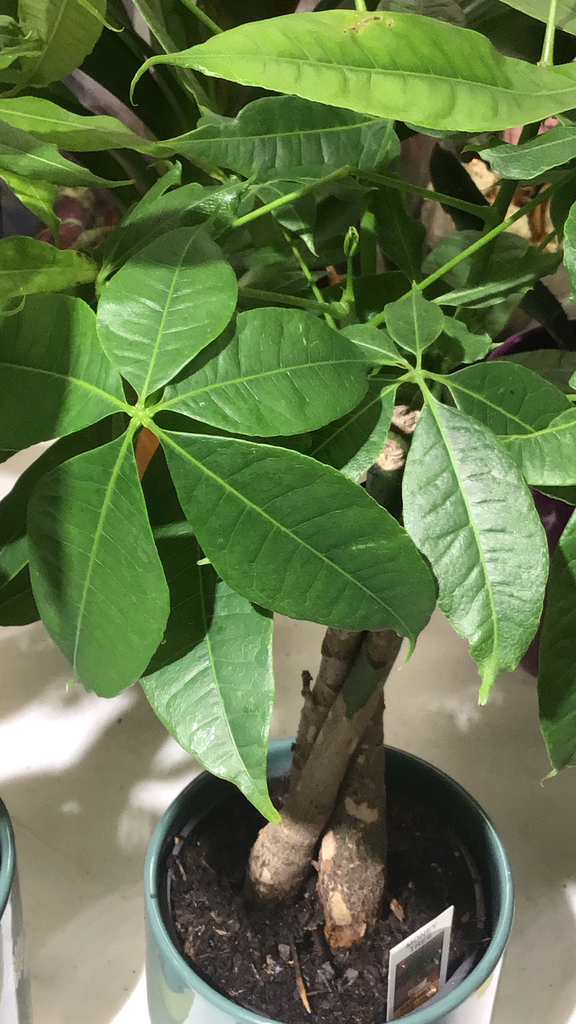 Money tree
Pachira aquatica
Money tree
Pachira aquatica- Pachira looks like a small tree with a distinct crown and palmately compound leaves on long stalks, while Chinese hibiscus is described as a shrub that flowers on new growth.
Horseshoe geranium Pelargonium zonale
- Pelargonium bears flowers in umbrella-shaped clusters above the foliage and needs bright sun, while Chinese hibiscus flowers on new growth in bright indirect light.
African violet Streptocarpus ionanthus
- Saintpaulia forms a compact rosette 20–40 cm across, with fuzzy leaves and flower stalks rising above it, while Chinese hibiscus can grow into a large shrub up to 4.5 m tall.
Frequently asked questions
- Why are the leaves turning yellow?
- The most common causes are pests, the soil drying out, or overwatering. Inspect the undersides of the leaves and check how quickly the pot dries out.
- Why are the buds dropping?
- Flowers drop when the soil dries out, temperatures change suddenly, or nutrients are lacking. Buds are especially sensitive when the plant is moved.
- Why isn't it flowering?
- Without pruning, shoots become long and produce less new flowering growth. A lack of light and irregular feeding also hinder flowering.
- Is it safe for cats and dogs?
- Yes, the plant is safe for cats and dogs. If a pet chews the leaves, it is better to restrict access to prevent damage to the plant itself.
- How can I propagate it at home?
- The easiest method is to take stem cuttings in March. Root a cutting with at least three nodes in soil under a cover.


