Avocado
The large pit at the center of the fruit is the clearest clue to why avocado (Persea americana) is often grown from seed. Indoors, it is primarily a small foliage tree with elliptical leaves, not a guaranteed source of fruit.


Tree and leaf structure
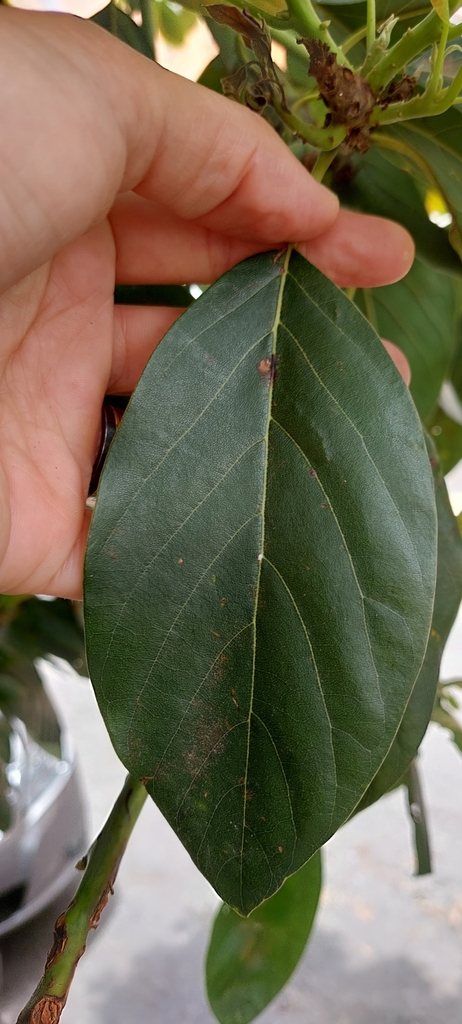
In nature, avocado is an evergreen fruit tree in the family Lauraceae. Its trunk is usually straight, its canopy branches heavily, and its elliptical leaves can reach 35 cm in length.
Leaves fall throughout the year, so losing a few leaves does not always indicate disease. In a pot, the plant often grows as a small foliage tree with a strong tendency toward upward growth, so it can become leggy without shaping.
- elliptical leaves
- a heavily branched canopy
- a large seed at the center of the fruit
- small greenish flowers
- a single-seeded berry
Botanically, the fruit is a berry with one large seed. This pit is the usual starting point for growing avocado at home.
Origins and names
The species is native to Mexico and Central America. It is cultivated in tropical and subtropical regions, and Mexico is cited as the main supplier of fruit to Europe.
The Ukrainian name "avocado" came through the English avocado and the Spanish aguacate. The English name "alligator pear" was also used, referring to the fruit's shape and the texture of the skin in some varieties.
Other names for the fruit are used in different regions: palta is common in parts of South America, while Portuguese uses abacate. These linguistic differences have no practical bearing on indoor growing, but they reflect the plant's long history in human culture.
Light and temperature
Steady growth requires a bright spot that is not constantly shaded. Direct sun, however, can damage the leaves, especially after a sudden change in conditions, so acclimate the plant gradually to brighter light.
Home care references mention a west-facing window as a suitable position. Light levels in lux are not the only consideration: stable conditions matter too, as sudden temperature changes and drafts can cause leaf drop.
| Condition | What it means indoors |
|---|---|
| Light | bright, without sudden exposure to direct sun |
| Temperature | a steady +16…+20 °C |
| Drafts | avoid them because of the risk of leaf drop |
If the plant has been in shade, do not move it straight into strong sun. Move it to a brighter spot gradually, watching the condition of the leaves.
Watering and potting mix
Use the top layer of the potting mix as your guide: water when it has dried out, but do not leave the roots in standing water. Excess moisture is more dangerous than briefly allowing the surface to dry, as it leads to root problems.
The potting mix should be light and loose, with a neutral pH and a drainage layer at the bottom of the pot. Home repotting references mention a mix of coarse sand, well-rotted manure, and garden soil in a 1:1:1 ratio.
- drainage holes in the pot
- a layer of expanded clay pebbles or gravel at the bottom
- a loose potting mix
- watering once the surface dries out
- no water left in the saucer
Misting the leaves is not essential; references advise against it because of the risk of fungal problems. If the air is dry in winter, maintain humidity around the plant with a tray of damp expanded clay pebbles beside the pot.
Germinating the pit
Take the pit from a ripe fruit. It can be germinated directly in potting mix or in water, but both methods require warmth, light, and a clean seed.
When planting in potting mix, bury the broad end of the pit about 2-3 cm deep. Part of the pit should remain above the surface so you can see the condition of the seed and its growing point.
- clean the flesh off the pit
- position it with the broad end down
- keep it in a warm, bright spot
- transplant once the roots reach 3-5 cm
- use a pot with drainage holes
The water method is often used to watch the root develop: make 3 holes in the pit for toothpicks and submerge the broad lower end in water. The upper part remains dry.
Flowers and fruit indoors
The flowers are small, greenish, and bisexual, and grow in the leaf axils. Their inconspicuous appearance makes them easy to mistake for small new shoots or buds rather than flowers.
The fruit has one seed and can be pear-shaped, ellipsoidal, or round. Indoors, the plant is more often grown for its foliage and the experience of germinating the seed; fruiting should not be considered an expected outcome.
The large pit is linked to an interesting biological fact: avocado is considered an example of an evolutionary anachronism. It is thought that large herbivores that are now extinct may have dispersed these fruits, and that after domestication, people began spreading and planting the seeds.
Common problems
The most common indoor problems are linked to growing conditions rather than rare diseases. The plant reacts to insufficient light, overwatering, drafts, and sudden changes in location.
If the leaves turn yellow or lose firmness, first check the moisture in the potting mix and the drainage. If the leaf edges dry out, assess the temperature, air dryness, and whether the pot is in a draft.
- constantly wet potting mix
- no drainage holes
- full shade
- sudden exposure to direct sun
- a cold draft
Repot with the root ball intact to avoid disturbing it unnecessarily. Young plants grow quickly, so check the pot and potting mix regularly.
- Light
- bright indirect light
- Temperature
- +16…+20 °C
- Watering
- when the surface dries out
- Soil
- light, loose potting mix
- Difficulty
- moderate
- Cats and dogs
- toxic
- Size indoors
- small potted tree
- Leaves indoors
- up to 35 cm
- Native range
- Mexico and Central America
Care
Indoors, avocado grows as a fast-growing foliage tree. It needs warmth, light, a loose potting mix, and watering that does not leave the roots sitting in water.
- Light
- Provide bright indirect light. Neither full shade nor sudden exposure to direct sun is suitable. Acclimate the plant gradually to a brighter spot.
- Temperature
- Keep at +16…+20 °C. Keep the temperature stable. Sudden changes and drafts can cause leaf drop.
- Watering
- Water when the top layer is dry. Water once the surface of the potting mix has dried out. Avoid leaving the roots in standing water.
- Soil
- Use a light, loose potting mix. The plant needs a neutral potting mix, drainage holes, and a layer of expanded clay pebbles or gravel at the bottom of the pot.
- Feeding
- Feed every two weeks. Apply fertilizer from early spring to mid-September, while the plant is actively producing leaves.
- Leaves
- Prune to shape the canopy. Because the tree grows and branches quickly, shaping helps keep it from becoming leggy indoors.
- Repotting
- Repot with the root ball intact. Keep the root ball intact when repotting and move the plant into a pot with reliable drainage.
Botany
4 ill.- Family
- Lauraceae
- Genus
- Persea
- Species
- Persea americana
- Author and year
- Mill.


Avocado (Persea americana) belongs to the family Lauraceae and the genus Persea. It is an evergreen fruit tree with a straight trunk, a substantial canopy, and elliptical leaves that can reach 35 cm.
The species is native to Mexico and Central America. Cultivated varieties have different fruits: the Mexican type has smaller fruit and aromatic leaves, the West Indian type has large, smooth fruit, and the Guatemalan type has egg-shaped or pear-shaped fruit with variable skin.
The large seed at the center of the fruit has made avocado an example of an evolutionary anachronism. The idea is that large herbivorous animals may have dispersed these fruits, and after those animals disappeared, humans took over the role of propagation.
How it differs from similar plants
Spineless yucca Yucca gigantea
- Yucca is easy to distinguish by its stiff, sword-shaped leaves and need for bright sun, while avocado has elliptical leaves and grows in bright indirect light.
Corn plant Dracaena fragrans
- Dracaena has elongated leaves arranged in rosettes at the tips of a woody stem, while avocado looks like a small foliage tree with elliptical leaves.
Weeping fig Ficus benjamina
- Weeping fig is recognizable by its smaller, glossy oval leaves with pointed tips and drooping branches, while avocado leaves can reach 35 cm.
Frequently asked questions
- How do I grow it from a pit?
- Yes, the pit can be germinated in potting mix or in water. Position it with the broad end down, and move the seedling into a pot once the roots reach 3-5 cm.
- Why are the leaves turning yellow?
- The most common causes are overwatering, insufficient light, or a sudden change in conditions. First check the top layer of the potting mix, drainage, and drafts.
- Does it need pruning?
- The plant usually does not need support, but it does need shaping. Pruning helps keep it from becoming leggy and encourages a more branched canopy.
- Can I keep it at home if I have a cat?
- Avocado is toxic to cats and dogs. Do not let pets chew the leaves, pit, or other parts of the plant.
- Will it bear fruit indoors?
- Small greenish flowers may appear, but fruiting indoors is not a reliable expectation. The plant is more often grown as a small foliage tree.