Hoya pubicalyx
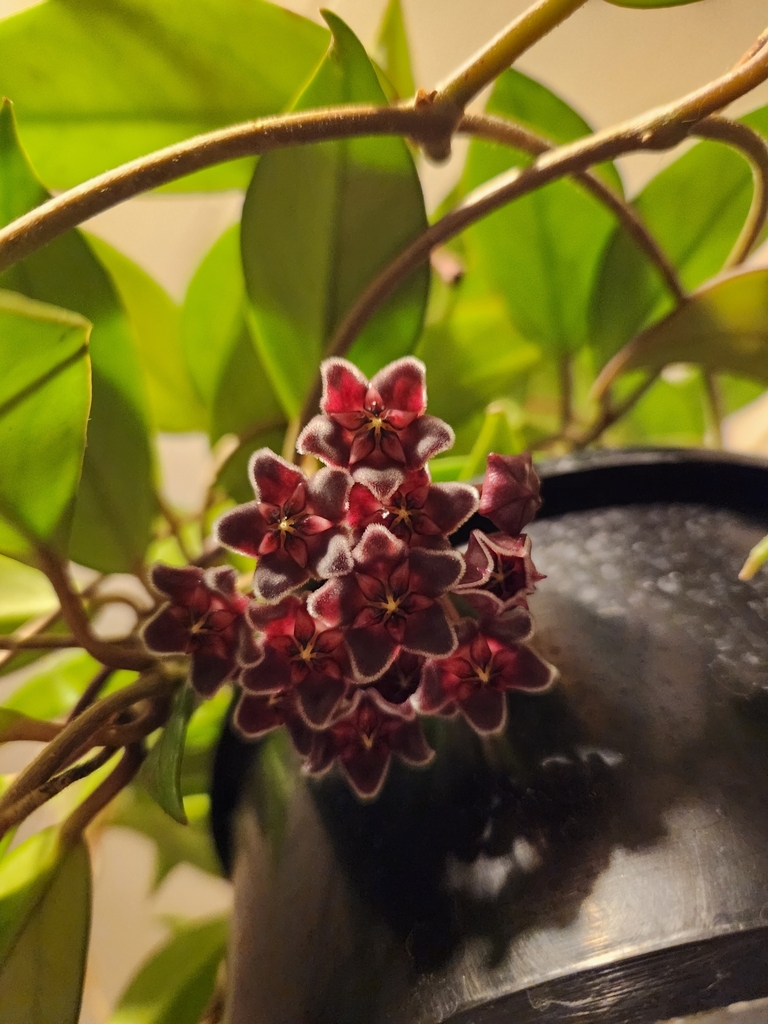
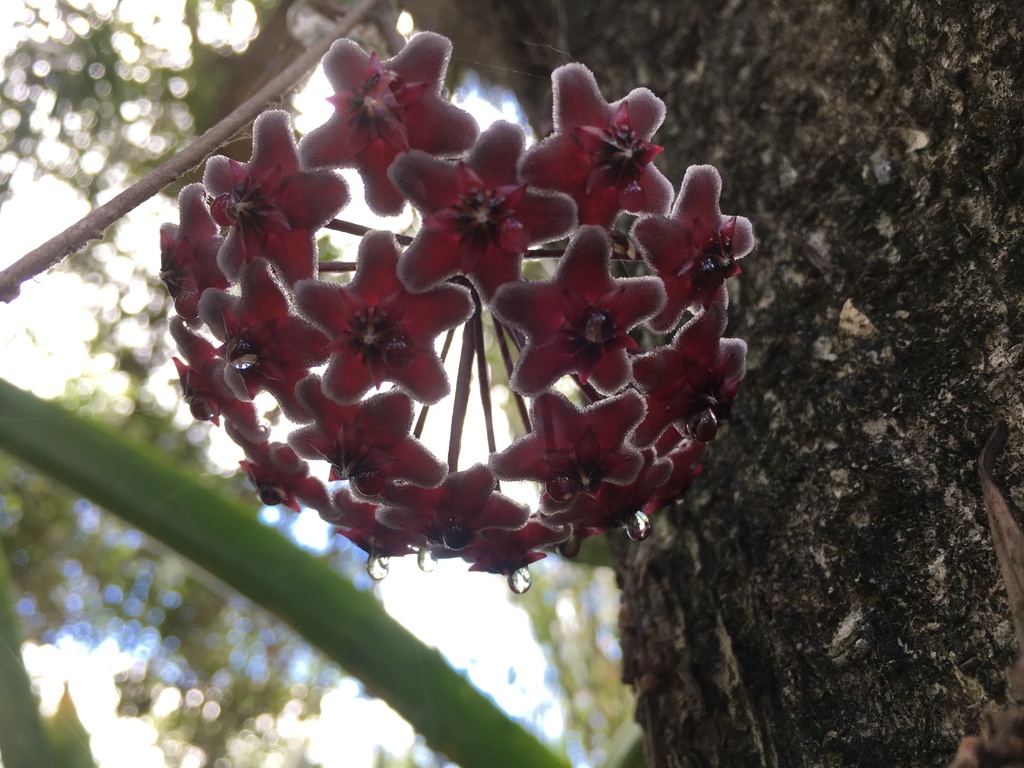
What is usually called a flower on Hoya pubicalyx is actually an entire flower cluster: small, star-shaped flowers gathered together, with a scent that is stronger in the evening. This vine comes from Luzon and needs light, support, and an airy potting mix.

Vine and leaf structure
The stems grow as a twining vine: train them along a trellis or let them trail from a hanging pot. Without training, the plant grows long; pruning helps limit its length and encourages fuller growth.
The leaves are narrow, long, dark green, and glossy. They sometimes develop silver flecks; in stronger light, their color may shift toward silvery pink, while some forms can darken to almost black.
A change in color does not necessarily mean something is wrong: in hoyas, it is often linked to the amount of light. It is more important to watch for leaves losing firmness or soft areas developing at the base of the stems.
Origin and natural conditions
The species is native to the Philippines (Luzon Island). In nature, it grows on trees as an epiphyte: it uses trunks and branches for support but does not feed on their tissues.
This explains its indoor potting requirements. Its roots are not suited to dense soil that stays wet for a long time, so the potting mix must let air through and drain excess water quickly.
| In nature | Indoors |
|---|---|
| Grows on trees | Needs support or a hanging pot |
| Roots have access to air | Needs a loose potting mix |
| Receives filtered light | Grows best near a bright window |
Light and placement
Active growth requires bright indirect light. Only the midday hours pose a risk: direct sun overheats the leaves at this time, while gentle sun early or late in the day does not harm the plant.
In a spot that is too dark, the stems become stretched and flowering is less likely. Move the plant closer to a window gradually so the leaves can adjust to stronger light.
- a bright spot without midday sun
- a trellis for vertical growth
- a hanging pot for long stems
Decide how to position the stems in advance: a mature vine quickly fills its support, and abruptly moving it while buds are forming can interfere with flowering.
Watering and potting mix
Water when the top 2-3 cm of potting mix has dried. Constantly wet roots are the main risk for this hoya, especially in a pot without proper drainage.
Water is needed more regularly in warm weather; reduce watering in winter. Let the condition of the potting mix guide you rather than the calendar: it dries more slowly in a cooler room.
- perlite for aeration
- bark for a coarse texture
- peat to retain moderate moisture
- a drainage hole in the pot
- draining excess water after watering
This mix is closer to an epiphyte's natural conditions than a heavy all-purpose potting mix. If the mix clumps together and takes a long time to dry, the risk of root rot increases.
Flowering and flower stalks
The flower clusters consist of star-shaped flowers in pink, red, or dark burgundy. Their scent is more noticeable in the evening and at night, which is not unusual for hoyas.
The main flowering period is late spring and summer. Repeat flowering is possible in favorable conditions, but it depends on the plant's maturity, light, and keeping the flowering stems intact.
- a mature plant
- bright indirect light
- flowering stems left uncut
Do not cut off the flowering stems after the flowers fade, as new flower clusters may appear on them. Focus pruning on vegetative stems that are too long or bare.
Propagation from cuttings
Vegetative propagation is done with stem cuttings. Take a healthy stem with 2-3 nodes, as the nodes are where roots and new growth develop.
Take a cutting 10-15 cm long, cutting below a node. Remove the lower leaves from 1-2 nodes so this section does not rot in the potting mix.
- cut a healthy stem below a node
- remove the lower leaves
- plant in a loose, well-drained potting mix
- cover with a clear bag or dome
- place in a bright spot out of direct sun
The plastic or dome should not touch the leaves, as rot develops more easily on a wet surface. Once rooted, gradually transition the cutting to normal care.
Common problems
The most common problems involve water, light, and ventilation. Roots that stay wet for a long time are at risk of rot; in low light, the plant grows but is slow to form flower clusters.
Pests are usually visible on stems, in leaf axils, and on the undersides of leaves. White, cottony deposits indicate mealybugs, while hard bumps indicate scale insects.
- yellowing leaves from overwatering
- limp stems due to root problems
- failure to flower in insufficient light
- gray mold in cool, humid conditions
- pests on stems and leaf undersides
If suspicious spots or deposits appear, separate the plant from other houseplants. Then check the potting mix, light, and undersides of the leaves, as there may be more than one cause.
- Light
- bright indirect light
- Temperature
- +16…+29 °C
- Watering
- when the top 2-3 cm is dry
- Soil
- light, well-drained potting mix
- Difficulty
- moderate
- Cats and dogs
- safe
- Size indoors
- up to 3-3.6 m
- Leaves indoors
- narrow, long
- Native range
- Philippines (Luzon Island)
Care
This hoya grows best in a warm, bright spot where its roots do not sit in water. Care comes down to balancing good light, an airy potting mix, and moderate watering.
- Light
- Provide bright indirect light. Tolerates morning or evening sun; shade it from direct midday sun to keep the leaves from overheating.
- Temperature
- Keep at +16…+29 °C. This is the range for active growth. In winter, keep conditions stable and avoid drafts and sudden temperature changes.
- Watering
- Water when the top 2-3 cm is dry. Water when the top layer of potting mix has dried. Reduce watering in winter; avoid standing water around the roots.
- Soil
- Use a light, well-drained mix. A loose potting mix with perlite, bark, and peat works well. The pot must let excess water drain after watering.
- Feeding
- Feed once a month. Use a soluble fertilizer at half strength in spring and summer. No feeding is needed in fall or winter.
- Support
- Provide support or a hanging pot. Train the stems along a trellis or grow the plant in a hanging pot. Training helps control the vine's length.
- Leaves
- Check for pests. Mealybugs and scale insects hide on stems and the undersides of leaves. White deposits or hard bumps are a reason to isolate the plant.
- Repotting
- Repot every 2-3 years. Repot in spring or as needed when the pot becomes too small. Choose a slightly larger container.
Botany
- Family
- Apocynaceae
- Genus
- Hoya
- Species
- Hoya pubicalyx
- Author and year
- Merr.
Hoya pubicalyx belongs to the genus Hoya and the family Apocynaceae. It is a vine with long stems, narrow, glossy leaves, and clusters of star-shaped flowers.
The species is native to the Philippines (Luzon Island). As an epiphyte, it is adapted to using trees for support and to a growing medium that gives its roots access to air.
Indoors, both the leaves and flower clusters contribute to its ornamental appeal. Pod-like fruits may form after pollination, but this rarely happens indoors.
Frequently asked questions
- Is Hoya pubicalyx safe for cats and dogs?
- Yes, the plant is safe for cats and dogs.
- How often should I water it?
- Water when the top 2-3 cm of potting mix has dried; reduce watering in winter.
- What light does it need?
- Bright indirect light without midday sun.
- Why isn't it flowering?
- Insufficient light or cut-off flowering stems are often the cause; flowering occurs mainly in mature plants.
- How do I propagate it from a cutting?
- Use stem cuttings with 2-3 nodes, planted in a loose, well-drained potting mix.


