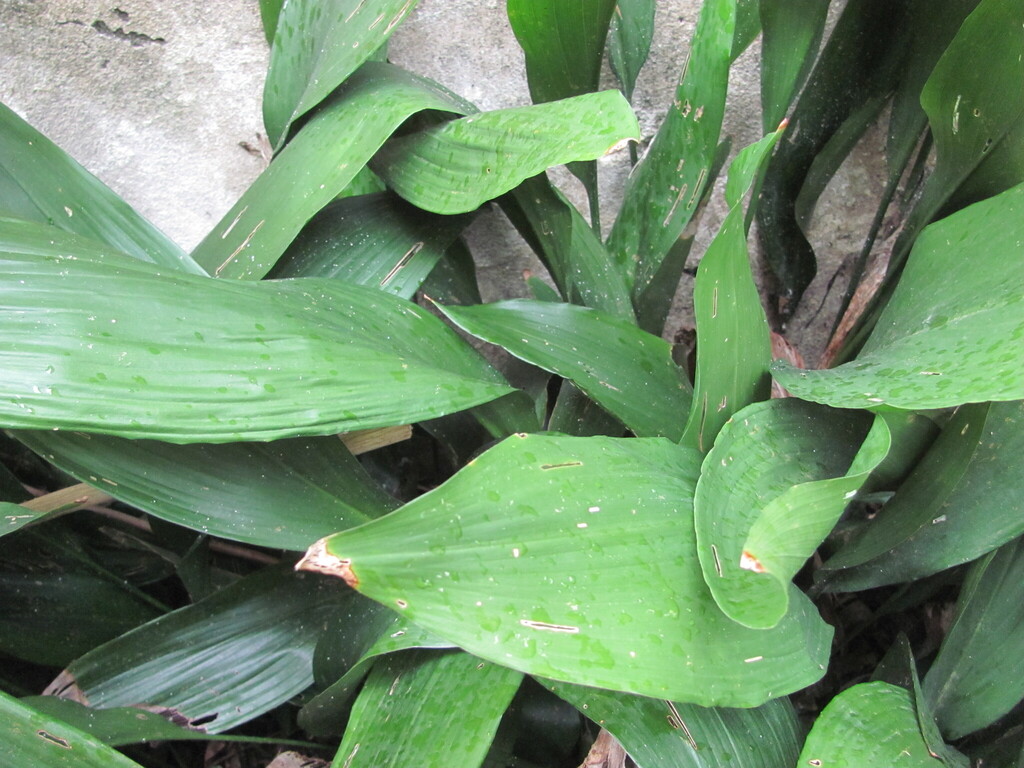
Ti plant
Ti plant (Cordyline fruticosa) developed as an evergreen broad-leaved shrub in bright, humid habitats in tropical Southeast Asia and the Pacific Islands; its light and humidity needs indoors reflect this.


Structure and foliage
Ti plant is an evergreen broad-leaved shrub with a woody trunk. The species is described as having a trunk up to 1.5 cm in diameter and a tuber-like root system, so the plant above ground becomes more palm-like with age, although it is not a palm.
The leaves are elongated or elongated and egg-shaped, 30-60 cm long and 5-10 cm wide. Their base color is green, but cultivated forms can have red and yellow tones.
- slender woody trunk
- broad, elongated leaves
- green base color
- red or yellow tones in cultivars
- tuber-like root system
The foliage gives the plant most of its ornamental bulk. As the lower leaves gradually die off, the trunk becomes more visible—a normal feature of a mature shrub.
Origins and natural habitat
The species is native to Southeast Asia and the Pacific Islands. These origins explain its need for a bright, humid spot: in dry air, leaves lose firmness more quickly, while shade weakens growth.
The plant was spread throughout Polynesia as a cultivated species. Its presence in Hawaii was linked to human planting and the vegetative spread of plant fragments, and its leaves were used to make household and ritual objects.
| In nature and cultivation | Indoors |
|---|---|
| Warm, humid habitats | A bright room without dry air |
| Broad leaves capture plenty of light | Good light is needed for dense growth |
| The plant can develop a woody trunk | The lower stem becomes bare with age |
Light and placement
A bright spot with elevated humidity is suitable for indoor growing. The plant is not suited to a dark corner: its leaves stay alive, but new growth becomes weaker.
Forms with red or yellow tones are particularly dependent on light, since their color shows only on healthy growth. A sudden change of location can temporarily halt growth, so it is better to acclimate the plant gradually.
- stretched stems
- less contrast in leaf color
- slow production of new leaves
Watering and humidity
Ti plant comes from humid tropical conditions, so consistent moisture matters more than infrequent heavy watering. The potting mix should not stay completely dry for long, but standing water around the roots is also undesirable.
The broad leaves lose moisture readily, especially in a warm, bright spot. Dry edges are more common in dry air, while dust on the leaves further impairs normal gas exchange.
| Sign | What it means |
|---|---|
| The top layer of potting mix has dried | It is time to water |
| Leaves lose firmness | Check the moisture in the potting mix |
| Leaf edges dry out | More consistent humidity is needed |
Flowers and fruit
When flowering, the plant produces long panicles measuring 40-60 cm. The flowers are small, fragrant, and yellowish-red; the berries ripen to red.
Flowering and fruiting are rare indoors. The plant is usually grown for its foliage, and the condition of its canopy is a better measure of care than whether it produces flower clusters.
- long panicles
- small, fragrant flowers
- yellowish-red flower color
- red berries when ripe
- rare fruiting indoors
Toxicity and common problems
The plant is mildly toxic to cats and dogs. Chewing the leaves can irritate the digestive tract, so place the pot where pets cannot routinely reach the foliage.
Most visible problems stem from a combination of light, humidity, and watering rather than a single cause. Start by inspecting the leaves, then check the moisture in the potting mix and the condition of the root zone.
- dry leaf edges
- loss of firmness after drying out
- soft stem base from waterlogging
- dull leaf color in shade
- dust on broad leaves
Propagation and repotting
In cultivation, the species is readily propagated vegetatively using stem sections. This reflects its ability to spread through plant fragments, not just seeds.
Repotting is needed when the root system has filled the pot and watering no longer moistens the potting mix evenly. An oversized container is undesirable because the lower layer stays wet for longer.
- firm, healthy stem
- clean cut
- consistent moisture in the potting mix
- bright spot without sudden changes in conditions
- gradual acclimation after rooting
- Light
- bright, humid spot
- Difficulty
- moderate
- Cats and dogs
- mildly toxic
- Leaves indoors
- 30-60 × 5-10 cm
- Native range
- Southeast Asia and the Pacific Islands
Care
Ti plant keeps its foliage in the best condition in a bright, humid spot. Care comes down to stable conditions without drying out, waterlogging, or sudden changes in light.
- Light
- Keep in a bright, humid spot. Grows best in a bright spot with sufficient humidity; in shade, growth weakens and leaf color fades.
- Temperature
- Keep warm. Its tropical origins mean it needs steady warmth without sudden temperature changes or cold air around the leaves.
- Watering
- Water when the top layer dries. Water when the top layer of potting mix has dried. Letting it dry out completely and leaving it waterlogged both harm the foliage.
- Feeding
- Feed during active growth. Feed when the plant is actively producing new leaves; reduce feeding in low light.
- Leaves
- Wipe dust off the leaves. The broad leaves collect dust quickly. Remove it with a soft, damp cloth without bending the leaf stalks.
- Repotting
- Repot when the roots are crowded. Repot once the roots have filled the pot. An oversized pot holds moisture in its lower layer for longer.
Botany
2 ill.- Family
- Asparagaceae
- Genus
- Cordyline
- Species
- Cordyline fruticosa
- Author and year
- (L.) A.Chev.


Ti plant (Cordyline fruticosa) belongs to the family Asparagaceae. It is an evergreen broad-leaved shrub with a woody trunk and a tuber-like root system.
The leaves are large: 30-60 cm long and 5-10 cm wide. Plants of the species are mostly green, while cultivated forms may have red or yellow tones.
The inflorescence is a 40-60 cm panicle of small, fragrant, yellowish-red flowers. Flowering and fruiting are rare indoors, although red berries ripen after flowering in nature.
How it differs from similar plants
Snake plant Dracaena trifasciata
- Sansevieria has long, stiff, blade-like leaves, while ti plant is described as a broad-leaved shrub with leaves measuring 30–60 × 5–10 cm.
Spineless yucca Yucca gigantea
- Yucca is distinguished by its large, sword-shaped leaves and tree-like appearance, while ti plant is described as a broad-leaved shrub for a bright, humid spot.
Corn plant Dracaena fragrans
- Dracaena has a woody stem topped with rosettes of elongated leaves, while ti plant is described as a broad-leaved shrub.
Frequently asked questions
- Is ti plant safe for cats and dogs?
- The plant is mildly toxic to cats and dogs. Chewing the leaves can irritate the digestive tract.
- Why are the leaf tips drying out?
- This is most often a response to dry air, uneven watering, or dust on the leaves.
- Does ti plant flower indoors?
- Yes, but it rarely flowers or fruits indoors. The species produces 40-60 cm panicles of small, fragrant flowers.
- What light does it need?
- It needs a bright spot with sufficient humidity. Growth weakens in deep shade.
- How large do the leaves get?
- The leaves reach 30-60 cm long and 5-10 cm wide.