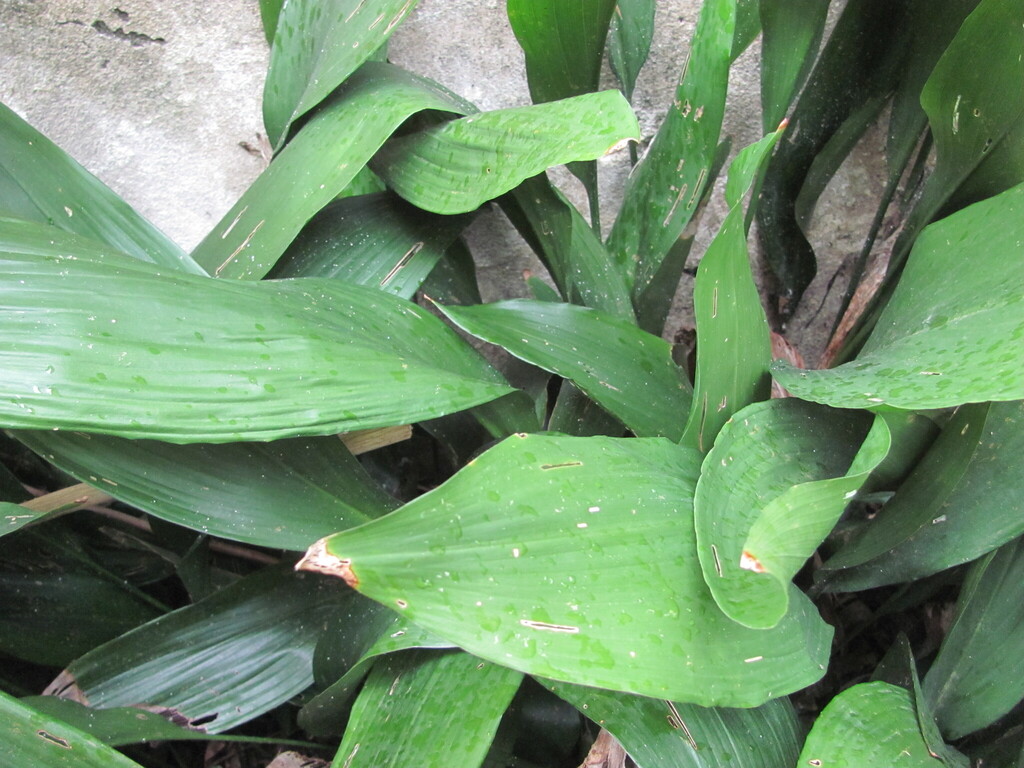
Spider plant
Often placed in a dark corner as an “undemanding plant,” the spider plant (Chlorophytum comosum) merely tolerates low light: in a very dark spot, its rosette loses its visual appeal.


Rosette structure
The leaves form a basal rosette. Each leaf blade is linear and smooth, with a prominent midrib and a soft tip; in the typical species, it is bright green.
In a mature plant, long, drooping flower stalks emerge from the center of the rosette. These stalks gave the spider plant its Ukrainian folk name, meaning “little spider”: small rosettes with aerial roots often form at the shoot tips.
- linear leaf blades
- dense basal rosette
- arching, drooping flower stalks
- small white flowers
- offset rosettes at the shoot tips
Origin and seasonal growth
The species is native to tropical and southern Africa. In the wild, it grows in seasonally dry tropical conditions, so its fleshy roots help it cope with an uneven water supply.
Indoors, this trait does not mean watering can be ignored entirely. In spring and summer, the plant grows more actively, producing flower stalks and offset rosettes, while its water needs decrease in winter.
| Condition | During the growing season | In winter |
|---|---|---|
| Watering | more generous | moderate |
| Temperature | +15…+18 °C | no lower than +18 °C |
| Growth | active shoot and rosette growth | slower growth |
Light and placement
The spider plant likes light but needs shade from direct sun at a south-facing window. Its rosette develops most consistently in bright indirect light, near an east- or west-facing window.
- an east- or west-facing window
- a north-facing window without deep shade
- a south-facing window with shading
The plant can grow in partial shade, but loses its visual appeal in a very dark spot. In sunlight, the leaves become brighter, provided the plant does not overheat and the potting mix does not dry out abruptly.
Watering and potting mix
Water the spider plant generously in summer; watering every 3 days can serve as a guide. In winter, reduce watering to a moderate level, about 1 time a week.
The species is not particularly fussy about soil. References recommend a mix of 3 parts loam, 2 parts leaf mold, and 1 part sand; a roomy container is also important, as the thick roots quickly fill the pot.
| Ingredient | Proportion |
|---|---|
| loam | 3 parts |
| leaf mold | 2 parts |
| sand | 1 part |
Flowers and shoots
The flowers are small and white, arranged in a loose inflorescence. After flowering, the arching stems often produce vegetative rosettes with leaves and aerial roots rather than seeds.
The flower stalk can be longer than the leaves and trail over the edge of the pot. This structure looks natural in a hanging container, as the shoots need no tying and hang freely downward.
- small white flowers
- loose inflorescence
- offset rosettes after flowering
Propagation and repotting
The simplest propagation method is to root the offset rosettes that appear at the tips of aerial shoots. Separate them from the parent plant and plant them in potting mix.
The plant can also be divided during repotting. Repot in spring when the root system starts growing out of the pot or pushes the rosette above the surface of the potting mix.
- rooting offset rosettes
- dividing a mature clump
- sowing seeds after fruiting
Leaf problems and pests
Cold drafts and a spot near a poorly insulated window noticeably spoil the plant's appearance. Near heaters, moisten the leaves periodically by showering or misting, although the spider plant tolerates dry air itself well.
- a very dark spot
- a cold draft
- placement near a heater
- a cramped pot with roots growing out
- thrips infestation
The leaves are brittle, so avoid vigorous wiping. A warm shower is better for cleaning; regular checks help you spot thrips before they damage much of the rosette.
Care
The spider plant tolerates inconsistent care better than many herbaceous houseplants, but keeps its shape best in a bright spot with regular watering. The main mistakes are deep shade, cold drafts, and a cramped pot.
- Light
- Provide bright indirect light. Grows well near an east- or west-facing window. Needs shade at a south-facing window; in a very dark spot, the rosette loses its visual appeal.
- Temperature
- Keep at +15…+18 °C. Keep at no lower than +18 °C in winter. It tolerates a brief drop to +8 °C, but cold drafts and a poorly insulated window spoil its appearance.
- Watering
- Water every 3 days in summer. Water more generously from spring through fall. In winter, water moderately, about 1 time a week, without letting the potting mix stay dry for long.
- Soil
- Use loam, leaf mold, and sand. A 3:2:1 mix of loam, leaf mold, and sand is suitable. The thick roots need a roomy pot.
- Feeding
- Feed every 2 weeks. From March through August, apply a compound fertilizer for foliage plants when watering.
- Support
- No support needed. The long flower stalks naturally trail. In a hanging container, the rosettes at the shoot tips have room to hang freely.
- Leaves
- Rinse with a warm shower. The leaves are brittle, so do not wipe them. You can rinse off dust with a warm shower at about +25 °C once a month.
- Repotting
- Repot in spring. Repot when roots grow out of the pot or push the plant upward. This is usually needed after 1-2 years.
Botany
4 ill.- Family
- Asparagaceae
- Genus
- Chlorophytum
- Species
- Chlorophytum comosum
- Author and year
- (Thunb.) Jacques
- Life form
- herbaceous perennial


The spider plant belongs to the family Asparagaceae and forms a dense basal rosette of long, linear leaves. In the typical species, the leaf blade is about 300 mm long and 20 mm wide, smooth, and has a prominent midrib.
The roots are fleshy, spindle-shaped, and succulent, up to 10 mm in diameter. This structure helps the plant tolerate an uneven water supply, but indoors it still grows more consistently with regular watering.
After flowering, some flowers are replaced by vegetative buds. These develop into small rosettes with aerial roots and root readily when they touch the potting mix.
How it differs from similar plants
Snake plant Dracaena trifasciata
- The spider plant's leaves form a rosette and measure about 300 × 20 mm, while sansevieria is recognizable by its long, stiff leaf blades.
Spineless yucca Yucca gigantea
- Yucca looks like a shrub or small tree with large, sword-shaped leaves and can reach 4 m, whereas the spider plant is described as a rosette up to 1 m.
Corn plant Dracaena fragrans
- Dracaena is easy to distinguish by its woody stem topped with leaf rosettes, while the spider plant is described as a rosette.
Frequently asked questions
- Can I keep it in shade?
- It can stand at a north-facing window if the spot is not too dark. In deep shade, the rosette loses its visual appeal.
- Is it safe for cats and dogs?
- Yes, the spider plant is safe for cats and dogs. If a pet chews the leaves, it is best to move the plant so the rosette is not damaged.
- How do I propagate a spider plant?
- The usual method is to take offset rosettes from the shoot tips and root them in potting mix. A mature clump can also be divided during repotting.
- How often should I water it?
- As a guide, water every 3 days in summer and about 1 time a week in winter. Adjust watering to the condition of the potting mix and the room temperature.
- Why are the leaves turning yellow or drying out?
- The cause may be a very dark spot, a cold draft, or placement near a heater. Also check whether the roots have outgrown the pot.