Snake plant
Shade won't kill this plant, but it is no substitute for light: in a dark corner, it tends to stop growing rather than thrive. Snake plant (Dracaena trifasciata) prefers drier conditions and won't tolerate standing water around its rhizome.


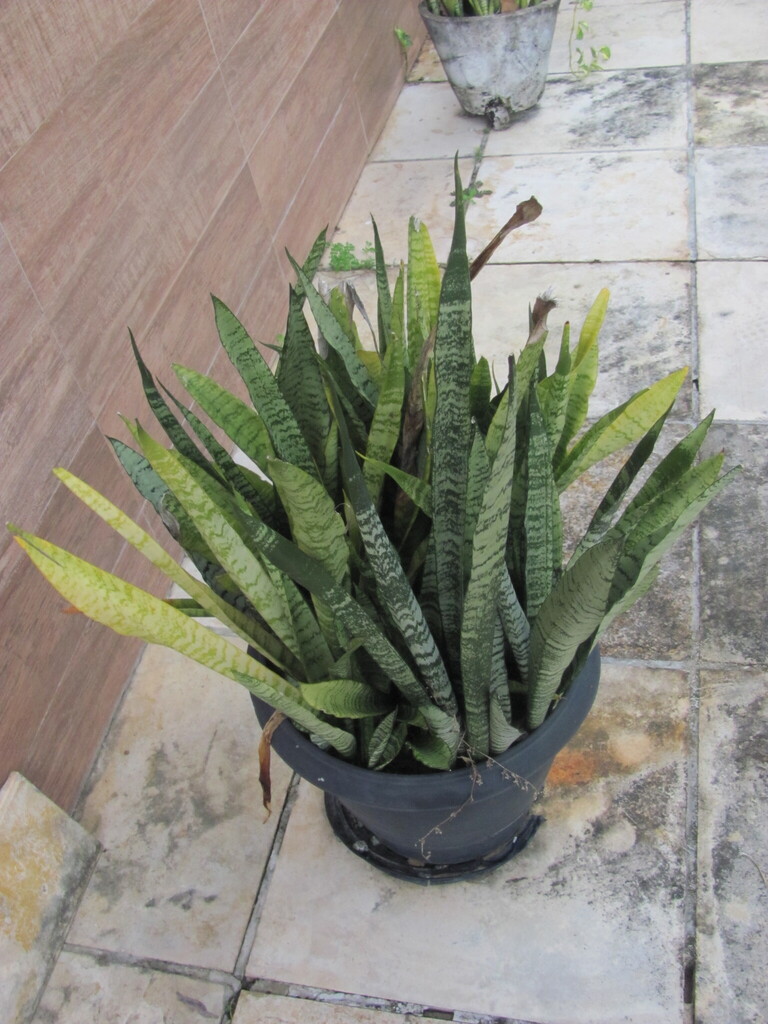
Leaf and rhizome structure
This is a stemless, rhizomatous plant with rosettes of stiff leaf blades. The leaves grow from the base, stand upright or curve slightly, and have characteristic crosswise bands of lighter and darker green.
- stiff leaf blades
- creeping rhizome
- rosettes at the growing point
- light and dark crosswise bands
- adventitious roots
The rhizome spreads sideways, so the plant gradually forms a denser clump and fills the entire pot. This explains why thin plastic pots sometimes distort or crack.
Origin and names
The species is native to western tropical Africa. In the wild, plants in this group are adapted to periods of water shortage: their thick leaf blades store moisture, and the cuticle reduces water loss.
The Ukrainian folk names meaning "mother-in-law's tongue" and "pike's tail" arose from the long, stiff, pointed leaf blades; these names have no botanical significance and may be applied to various related plants.
The species' current scientific name is Dracaena trifasciata. The old name Sansevieria trifasciata is still common in cultivation because the species was previously placed in the separate genus Sansevieria and later moved to Dracaena.
Light and placement
The plant tolerates partial shade but grows better in bright indirect light. In deep shade, new leaf blades emerge more slowly, and the striped pattern may look less distinct.
| Condition | What happens |
|---|---|
| Bright indirect light | More active growth and clearer leaf markings |
| Partial shade | The plant retains its shape but grows more slowly |
| Farther into the room with artificial light | Adaptation is possible if the lighting is consistent |
Avoid moving the pot abruptly from shade into direct sun: leaves that formed in lower light scorch more easily. Change its position gradually, especially for variegated forms.
Watering and potting mix
Overwatering is more dangerous than a brief dry spell. The rhizome and the base of the rosette are sensitive to standing water, so the potting mix needs to dry out between waterings, and water should not be left in the saucer.
- constantly wet potting mix
- water in the center of the rosette
- standing water in the saucer
Watering once every 7 days in summer and about once a month in winter can serve as a guide. The actual interval varies with temperature, pot size, and how quickly the potting mix dries out.
Repotting and propagation
Repot when the rhizome becomes crowded. Choose a wide, stable pot: the roots spread more sideways than downward.
- rhizome division
- leaf cuttings
- seeds
Rhizome division works well for mature clumps and preserves the traits of variegated cultivars. Leaf cuttings also root, but periclinal chimeras may not retain their variegation when propagated this way.
Flowering and subsequent growth
Flowering is uncommon indoors. The inflorescence usually takes the form of a simple or branched raceme with greenish-white flowers; in the wild, moths pollinate them, and fruit set is inconsistent.
The flower stalk emerges from the apical meristem. After flowering, that rosette no longer produces new leaf blades, but the plant does not die and continues growing through offsets from the rhizome or stolons.
Cooler winter conditions at +15…+16 °C may encourage a mature plant to initiate a flower stalk. This does not guarantee flowering; it is simply one of the conditions under which flowering occurs more often.
Why leaves turn yellow or soft
Yellowing and softening leaves are most often linked to problems at the base of the rosette or around the rhizome. If the potting mix stays wet for a long time, the tissues lose firmness and may rot.
- waterlogged potting mix
- cold conditions
- water in the center of the rosette
- standing water in the saucer
- excess nitrogen
Dry brown patches do not always mean rot: sometimes they are signs of physical damage or scorching. Wet patches, darkening at the base, and a soft leaf blade are reasons to check the roots and let the potting mix dry out.
- Light
- bright light, partial shade
- Temperature
- +18…+25 °C
- Watering
- after the potting mix has dried out a little
- Soil
- well-drained potting mix
- Difficulty
- easy
- Cats and dogs
- mildly toxic
- Size indoors
- from 20 cm
- Leaves indoors
- long, stiff leaf blades
- Native range
- western tropical Africa
Care
Snake plant handles a missed watering better than constantly wet potting mix. Basic care comes down to a bright spot, moderate watering, and a stable pot.
- Light
- Provide bright light or partial shade. Variegated forms retain their markings better near a bright window. Growth slows in deep shade.
- Temperature
- Keep at +18…+25 °C. In winter, it tolerates +14…+16 °C, but not below +10 °C: cold combined with wet potting mix causes rot.
- Watering
- Water after the mix has dried out a little. As a guide, water once every 7 days in summer and about once a month in winter. Do not pour water into the center of the rosette.
- Soil
- Use a well-drained potting mix. Standing water around the rhizome quickly leads to rot. A drainage layer is needed at the bottom of the pot.
- Feeding
- Feed in spring and summer. Feeding once a month with fertilizer for cacti and succulents is enough. Feeding can be skipped for the first year after repotting.
- Support
- No support needed. The leaf blades support themselves. For tall forms, a heavy, stable pot matters more than a support.
- Leaves
- Wipe dust off the leaves. Misting is not needed: the thick cuticle reduces water loss. Remove dust with a damp cloth or sponge.
- Repotting
- Repot when the roots are crowded. The rhizome spreads sideways and can distort a thin pot. The plant is often divided during repotting.
Botany
4 ill.- Family
- Asparagaceae
- Genus
- Dracaena
- Species
- Dracaena trifasciata
- Author and year
- (Prain) Mabb.
- Life form
- shrub or small tree


Dracaena trifasciata belongs to the genus Dracaena in the family Asparagaceae. The old name sansevieria remains common in everyday use, although modern taxonomy places the species within Dracaena.
The specific epithet trifasciata comes from Latin words associated with "three" and "band." It refers to the striped pattern of the leaf blade, where light and dark areas alternate crosswise or diagonally.
Stiff, succulent leaves and a thick cuticle help the plant reduce water loss. The rhizome produces new offsets, so the clump gradually becomes denser and can resume growth after an individual rosette flowers.
Popular cultivars
3- Three-bandedDracaena trifasciata
- leaves with light and dark crosswise or diagonal bands
- CylindricalSansevieria cylindrica
- stiff cylindrical leaves, quite different in shape from those of the three-banded species
- PinguiculaSansevieria pinguicula
- a succulent desert species; thick, fleshy leaves are characteristic of these sansevierias
How it differs from similar plants
Corn plant Dracaena fragrans
- Dracaena is distinguished by its woody stem topped with rosettes of elongated leaves, while the snake plant's main feature is its long, stiff leaf blades.
Spineless yucca Yucca gigantea
- Yucca needs bright sun and forms a shrub or small tree up to 4 m tall, while snake plant tolerates partial shade and starts at a more compact 20 cm.
Spider plant Chlorophytum comosum
- Chlorophytum has a rosette with leaves around 300 × 20 mm, while snake plant is recognized by its long, stiff leaf blades.
Frequently asked questions
- How often should I water a snake plant?
- As a guide, water once every 7 days in summer and about once a month in winter. The potting mix should dry out a little between waterings.
- Why are the leaves turning yellow?
- The most common cause is overwatering or cold, wet potting mix. Check the base of the rosette and remove any standing water.
- Can I keep it at home if I have a cat?
- The plant is mildly toxic to cats and dogs: chewing it can irritate mucous membranes. Keep the pot somewhere your pet will not chew the leaves.
- How do I propagate a snake plant?
- Rhizome division is the most reliable method. Leaf cuttings also root, but the cultivar's variegated traits may not be preserved.
- When should I repot?
- When the rhizome becomes crowded or the pot starts to distort. Repot into a wide, stable container with drainage.

