Norfolk Island pine
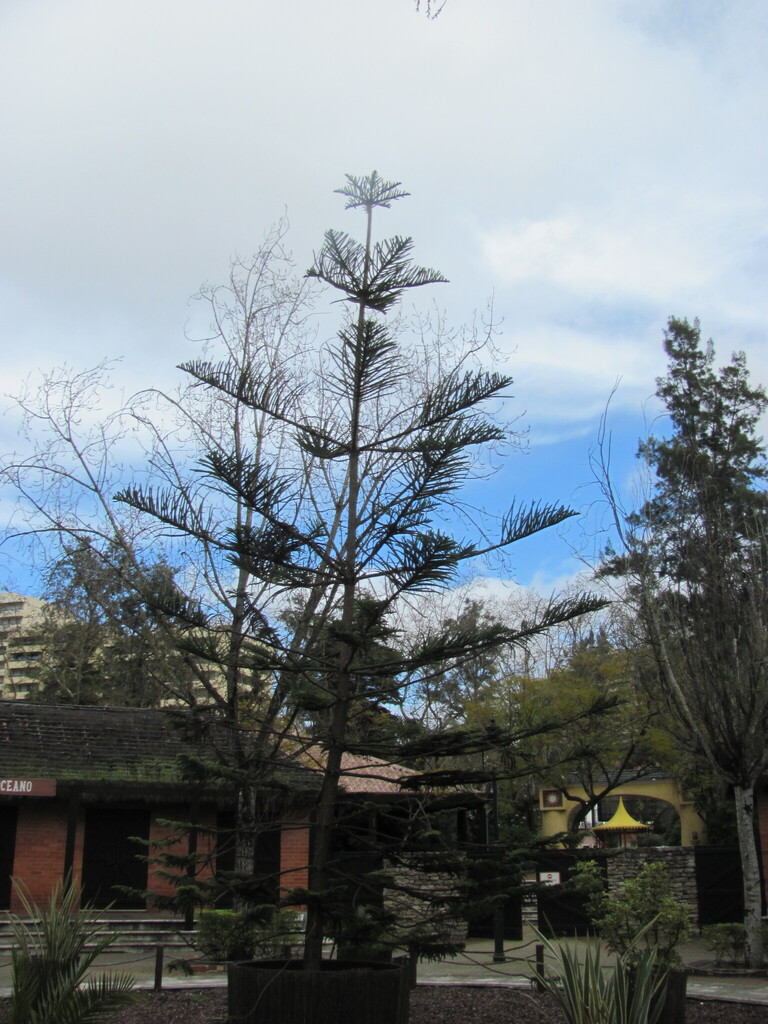
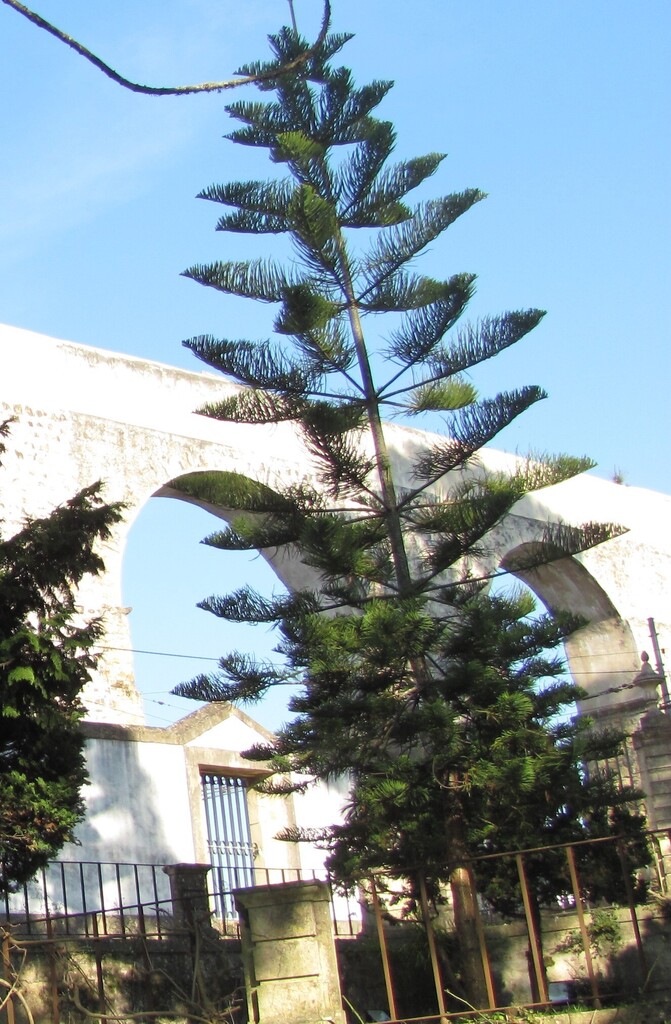
On Norfolk Island, Norfolk Island pine (Araucaria heterophylla) developed as a lowland conifer with a tiered crown. Indoors, it is recognizable by its evenly spaced whorls of branches and green needles.

Origin and size in the wild
In the wild, this species is found on Norfolk Island—a small island with lowland areas. This range makes it more than an ornamental conifer: it is an endemic species with a narrow natural distribution.
In natural conditions, the tree develops a conical crown and reaches 50-70 m in height. Its trunk circumference is 1.25-1.75 m, so an indoor plant is simply a young or growth-restricted version of a much larger tree.
Tiered crown and needles
The branches are arranged in even tiers, giving the crown an orderly, pagoda-like silhouette. This symmetry is particularly prone to changing indoors when light comes from only one side.
The bark is gray-brown and flakes off in small scales. The leaves change with age: juvenile leaves are awl-shaped, concave, green, and up to 1.2 cm long; adult leaves are scale-like, closely spaced, and 4-5 mm long.
- even tiers of branches
- conical crown
- green needle-like or scale-like foliage
- gray-brown scaly bark
- leaf shape changes with age
Light and placement
To keep the crown symmetrical, choose a bright spot where growth is not constantly drawn to one side. If the plant stands near a window, turn it gradually so that new growth does not stretch only toward the light.
Hot air near a radiator and sudden changes in conditions do not suit an indoor conifer. Choose a spot where the crown does not touch glass, curtains, or walls: distorted branches are slow to regain their symmetry.
Watering and potting mix
The roots should not sit in water constantly. Base watering on the condition of the potting mix rather than a schedule: the top layer should dry out, but avoid letting the root ball dry out completely.
Use an airy potting mix that drains excess water well. A stable pot is also important for a tall plant: a lightweight container with wet potting mix can easily tip over.
| In the wild | Indoors |
|---|---|
| The tree grows as a large conifer endemic to the island | Growth is limited by the pot, light, and indoor conditions |
| The crown develops freely and evenly | One-sided light easily distorts the crown |
| The roots grow in natural soil | An airy potting mix without standing water is needed |
Cones and seeds
This conifer is a gymnosperm, so it does not produce flowers in the usual sense seen in flowering plants. Its reproductive structures are cones: male cones are elongated, grow in clusters, and are yellowish-brown or reddish.
Female cones are wider than they are long and reach 12-15 cm in length. The seeds have broad wings and measure 2.5-3 cm long and about 1.2 cm wide.
Common problems
Yellowing or shedding needles are most often linked to watering problems, a dried-out root ball, or waterlogged conditions. Conifers do not always recover quickly from these changes, so stable conditions matter more than abrupt adjustments to care.
Losing the top changes the shape of the entire crown. If the central leader is damaged, the plant may produce a replacement side shoot, but its symmetrical silhouette is often disrupted.
- one-sided light
- standing water around the roots
- potting mix drying out completely
- hot air from radiators
- damage to the central growing tip
Toxicity and pets
The plant is mildly toxic to cats and dogs. This is no cause for alarm, but keep shoots and needles out of reach of pets that chew houseplants.
Normal hand hygiene is sufficient after handling the plant. If a pet has chewed a substantial amount of needles or shows noticeable signs of irritation, consult a veterinarian.
- Difficulty
- moderate
- Cats and dogs
- mildly toxic
- Leaves indoors
- up to 1.2 cm
- Native range
- Norfolk Island
Care
Indoors, this conifer does best in stable conditions: even light, careful watering, and no overheating. The main goal of care is to maintain a symmetrical crown and healthy needles.
- Light
- Provide bright indirect light. Even light helps maintain a symmetrical, tiered crown. Light from just one side gradually distorts new growth.
- Temperature
- Keep temperatures moderate; avoid heat. Avoid sudden temperature changes and hot air near radiators. No specific winter minimum is given.
- Watering
- Water when the top layer dries. The potting mix should not stay constantly wet. Avoid letting the root ball dry out completely as well.
- Soil
- Use an airy potting mix. The potting mix needs to drain excess water and resist compaction around the roots.
- Feeding
- Feed during active growth. Feed only while the plant is actively growing. Avoid overfertilizing potted conifers.
- Support
- No support needed. Support is usually unnecessary, but the pot must be stable: a symmetrical crown loses its shape if the plant falls over.
- Leaves
- Do not prune the top. The central leader determines the crown's shape. Damage to the top often disrupts its symmetry.
- Repotting
- Repot when the roots are crowded. Repot carefully, without unnecessarily disturbing the root ball. The pot must suit the weight of the crown.
Botany
4 ill.- Family
- Araucariaceae
- Genus
- Araucaria
- Species
- Araucaria heterophylla
- Author and year
- (Salisb.) Franco


Norfolk Island pine (Araucaria heterophylla) belongs to the family Araucariaceae. It is a conifer from Norfolk Island, where it is endemic with a narrow natural range.
The crown is conical, with branches arranged in even tiers. Juvenile leaves are awl-shaped and needle-like, up to 1.2 cm long; adult leaves become scale-like and lie more closely against the shoots.
The species produces male and female cones. Male cones are elongated and 4 cm long, while female cones are much larger—12-15 cm; the seeds are winged and 2.5-3 cm long.
How it differs from similar plants
Spineless yucca Yucca gigantea
- Norfolk Island pine is easy to distinguish by its evenly spaced whorls of branches and short green needles, while yucca has large, stiff, sword-shaped leaves.
Corn plant Dracaena fragrans
- Norfolk Island pine has a tiered crown with needles on its branches, while dracaena looks like a small tree with a woody stem and rosettes of elongated leaves at the tips.
Avocado Persea americana
- Norfolk Island pine has a coniferous appearance with whorls of branches, while avocado grows as a small broadleaf tree with elliptical leaf blades.
Frequently asked questions
- Can I keep it at home if I have a cat?
- The plant is mildly toxic to cats and dogs, so keep its needles and shoots out of reach to prevent chewing.
- Why are the needles turning yellow?
- This is most often a response to drying out, standing water, or a sudden change in conditions. Damaged needles recover slowly.
- Can I prune the top?
- Do not prune the top: it forms the central leader and maintains the crown's symmetry.
- Does it produce cones indoors?
- Cones rarely appear indoors. In the wild, female cones reach 12-15 cm in length.
- Why is the crown growing unevenly?
- The cause is usually one-sided light or branches touching a wall, glass, or curtains.


