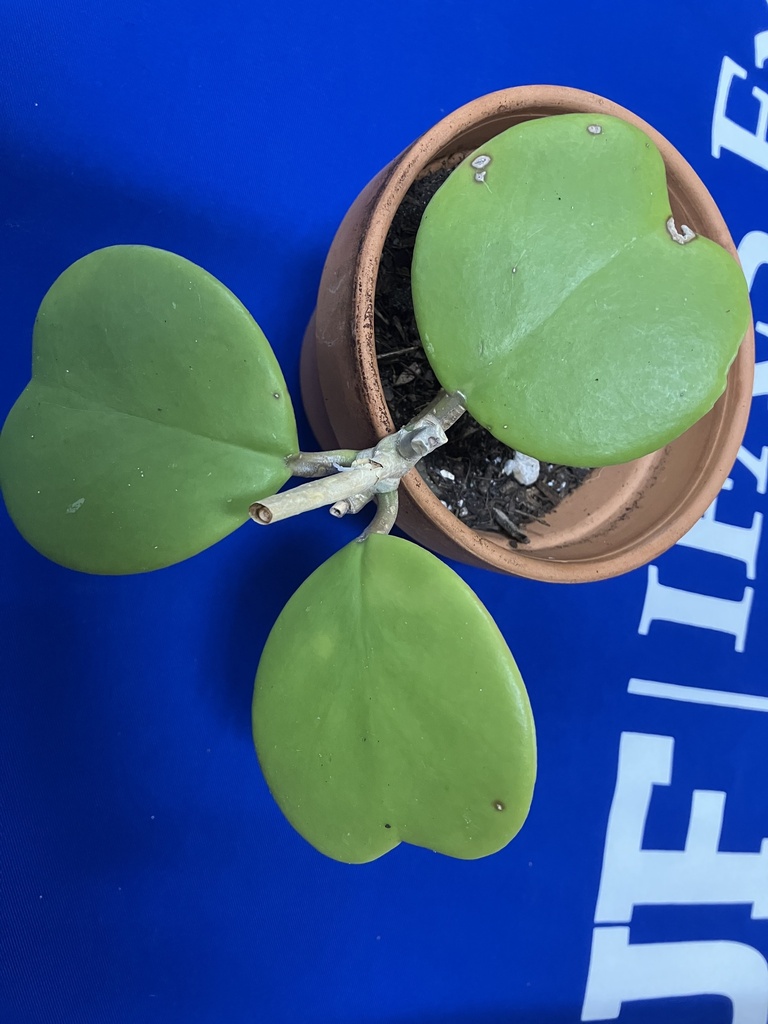
Wax plant
In the open woodlands of East Asia and Australia, wax plant (Hoya carnosa) grows as an epiphytic vine: it uses trees for support and stores water in its fleshy leaves. Indoors, it does best in a bright spot without waterlogging.


The vine's structure
Wax plant is an evergreen epiphytic vine with stems that become woody with age. Indoors, it is grown as a trailing plant or trained along a support, since it anchors itself to trees in the wild.
The leaves are fleshy, oval, glossy, and dark green; cultivars may have cream edges or a lighter area along the midrib. Young, leafless stems may have a purplish-brown tint, gradually turning green as leaves and aerial roots develop.
Origin and growth habit
The species is native to East Asia and Australia. In the wild, wax plant grows in open woodland: its stems climb or trail, with woody plants providing support.
| In the wild | Indoors |
|---|---|
| Epiphytic vine on trees | Trailing plant or vine trained on a support |
| Bright areas of open woodland | Sunny window with shade in summer |
| Water drains away from the roots quickly | Needs a well-drained potting mix |
An epiphyte is not a parasite: it does not feed on the tree's tissues but uses the tree as an anchor. In a pot, this means the roots need air and must not sit in water.
Light and placement
Wax plant needs good light to flower regularly. In cultivation, it flowers more profusely at sunny windows, but direct summer sun is best filtered with shade.
- a bright spot near a window
- shade from direct summer sun
- a consistent position once buds appear
Moving the plant frequently while flower clusters are forming can interfere with flowering. Once the plant has set buds, avoid turning the pot unnecessarily.
Watering and potting mix
Water more generously in spring and summer, but let the top layer of potting mix dry between waterings. In fall and winter, reduce the amount of water and stop misting.
| Season | Care |
|---|---|
| Spring and summer | Water when the top layer has dried; mist if needed |
| Fall and winter | Reduce watering; do not mist |
The potting mix should be light and well drained. Short intervals between waterings are not the danger for wax plant; constantly wet roots in a dense mix are.
Flowering and flower stalks
The flowers are star-shaped and fragrant, arranged in umbrella-shaped clusters. The petals range from white to pink, with a dark pink or wine-red center; a single cluster can contain up to 20 flowers.
- adequate light
- old flower stalks left intact
- moderate watering without waterlogging
Do not cut off the flower stalks after the flowers fade: new buds may appear on them. Indoors, flowering is more common in the warm season and may repeat under favorable conditions.
Propagation and repotting
The most common propagation method is by cuttings. Use stems from the previous year's growth, taking cuttings in spring or fall.
- taking cuttings from the previous year's stems
- rooting by layering
- propagating from seed when fresh seed is available
Repot young plants more often and mature plants only as needed. An oversized pot is unnecessary: drainage holes and a loose potting mix matter more.
Why leaves turn yellow
Yellowing leaves are most often linked to care problems: too much water, overheating in direct sun, or temperatures that are too low. If yellowing leaves are accompanied by soft stems, check the roots first.
- constantly wet potting mix
- harsh summer sun without shade
- cold conditions with wet roots
- scale or mite infestation
- stress after drying out too much
Pests that may affect wax plant include aphids, scale insects, spider mites, whiteflies, and nematodes. Start by inspecting the undersides of the leaves, the leaf stalks, and young stems.
Care
Wax plant tolerates moderate intervals between waterings but responds poorly to water sitting around its roots. For flowering, it needs a bright spot, a consistent position, and its old flower stalks left intact.
- Light
- Provide bright light with shade in summer. It flowers more profusely at sunny windows, but direct summer sun is best filtered to prevent the leaves from overheating.
- Temperature
- Keep at +17…+25 °C. This is the range for the growing season. Reduce watering in winter; cooler conditions of +10…+15 °C are acceptable.
- Watering
- Water when the top layer has dried. Water more generously in spring and summer, and reduce watering in fall and winter. Constantly wet potting mix causes root problems.
- Soil
- Use a light, well-drained potting mix. Any well-drained mix will work. As an epiphytic vine, it needs air around its roots and excess water to drain away quickly.
- Feeding
- Use succulent fertilizer if needed. Feeding is not essential if the potting mix is regularly replaced. If needed, use fertilizer for succulent plants.
- Support
- Provide support or use a hanging pot. The stems can be trained along a support or left to trail. In the wild, the vine anchors itself to woody plants.
- Leaves
- Remove only dried parts. Do not cut off old flower stalks after flowering: new buds may form on them. Remove dried and damaged parts separately.
- Repotting
- Repot young plants annually. Repot mature plants as needed, roughly once every three years. The pot must have drainage holes.
Botany
3 ill.- Family
- Apocynaceae
- Genus
- Hoya
- Species
- Hoya carnosa
- Author and year
- (L.fil.) R.Br.
- Life form
- epiphytic vine


Wax plant (Hoya carnosa) belongs to the family Apocynaceae and the genus Hoya. It is an epiphytic vine: in the wild, it does not grow as a ground-dwelling shrub but anchors itself to other plants without parasitizing them.
The fleshy, glossy leaves help the plant tolerate irregular watering. The waxy appearance of its leaves and flowers has led to names such as wax plant and wax ivy.
The genus Hoya is named after the English gardener Thomas Hoy, who worked with tropical greenhouse plants. Cultivars with different leaf colors are common in cultivation, including those with cream edges or a pale center.
Popular cultivars
5- Hoya carnosaHoya carnosa
- fleshy, oval, glossy, dark green leaves; star-shaped flowers ranging from white to pink with a dark pink or wine-red center
- Hoya bellaHoya bella
- miniature trailing form
- CompactaHoya carnosa 'Compacta'
- leaves partly folded along the midrib and curled near the tip
- Cream-edged
- variegated leaves with cream edges
- Yellow-centered
- variegated leaves with yellow centers
How it differs from similar plants
Brazilian jasmine Mandevilla sanderi
- Dipladenia has woody, twining stems, while wax plant is described as an epiphytic vine with fleshy, oval leaves.
Oleander Nerium oleander
- Oleander is recognizable by its narrow, leathery leaves with a pale midrib, while wax plant has fleshy, oval leaves.
Madagascar periwinkle Catharanthus roseus
- Catharanthus is a compact subshrub with stems that become woody and reach 30–60 cm, while wax plant is described as an epiphytic vine.
Frequently asked questions
- Is wax plant poisonous to cats and dogs?
- Wax plant is safe for cats and dogs. If a pet chews the stems, it is still best to move the plant to prevent damage to the leaves and flower stalks.
- Why isn't my wax plant flowering?
- The most common reasons are insufficient light or the removal of old flower stalks. Flowering is more likely in a well-lit spot where the plant is not moved frequently.
- Can I cut off the flower stalks after flowering?
- No, leave them in place after the flowers fade. New buds may form on old flower stalks.
- How do I propagate wax plant?
- The easiest method is to take cuttings from the previous year's stems. Take cuttings in spring or fall.
- Why are the leaves turning yellow?
- Common causes include wet potting mix, overheating in direct sun, or cold conditions. Check the roots and inspect the undersides of the leaves for pests.