Indian laurel fig
Smooth elliptical leaves and aerial roots identify the Indian laurel fig (Ficus microcarpa) even before it bears fruit: in the wild, these roots can become supporting roots, and the small syconia ripen in pairs.


Structure and identifying features
The leaves are usually arranged alternately. The leaf blade ranges from narrowly to broadly elliptical and may also be obovate; it measures 2.5-12 cm long and 1.5-9 cm wide.
The leaf margin is entire, and the tip is blunt or ends in a short point. The leaf stalk has a groove on its upper surface and may be hairy; it measures 2-20 mm long.
- smooth leaf blades with entire margins
- often asymmetrical leaf bases
- white milky sap at cuts
- aerial roots that can become supporting roots
- paired, stalkless syconia measuring 7-12 mm in diameter
Aerial roots are not a sign of disease but part of the plant's natural structure. On large plants, they can provide support and change the outline of the crown.
Origin and natural conditions
The Indian laurel fig is native to an area extending from Asia to Australia and the Pacific islands. It is a tropical and subtropical species associated with warm climates and humid air.
In the wild, it grows in tropical forests, near rivers, along coasts, in swamps, and in mangrove thickets. Young plants may begin life as epiphytes or grow on exposed rocks.
| In the wild | Indoors |
|---|---|
| Humid tropical and subtropical air | Steady humidity is preferable, without sudden dry spells |
| Riverbanks, swamps, and mangroves | Roots should not remain completely dry for long |
| May begin life as an epiphyte | The potting mix must let air reach the roots |
Light and placement
Within its natural range, this species grows in various open and partly sheltered habitats, from tropical forests to coasts. Indoors, this means it needs a bright spot without sharp extremes: deep shade slows growth, while overheating near glass quickly dries out the potting mix.
The plant needs warmth, though in the wild it can withstand temperatures close to 0 °C. These are not suitable indoor growing conditions: a cold windowsill combined with wet potting mix puts the roots at risk.
When choosing a spot, consider not only the amount of light but also the stability of the conditions. A sudden move from a warm spot to a cool one, or from a humid area to a dry one, can affect the leaves sooner than a brief lack of light.
Watering and potting mix
The Indian laurel fig comes from places with humid air, so prolonged drying out is undesirable. At the same time, its roots need air, especially given that young plants can grow as epiphytes or on rocks.
The potting mix should not compact into a dense, wet mass. Judge watering needs by the condition of the mix: it should not stay dry for long, but standing water around the roots is equally undesirable.
- an airy potting mix
- steady moisture without standing water
- no prolonged drying out
- a drainage hole in the pot
- monitoring the condition of the leaf blades
Milky sap and pets
Cuts and damaged areas release white milky sap. When pruning and shaping the crown, keep the sap away from mucous membranes and out of reach of pets.
The plant is toxic to cats and dogs. If a pet chews the leaves or shoots, move the pot out of reach and remove the damaged parts.
After pruning, cuts on the plant may remain wet. Keep pets from touching them until they dry, even if the damage is minor.
Fruit and pollination
The syconia are usually stalkless and arranged in pairs. They may be almost spherical or flattened and pear-shaped; as they ripen, their color changes from cream, yellow, orange, pink, or red to purple or black.
The flowers of this species are stalkless, with three perianth segments; male and female flowers occur on the same plant. Pollination involves the fig wasp Eupristina verticillata, and non-pollinating wasps may also develop in the syconia.
In the wild, the fruit attracts birds in regions where the species has been introduced. This explains why figs can spread readily beyond their native range wherever conditions are suitable.
- Light
- bright spot
- Watering
- do not let it dry out
- Soil
- airy potting mix
- Difficulty
- moderate
- Cats and dogs
- toxic
- Leaves indoors
- 2.5-12 × 1.5-9 cm
- Native range
- from Asia to Australia and the Pacific islands
Care
This tropical and subtropical species has white milky sap, so the main risks indoors are cold, overly dry air, and pets having access to its shoots. Rather than setting a watering schedule in advance, use the condition of the potting mix and leaves as your guide.
- Light
- Choose a bright spot. Steady light without sharp extremes suits this plant: deep shade slows growth, while overheating near glass quickly dries out the potting mix.
- Temperature
- Keep it consistently warm. This species needs warmth. It can withstand temperatures close to 0 °C only briefly; these are not suitable indoor growing conditions.
- Watering
- Do not let it dry out completely. Its natural habitats include humid areas, riverbanks, swamps, and mangroves, so prolonged dryness is undesirable for the roots.
- Soil
- Use an airy potting mix. Young plants sometimes start life as epiphytes or on rocks, so the roots need access to air rather than a dense, wet mass.
- Support
- Provide support if needed. In the wild, aerial roots can become supporting roots. Indoors, support is needed only when the crown or trunk becomes unstable.
- Leaves
- Avoid unnecessary damage. Cuts release white milky sap. After pruning, keep the plant out of reach of cats and dogs.
Botany
4 ill.- Family
- Moraceae
- Genus
- Ficus
- Species
- Ficus microcarpa
- Author and year
- L.fil.

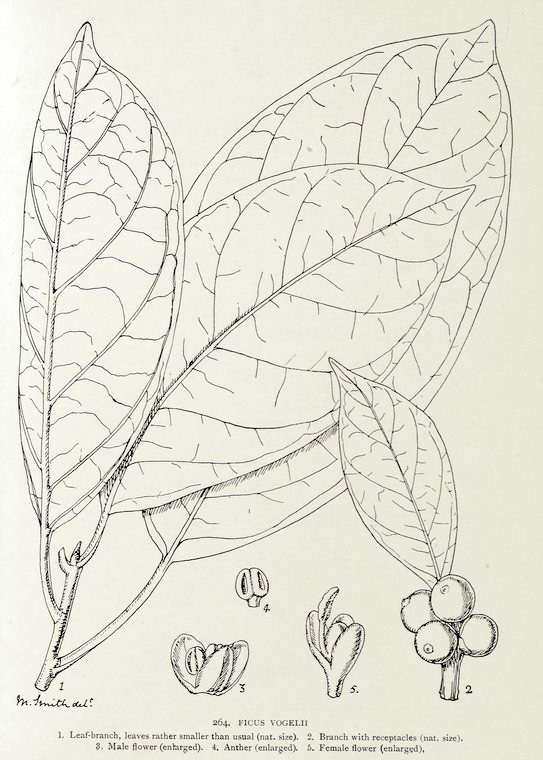


The Indian laurel fig (Ficus microcarpa) belongs to the genus Ficus in the family Moraceae. The genus includes over 800 species of trees, shrubs, vines, epiphytes, and other growth forms; most are evergreen.
In the wild, it is a large banyan tree or spreading shrub with numerous aerial roots. The leaf blades have entire margins, are usually hairless, and have 5-9 pairs of lateral veins.
The species is native to areas extending from Asia to Australia and the Pacific islands. Its ecology is associated with warm, humid places: tropical forests, riverbanks, coasts, swamps, and mangroves.
How it differs from similar plants
Weeping fig Ficus benjamina
- Ficus benjamina has drooping branches and pointed leaf tips; Ficus microcarpa has smooth elliptical leaf blades and conspicuous aerial roots.
Fiddle-leaf fig Ficus lyrata
- Ficus lyrata has large leaves that narrow in the middle and broaden toward the tip, while those of Ficus microcarpa are smooth, elliptical, and much smaller.
Rubber plant Ficus elastica
- Ficus elastica stands out for its much larger leathery, glossy leaves, while Ficus microcarpa has smooth elliptical leaf blades measuring 2.5–12 × 1.5–9 cm and aerial roots.
Frequently asked questions
- Is the Indian laurel fig poisonous to cats and dogs?
- Yes. The plant is toxic to cats and dogs, so keep leaves and pruned shoots out of reach to prevent chewing.
- Why do aerial roots appear?
- Aerial roots are a natural feature of this species. In the wild, they can become supporting roots and hold up the crown.
- How large are the leaves?
- The leaf blade measures 2.5-12 cm long and 1.5-9 cm wide. Its shape varies from elliptical to obovate.
- Does it need high humidity?
- Yes, this species comes from places with humid air. Indoors, prolonged drying out and sudden chilling are undesirable.
- Why are the leaves turning yellow or falling off?
- First check warmth, moisture in the potting mix, and light levels. This species needs warmth and reacts poorly to cold, wet potting mix.


