Bird of paradise
What looks like a single “bird-shaped” flower is actually an inflorescence: a firm, horizontal bract holds several flowers with orange sepals and blue petals. This is the distinctive feature of bird of paradise (Strelitzia reginae).


Leaf and root structure
The plant forms a short, branching rhizome and fleshy, brittle roots up to 7 mm thick. Above it rises a short pseudostem formed by the widened bases of the leaf stalks.
The leaves are arranged in two rows, giving a mature plant a fan-like shape. The leaf stalks reach 50-100 cm long, and the stiff, leathery leaf blades are grayish green with prominent pinnate veins.
- Short, branching rhizome
- Fleshy, brittle roots
- Leaves arranged in two rows
- Long leaf stalks with sheaths
- Stiff, leathery leaf blades
Origin and natural conditions
The species is native to South Africa, in the Cape Province. In the wild, it grows along riverbanks, at forest edges, and in cleared areas where there is plenty of light but moisture does not constantly sit around the roots.
Its natural habitats have neutral clay-loam soils with sand, peat, and well-rotted manure. This explains why it needs a nutrient-rich potting mix with good structure indoors, rather than a heavy mass that takes a long time to dry out.
| In the wild | Indoors |
|---|---|
| Riverbanks, forest edges, cleared areas | A bright spot near a window |
| Neutral clay-loam soils | A loam-based mix with sand, peat, and well-rotted manure |
| High light levels | Protection from direct summer sun |
Light and temperature
This species needs plenty of light and grows better in a well-lit spot. Direct summer sun can damage the leaf blades, so the most reliable approach is bright light with shade during hot weather.
Recommended temperatures during the growing period are +20…+25 °C. In winter, it is best kept cooler, at around +12…+15 °C; damage can occur below +10 °C.
- Bright light without overheating in summer
- Warm conditions during the growing period
- Lower temperatures in winter
- Protection from cold window glass
- Partial shade outdoors in summer
Watering, potting mix, and feeding
The plant likes light, warmth, and moderate moisture, so watering should maintain even moisture without waterlogging. Water more generously as buds and flowers appear, because developing inflorescences use more moisture.
Choose a neutral, nutrient-rich, free-draining potting mix: sources describe a mixture of soil, peat, and sand, while natural conditions feature a clay-loam base with sand, peat, and well-rotted manure. Avoid damaging the roots when repotting, as they are fleshy and brittle.
- Moderate watering outside the budding period
- More generous watering during bud formation
- Neutral, nutrient-rich potting mix
- Added sand for structure
- No feeding during flowering
Flowering and inflorescence structure
The flower stalks are strong and long, rising slightly above the leaves. A mature plant may have from 6 to 35, but the number depends on its age and overall condition.
A firm, purplish-red bract, 12-25 cm long, sits horizontally. Large, stalkless, bisexual flowers open within it and have no scent: orange sepals are paired with blue petals, two of which are fused into an arrow-like shape.
| Feature | Details |
|---|---|
| Flowering period | From fall to early spring |
| Peak flowering | October-November and February-March |
| From flower stalk to first flower | Two months |
| Interval between flowers opening | 3-4 days |
| How long the inflorescence remains attractive | 3-5 weeks |
Pollination and seeds
In the wild, pollination involves sunbirds: a bird lands on the bract, reaches for nectar, and picks up pollen in the process. In cultivation, flowers can be hand-pollinated with a brush, most effectively on the second day after a flower opens.
The fruit is a three-chambered capsule that splits open and contains 6-80 seeds. The seeds are black, glossy, and spherical, up to 0.7 cm wide, with a dense orange aril on one side.
- Seeds mature 175-185 days after pollination
- Fresh seeds germinate in 25-30 days
- Month-old seeds germinate in 40-45 days
- Older seeds may germinate in 6-12 months
- Seeds lose viability after storage for more than half a year
Repotting and propagation
Sow seeds in early spring at a depth of 2-2.5 cm in a loose, nutrient-rich mix of equal parts soil, peat, and sand. The optimal germination temperature is +20…+25 °C.
Seedlings develop slowly: the first leaf unfolds after 20-25 days, and the second appears only after 4-5 months. Seed-grown plants first flower at 5-6 years old.
Vegetative propagation is by division, using plants at least 7 years old. After division, the new plants grow more slowly and reach full development after about 2 years.
Common problems
A lack of flowers is most often linked to insufficient light or the absence of cooler winter conditions. Flower stalk formation depends on bright indirect light, a warm growing season, and winter temperatures lowered to the recommended range for cultivation.
Leaf damage can result from direct summer sun or exposure to cold. The plant suffers damage below +10 °C, and temperatures below −2…-5 °C are fatal.
- Insufficient light
- Direct summer sun
- Temperatures below +10 °C
- Damage to brittle roots
- Fruit formation after pollination
- Light
- Bright indirect light
- Temperature
- +20…+25 °C
- Watering
- Moderate; generous during flowering
- Soil
- Loam with sand
- Difficulty
- Moderate
- Cats and dogs
- Mildly toxic
- Size indoors
- 1-2 m
- Leaves indoors
- 25-70 × 10-40 cm
- Native range
- South Africa, Cape Province
Care
Bird of paradise needs plenty of light, warmth during the growing season, and careful watering that does not leave the roots constantly wet. Its fleshy, brittle roots and winter temperatures are the most sensitive aspects of its care.
- Light
- Provide bright indirect light. This species grows in well-lit places; direct summer sun can damage the leaf blades.
- Temperature
- Keep at +20…+25 °C. This is the range for the growing period. Recommended winter temperatures are +12…+15 °C; damage can occur below +10 °C.
- Watering
- Water moderately; generously when in bud. Keep the potting mix moderately moist. Water more generously as buds and flowers appear.
- Soil
- Use a neutral, loam-based potting mix. A nutrient-rich, loam-based mix with sand, peat, and well-rotted manure is suitable; avoid a heavy mix that stays waterlogged.
- Feeding
- Stop feeding during flowering. During the period of relative dormancy, sources recommend feeding every ten days with a complete mineral fertilizer; stop feeding during flowering.
- Support
- Usually no support is needed. The flower stalks are described as strong and long, and the leaves are held on stalks in a fan. A separate support is usually unnecessary.
- Leaves
- Mist with warm water. The plant responds well to misting with warm water. In summer, it can be moved outdoors into partial shade.
- Repotting
- Handle the roots carefully. The roots are fleshy and brittle, so repot without roughly loosening the root ball. Move seedlings after the second leaf appears.
Botany
4 ill.- Family
- Strelitziaceae
- Genus
- Strelitzia
- Species
- Strelitzia reginae
- Author and year
- Banks

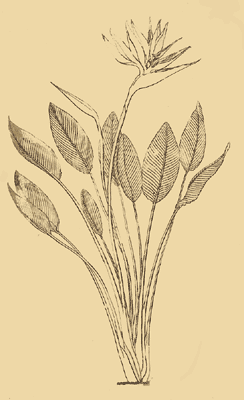


Bird of paradise belongs to the family Strelitziaceae and the genus Strelitzia. The species is described as Strelitzia reginae Banks, and the reference uses the name strelitzia.
It is an evergreen herbaceous plant, 1-2 m tall, with leaves arranged in two rows. The leaf blades are stiff, leathery, and grayish green, measuring 25-70 cm long and 10-40 cm wide.
Ukrainian folk names such as “bird of paradise” refer not to a single flower but to the shape of the whole inflorescence. The horizontal bract serves as a perch for pollinating birds, and the flowers open in sequence.
How it differs from similar plants
Chinese hibiscus Hibiscus rosa-sinensis
- Hibiscus differs noticeably in size: indoors, it can reach 4.5 m, while bird of paradise usually stays within 1–2 m.
Horseshoe geranium Pelargonium zonale
- Pelargonium has an umbrella-shaped cluster of individual flowers above its green canopy, while bird of paradise is recognized by its firm, horizontal bract holding orange-and-blue flowers.
African violet Streptocarpus ionanthus
- Saintpaulia forms a low rosette of fuzzy leaves with flower stalks above it, while bird of paradise is much taller and has large leaves 25–70 cm long.
Frequently asked questions
- Why isn't my bird of paradise flowering?
- Usually because of insufficient light or a lack of cooler winter conditions. Recommended winter temperatures in cultivation are +12…+15 °C, with bright light.
- When does bird of paradise flower?
- The flowering period runs from fall to early spring. Two peaks are most often noted: October-November and February-March.
- Can I keep it at home if I have a cat or dog?
- Yes, but the plant is mildly toxic to cats and dogs. The leaves, flowers, and seeds are mildly poisonous, so pets should not chew them.
- Can I grow bird of paradise from seed?
- Yes, but growth is slow: seed-grown plants first flower at 5-6 years old. Fresh seeds germinate in 25-30 days.
- How do I propagate bird of paradise by division?
- Divide mature plants that are at least 7 years old. After division, the new plants grow more slowly and reach full development in about 2 years.


