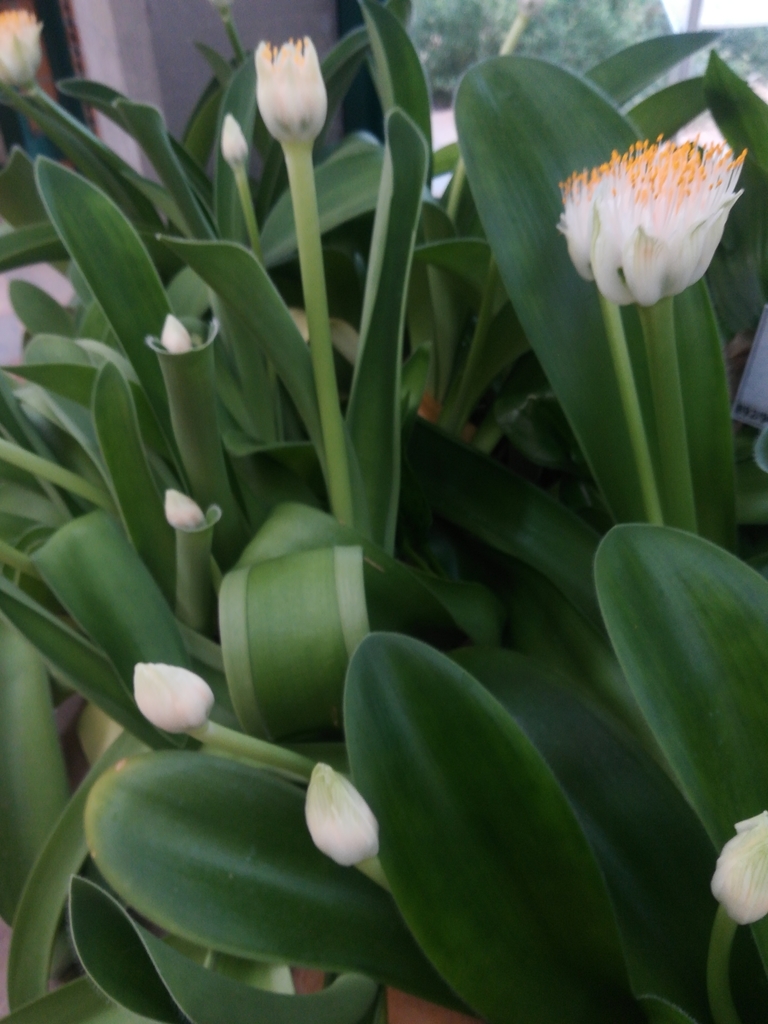
Hippeastrum
Mistakes with this bulb often begin after flowering: the leaves are cut off too soon, or the plant is kept growing all year. Hippeastrum (Hippeastrum vittatum) prepares for its next flowering cycle by alternating active growth with dormancy.


Bulb, leaves, and flower stalk
The main nutrient reserves are stored in the bulb. It consists of a short, thickened stem and tightly packed scales, with cordlike roots growing from the basal plate.
The leaves are linear, channeled on top and keeled underneath, and arranged in two opposite rows. They reach 50-70 cm long and 4-5 cm wide, so the plant remains striking after flowering, even without a flower stalk.
- a rounded or slightly conical bulb
- linear leaf blades
- a hollow flower stalk
- large funnel-shaped or star-shaped flowers
- distinct alternating periods of growth and dormancy
Origin and seasonal cycle
The species is native to the Andes of Peru and Bolivia. In cultivation, this explains its need for a seasonal cycle rather than any supposed fussiness: active growth should not continue uninterrupted all year.
While the leaves remain active after flowering, the bulb replenishes its reserves for the next cycle. If green leaves are cut off too soon or the potting mix is kept constantly wet, the plant may produce leaves without flowering normally.
The name on the label
The name “amaryllis” has become established in the trade for large indoor bulbs, although botanically this plant belongs to the genus Hippeastrum; the confusion persists because of their close relationship within the family Amaryllidaceae.
For care, the genus matters more than the name on the price tag. In Hippeastrum, flowering depends on the bulb's activity, subsequent leaf growth, and a dormant period, so its care differs from that of plants without a distinct seasonal cycle.
Light and placement
During growth, the plant needs bright indirect light. South-, southwest-, or southeast-facing windows work well, provided direct sun does not overheat the pot and bulb.
Light is just as important after flowering as before it. The leaves replenish the bulb during this period, so prolonged shade weakens the next cycle.
| Stage | What matters |
|---|---|
| Active growth | Bright indirect light and a temperature of 17-25 °C |
| After flowering | Keeping green leaves to nourish the bulb |
| Dormancy | Less water and no encouragement of growth |
Watering and potting mix
Adjust watering to the stage of development. Give little water at the start of growth; once the flower stalk appears, water more generously, but do not let water sit around the basal plate.
Bottom watering helps keep water off the top of the bulb. The potting mix should be light, nutrient-rich, and well-drained; use a mix for bulbs or flowering plants with perlite or coarse sand.
- drainage holes in the pot
- a light potting mix that is not compacted
- moderate watering as growth begins
- more generous watering as the flower stalk develops
- no standing water around the bulb
Dormancy and flowering
Dormancy falls in October-January. During this time, the plant does not need as much water and fertilizer as it does during growth, because the bulb enters a different phase.
After dormancy, the flower stalk may appear before the leaves or at almost the same time. A single stalk usually carries 2-4 large flowers, but the result depends on the bulb's condition.
- no dormant period
- green leaves cut off too soon
- excessive watering before the flower stalk appears
- a pot that is too large
- a bulb weakened by its previous flowering cycle
Problems, repotting, and safety
Repot every 3-4 years, after flowering or before new growth begins. There is no need to disturb the roots too often, but compacted potting mix and poor drainage increase the risk of rot.
Potential pests include scale insects, aphids, spider mites, and mealybugs. Downy mildew, leaf scorch fungus, and red rot are serious disease risks; problems most often worsen when the bulb sits in wet potting mix.
The plant is toxic to cats and dogs. Place the pot where pets cannot chew the leaves or reach the bulb during repotting.
- Light
- bright indirect light
- Temperature
- 17-25 °C
- Watering
- according to growth stage
- Soil
- light, well-drained
- Difficulty
- moderate
- Cats and dogs
- toxic
- Size indoors
- leaves 50-70 cm
- Leaves indoors
- 50-70 × 4-5 cm
- Native range
- Andes: Peru and Bolivia
Care
This bulbous plant has a distinct cycle: growth, flowering, replenishing the bulb, and dormancy. The most common mistakes involve watering and cutting off leaves at the wrong time, rather than a lack of care.
- Light
- Provide bright indirect light. South-, southwest-, or southeast-facing windows work well, provided direct sun does not overheat the pot.
- Temperature
- Keep at 17-25 °C. This is the range for active growth. Dormancy falls in October-January; reduce watering and feeding during this time.
- Watering
- Adjust watering to the growth stage. Water sparingly as growth begins; once the flower stalk appears, water more generously without letting water sit. Bottom watering reduces the risk of wetting the bulb.
- Soil
- Use a light, well-drained potting mix. A mix for bulbs or flowering plants with perlite or coarse sand works well; a heavy mix increases the risk of rot.
- Feeding
- Feed every two weeks. Start feeding when growth begins: use fertilizer for foliage plants at first, then switch to fertilizer for flowering plants when the flower stalk appears.
- Leaves
- Do not cut off green leaves. The leaves nourish the bulb after flowering. Remove them only after they naturally turn yellow and die back.
- Repotting
- Repot every 3-4 years. Repot after flowering or before new growth begins, when the potting mix has compacted or the pot is no longer suitable.
Botany
4 ill.- Family
- Amaryllidaceae
- Genus
- Hippeastrum
- Species
- Hippeastrum vittatum
- Author and year
- (L'Hér.) Herb.


Hippeastrum (Hippeastrum vittatum) belongs to the family Amaryllidaceae. It is a bulbous plant with a distinct storage organ: the bulb supports flowering, renewed leaf growth, and the transition to dormancy.
The species is native to the Andes of Peru and Bolivia. Growing it indoors requires attention not just to temperature or watering, but to the whole cycle: emergence from dormancy, flower stalk development, leaf activity after flowering, and dormancy.
The leaves are long and linear, reaching 50-70 cm long and 4-5 cm wide. The flower stalk is hollow, and the number of flowers it carries usually depends on the bulb's vigor.
How it differs from similar plants
Clivia Clivia miniata
- Clivia leaves form a dense rosette and are wider: 5.5–8 cm compared with 4–5 cm in Hippeastrum.
Amazon lily Urceolina amazonica
- Eucharis is recognizable by its broad, glossy leaf blades, whereas Hippeastrum leaves are described as narrow, at 4–5 cm wide.
Frequently asked questions
- Why isn't it flowering?
- Most often, the plant has not had a dormant period, or the bulb has been weakened by cutting off green leaves too soon.
- How often should I water it?
- Water sparingly as growth begins; once the flower stalk appears, water more generously, but do not let water sit around the bulb.
- Is it dangerous to cats and dogs?
- Yes, the plant is toxic to cats and dogs. Do not let pets chew the leaves or reach the bulb.
- When should I cut off the leaves after flowering?
- Do not cut off green leaves, as they nourish the bulb. Remove them after they naturally turn yellow and die back.
- How often should I repot it?
- Every 3-4 years, usually after flowering or before new growth begins.
- Are Hippeastrum and amaryllis the same thing?
- No. True amaryllis (Amaryllis belladonna) is a South African garden bulb. Plants sold in winter as “amaryllis” for the windowsill are almost always hybrid Hippeastrum.