White paintbrush
The genus name can be misleading: it comes from the words for “blood” and “flower,” but white paintbrush (Haemanthus albiflos) is a white-flowered species. It is a bulbous plant in the amaryllis family with a few fleshy leaves.
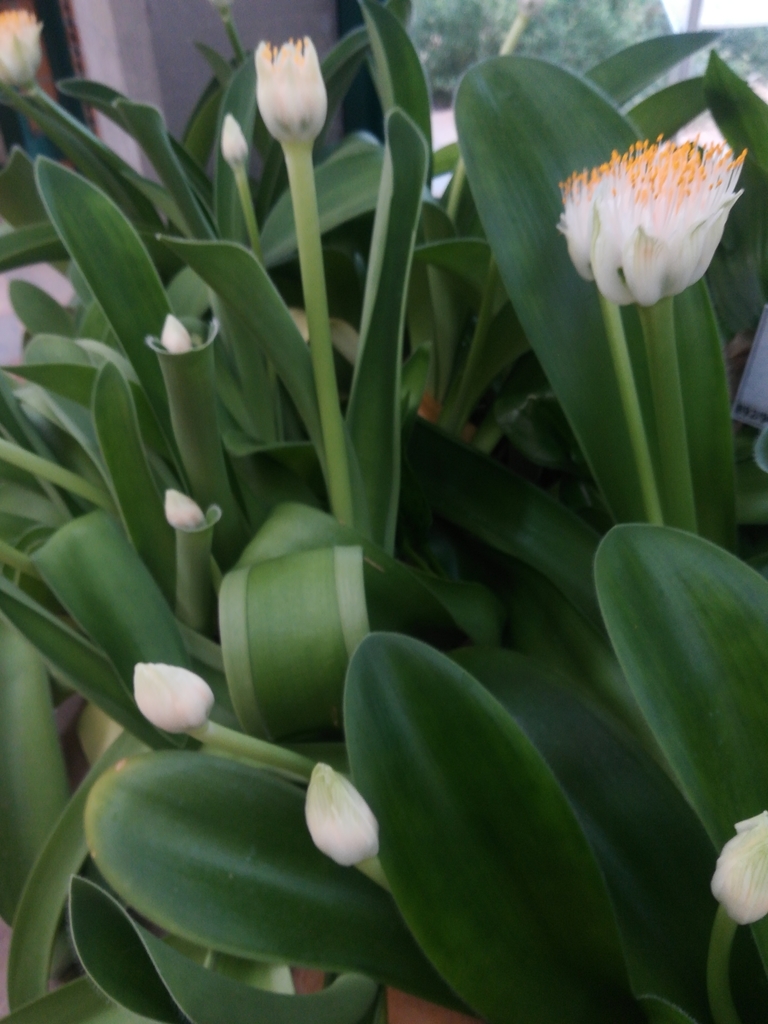
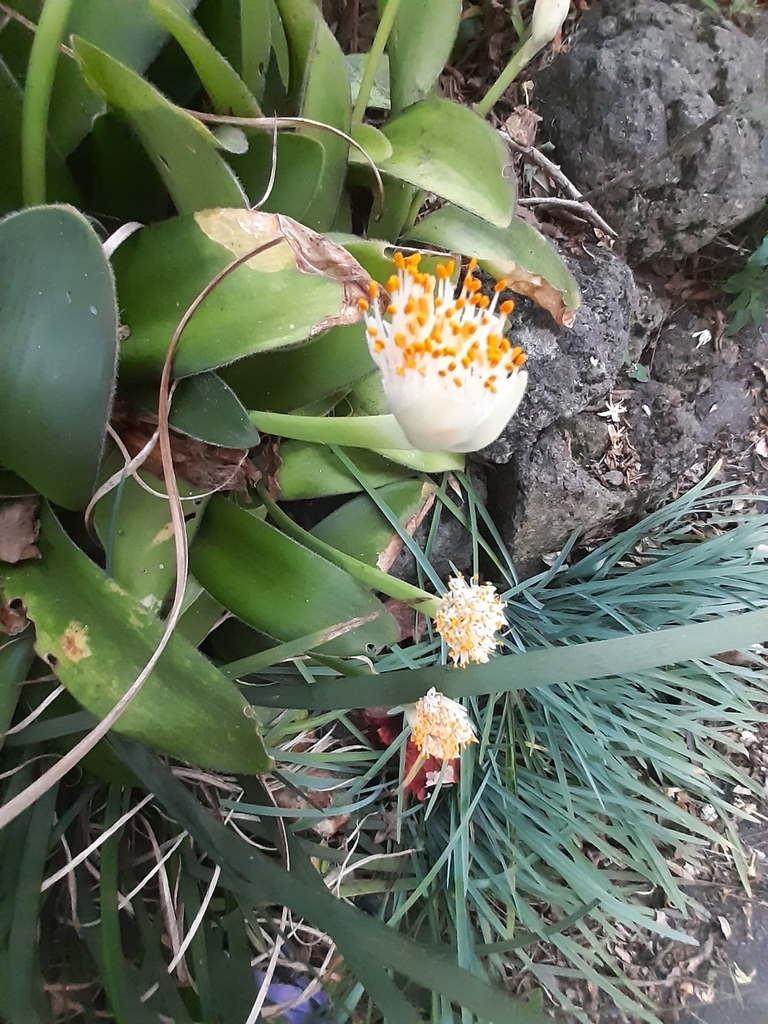

The name and flower color
The scientific genus name Haemanthus comes from Greek words meaning “blood” and “flower.” The name refers to the red flowers of the genus's type species, not to all its members.
For this white-flowered species, that etymology can be confusing: expecting a red flower head would be a mistake. The name remains a historical part of its classification, rather than a description of every plant in the genus.
Bulb and leaves
Members of the genus have an egg-shaped or pear-shaped bulb. It is usually buried in the potting mix, though it sometimes extends partly above the surface.
The leaves are few, strap-shaped, and fleshy. This structure sets the plant apart from houseplants that continually produce masses of thin leaves: here, the main storage organ is the bulb.
- an egg-shaped or pear-shaped bulb
- a few strap-shaped leaves
- a fleshy leaf blade
Flowers and fruit
The flowers form a dense umbel at the tip of the flower stalk. The flower head is surrounded by egg-shaped bracts, which can be red or white within the genus.
The corolla has a short tube. Each flower has 6 stamens with threadlike filaments and oblong anthers; the pistil is threadlike, with a three-part stigma and an inferior ovary.
| Structure | Description |
|---|---|
| Inflorescence | A dense umbel at the tip of the flower stalk |
| Bracts | Egg-shaped, red or white |
| Fruit | A fleshy, rounded berry with black seeds |
Origin and native range
The species is native to South Africa. All species in the genus come exclusively from this region, so the genus has a clearly defined geographic range.
Some species are grown as houseplants and greenhouse plants. Indoors, it is important to remember that this is not an herbaceous plant with incidental roots, but a bulbous species with a storage organ.
| In the wild | Indoors |
|---|---|
| South Africa | A pot with loose potting mix |
| The bulb sits in the substrate | Avoid damaging the bulb when repotting |
| Seasonal growth depends on local conditions | Adjust watering to the condition of the leaves and potting mix |
Watering and potting mix
A common care mistake is treating the bulb as though it needs constantly wet potting mix. The fleshy leaves and bulb can store moisture, so standing water around the base of the bulb is undesirable.
Water after the potting mix has dried partially, avoiding extremes. The mix should let air and water pass through: in a dense mix, the bulb stays in contact with moisture for longer.
- a loose potting mix
- drainage of excess water from the pot
- careful handling of the bulb
Leaves and the growing period
The plant's few leaves should not be cut off while they are still alive. They help nourish the bulb, so removing a healthy leaf blade prematurely weakens the plant.
If a leaf is aging naturally, remove it only once it has died completely or is badly damaged. Judging the plant's condition solely by the number of leaves is misleading: having few leaves is characteristic of the genus.
Toxicity and safe placement
The plant is toxic to cats and dogs. Place the pot where pets cannot chew the leaves, bulb, or freshly cut surfaces after plant care.
When repotting, do not break the bulb apart or leave pieces within reach of pets. After handling the plant, routine handwashing and clearing away plant debris are sufficient.
- Light
- bright indirect light
- Temperature
- room temperature during growth
- Watering
- moderate
- Soil
- loose, well-drained
- Difficulty
- moderate
- Cats and dogs
- toxic
- Native range
- South Africa
Care
This is a bulbous plant in the amaryllis family, so care centers on the condition of the bulb, leaves, and potting mix. Constant moisture around the base of the bulb is undesirable, and healthy leaves should be kept until they die back naturally.
- Light
- Provide bright indirect light. Keep the leaves out of harsh midday sun. In deep shade, the plant generally grows less vigorously.
- Temperature
- Keep at room temperature during growth. Stable room conditions are suitable during active growth. Cold, wet potting mix is undesirable for bulbous plants.
- Watering
- Water after the potting mix has dried partially. The bulb and fleshy leaves store water, so constantly wet potting mix is undesirable. Prolonged drying also weakens the leaves.
- Soil
- Use a loose, well-drained potting mix. The potting mix should allow water and air to reach the bulb. A dense mix holds moisture around the base of the bulb for longer.
- Feeding
- Feed only during growth. Feed when leaves or a flower stalk are actively growing. Stop feeding when there is no visible growth.
- Leaves
- Do not cut off healthy leaves. The plant has few leaf blades, and they nourish the bulb. Remove only completely dead or damaged parts.
- Repotting
- Repot when the pot is too tight. Repot carefully without damaging the bulb or roots. Resume watering after repotting without overwatering.
Botany
4 ill.- Family
- Amaryllidaceae
- Genus
- Haemanthus
- Species
- Haemanthus albiflos
- Author and year
- Jacq.


Haemanthus belongs to the family Amaryllidaceae. It is a monocotyledonous flowering plant with a bulb that usually sits in the substrate and serves as a storage organ.
Leaves in the genus are few, strap-shaped, and fleshy. The inflorescence forms at the tip of the flower stalk as a dense umbel surrounded by egg-shaped bracts.
The fruit is described as a fleshy, rounded berry with black seeds. The genus is native to South Africa, and its scientific name refers to the red flowers of the type species.
How it differs from similar plants
Hippeastrum Hippeastrum vittatum
- White paintbrush has a few fleshy leaves, while hippeastrum is described as having long leaves 50–70 cm long and 4–5 cm wide.
Clivia Clivia miniata
- Clivia is recognizable by its dense rosette of strap-shaped, dark green leaves and an umbel of orange flowers, while white paintbrush is described as a white-flowered plant with a few fleshy leaves.
Frequently asked questions
- Is white paintbrush toxic to cats and dogs?
- Yes, the plant is toxic to cats and dogs. It is best to place the pot out of pets' reach.
- Why isn't the flower head red if the name means “blood”?
- The genus name refers to the red flowers of the type species. Haemanthus albiflos is a white-flowered species.
- Is this an amaryllis or a different plant?
- No. It belongs to the family Amaryllidaceae, but is in a separate genus, Haemanthus.
- Why are there so few leaves?
- The genus characteristically has a few strap-shaped, fleshy leaves. A small number of leaves is not a problem in itself.
- Does the bulb need to be completely buried?
- The bulb is usually buried in the potting mix, but sometimes extends partly above it. Avoid damaging it when repotting.


