Scarlet star
Its drooping flower cluster sets scarlet star (Guzmania lingulata) apart from other bromeliads: in the wild, this epiphyte grows on trees in the humid tropical and cloud forests of Central and South America.
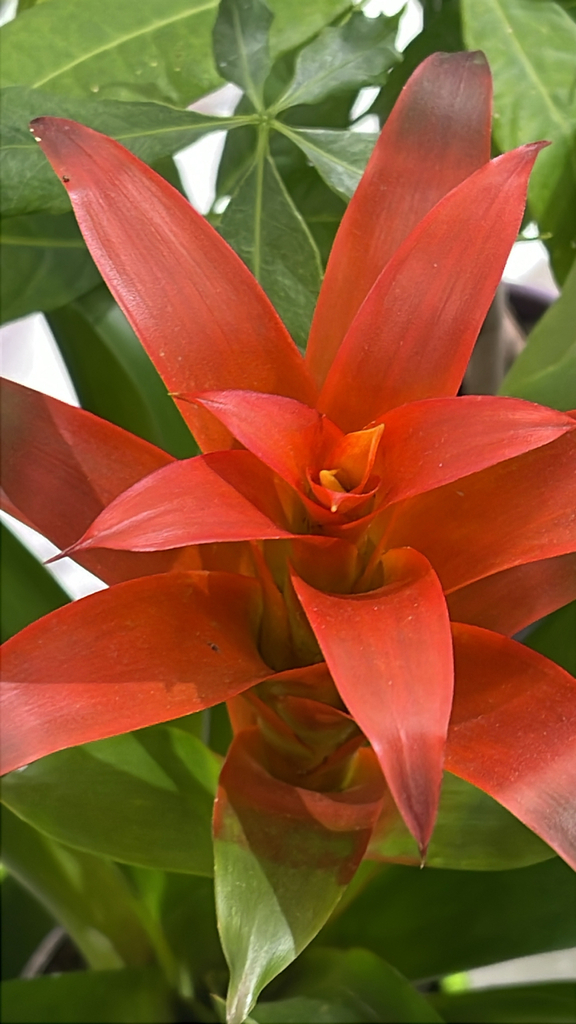


Structure and flower clusters
Scarlet star belongs to the family Bromeliaceae, so it is more accurate to describe its flower cluster rather than a single “flower.” Descriptions of the species in the wild mention a drooping flower cluster—a feature that sets it apart from many bromeliads with stiff, upright flower stalks.
A bromeliad's leaf rosette is more than decorative: it forms the center of the plant and determines how moisture is held around the base. Indoors, the key is not to let this center remain constantly wet without airflow.
Origin and natural conditions
The species is native to Central and South America. In the mountain forests of the Sierra Nevada de Santa Marta in northern Colombia, Guzmania lingulata is listed among the vascular epiphytes that grow on trees without parasitizing them.
| Conditions in the wild | What this means for the plant |
|---|---|
| Above 900 m above sea level | Forests with shorter trees, palms, and numerous vascular epiphytes |
| 1150-2500 m above sea level | Sub-Andean cloud forests with broadleaf trees |
| 2500-3300 m above sea level | Cloud forests, often shrouded in fog, with mosses, lichens, and liverworts |
These conditions explain its need for an airy potting mix, indirect light, and moisture without standing water. There is no need to recreate a mountain forest indoors, but remember that this is not a plant suited to heavy, wet soil.
Light and placement
In the wild, this epiphyte lives among forest vegetation, where light filters through the tree canopy. Bright indirect light without prolonged direct sun is therefore a natural choice for growing it indoors.
- a bright spot where the leaves will not overheat suddenly
- a stable position without frequent moves
- good air circulation around the rosette
Growth usually slows in deep shade, while too much sun can quickly dry out the potting mix and leaf rosette. The best spot gives the plant plenty of daylight without exposing it to direct midday sun.
Watering and potting mix
As an epiphyte, this species is not adapted to dense soil that holds water around its roots for a long time. The potting mix should be airy and coarse so water can pass through rather than collect in it.
- an airy epiphytic potting mix
- moderate moisture without waterlogging
- draining excess water after watering
Letting it dry out too much is also undesirable: in humid forests, epiphytes regularly receive water from rain, fog, and organic debris on bark. Indoors, use the condition of the potting mix as your guide: it should be neither dust-dry nor constantly wet.
Seasonal moisture
Rainfall in the mountain forests of Santa Marta is seasonal: wet periods fall in September-December and May-July, and dry periods in January-April and July-August. This is not a ready-made watering schedule for an apartment, but it offers an important clue: the plant does not live in permanently waterlogged conditions.
The north-facing slopes overlooking the sea receive more rainfall, and at elevations of 1000-1500 m, average annual rainfall can reach 3000 mm. Meanwhile, cloud forests at higher elevations receive less rainfall, but frequent fog maintains a moist environment.
Indoors, this comes down to balance: the plant needs moisture, but its roots need air. If the potting mix becomes compacted or takes a long time to dry, the risk of problems is greater than from a brief pause between waterings.
Common problems
The most common difficulties stem not from the species' origins but from care mistakes: heavy potting mix, standing water, a sudden change of location, or a spot that is too dark. For an epiphytic bromeliad, these conditions quickly disrupt the functioning of the roots and rosette.
- yellowing leaves from overwatering or insufficient light
- drying leaf edges in dry air with inconsistent watering
- rot at the base from standing water
- loss of firmness after the potting mix dries out too much
- stalled growth in a shaded spot
A single symptom does not always point to a single cause, so consider the whole setup: light, potting mix, water, and the temperature around the plant. Make any changes gradually so the plant does not face several stresses at once.
Pet safety
The plant is safe for cats and dogs. This means the species is not reported to have the toxic effects associated with plants containing irritating sap or dangerous alkaloids.
Even so, eating the leaves is not part of normal plant care: tough plant tissue can physically irritate the digestive tract. It is therefore best to place the pot where a pet cannot break the rosette or spill the potting mix.
- Light
- indirect light
- Watering
- moderate
- Soil
- epiphytic potting mix
- Difficulty
- moderate
- Cats and dogs
- safe
- Native range
- Central and South America
Care
Scarlet star grows as an epiphytic bromeliad: it needs moisture, air around its roots, and indirect light. The worst combination is a dense, wet potting mix and low light.
- Light
- Provide bright indirect light. In the wild, it grows among forest vegetation, so it grows best without prolonged direct sun.
- Temperature
- Keep temperatures consistently warm. Avoid sudden temperature changes and cold drafts; do not try to replicate natural mountain temperatures indoors.
- Watering
- Water moderately. Keep the potting mix moist but not waterlogged. Standing water around the roots is undesirable for an epiphytic bromeliad.
- Soil
- Use an airy epiphytic mix. It needs a coarse mix that allows water and air to pass through. Heavy soil stays moist for a long time and increases the risk of rot.
- Feeding
- Feed sparingly. Epiphytes receive nutrients in small amounts in the wild, so excess fertilizer is unnecessary.
- Leaves
- Clean leaves gently. Remove dust from the leaves without leaf polish so it does not interfere with gas exchange at the surface.
- Repotting
- Repot when the mix becomes compacted. Repotting is mainly needed to restore airflow through the mix, not to keep increasing the pot size.
Botany
4 ill.- Family
- Bromeliaceae
- Genus
- Guzmania
- Species
- Guzmania lingulata
- Author and year
- (L.) Mez


Scarlet star (Guzmania lingulata) is a member of the family Bromeliaceae from Central and South America. In the wild, the species occurs as a vascular epiphyte in humid tropical and cloud forests.
An epiphytic lifestyle means the plant uses trees for support but does not feed on their tissues. This makes an airy potting mix and the absence of standing water around the roots important when growing it indoors.
In the mountain forests of Santa Marta, this species is listed among epiphytes found above 900 m above sea level. This environment combines moisture, fog, forest shade, and good air circulation.
How it differs from similar plants
Air plant Tillandsia ionantha
- Indirect light is sufficient for scarlet star, while Tillandsia needs bright indirect light.
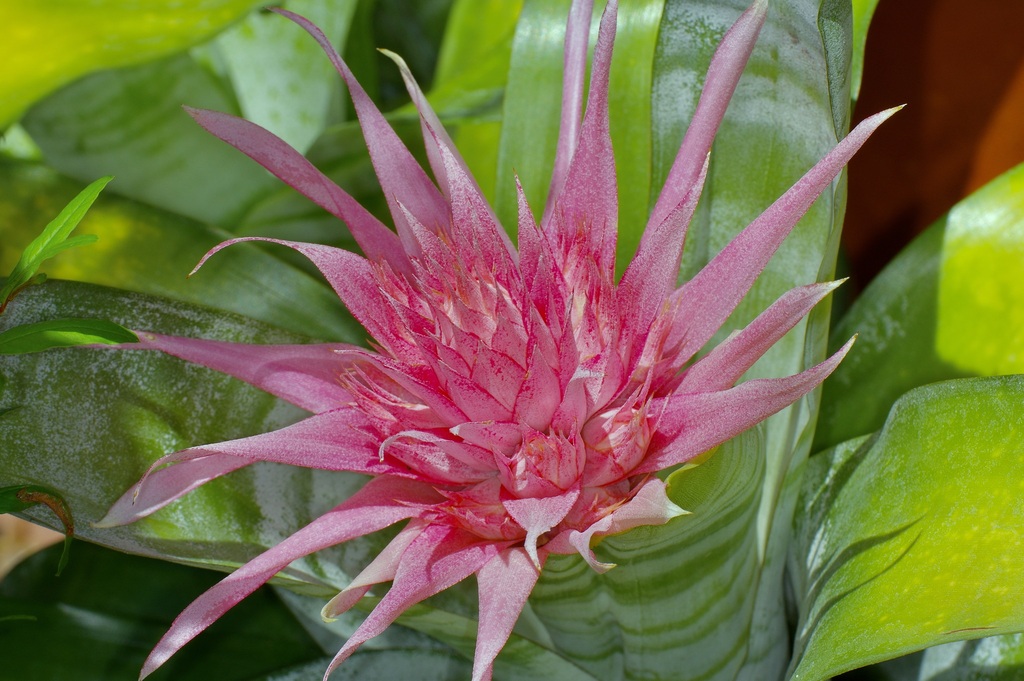 Urn plant
Aechmea fasciata
Urn plant
Aechmea fasciata- A drooping flower cluster sets scarlet star apart, while Aechmea is recognizable by the silvery bands across its firm leaves.
Flaming sword Lutheria splendens
- Indirect light is recommended for scarlet star, while Vriesea needs bright indirect light.
Frequently asked questions
- Is scarlet star safe for cats and dogs?
- Yes, the plant is safe for cats and dogs. However, eating the leaves can physically irritate the digestive tract.
- Why are the leaves turning yellow?
- The most common causes are overwatering, compacted potting mix, or insufficient light. Check the roots and watering conditions first.
- How often should I water it?
- Water moderately: moisten the potting mix without leaving standing water. Use the condition of the airy mix as your guide, not a calendar.
- What potting mix does it need?
- It needs an airy epiphytic potting mix. Heavy garden soil is unsuitable for this species because it holds water for a long time.
- Can I keep it in shade?
- Place it in a bright spot with indirect light. Growth slows in deep shade.


