Cape sundew
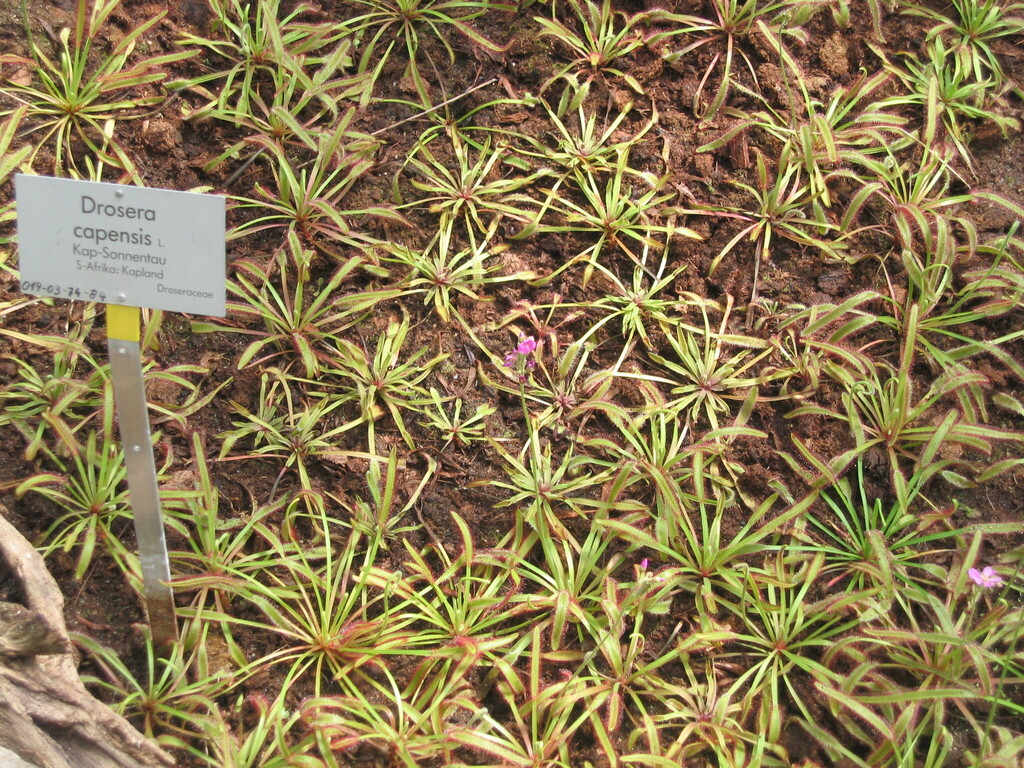
Drops of clear mucilage on glandular hairs make the leaves look covered in dew: this is how the Cape sundew (Drosera capensis) attracts and traps small insects, then digests them with enzymes.


Structure of the leaf trap
The leaf blade is covered with glandular hairs that secrete sticky mucilage. These droplets give the plant its distinctive appearance: they sit on the surface like dew but act as a trap for small insects.
Sundew leaves often form a rosette at the base of the plant. When prey touches the sensitive hairs, the edge of the leaf blade may gradually curl around it, then open again after digestion.
How feeding works
The Cape sundew is an insectivorous plant. Its sticky secretion does more than hold prey: it contains substances with a paralyzing effect and digestive enzymes that break down protein-rich food.
- contact with protein-rich prey
- the insect is held by mucilage
- the leaf blade curls around it
- digestive enzymes are released
- the leaf opens again
A stray drop of water or a dry leaf fragment does not trigger the full digestive process. This selectivity helps the plant avoid wasting resources on stimuli that provide no nutrients.
Origin and natural conditions
The species is native to Cape Province, South Africa. For indoor growing, this matters not as a decorative detail but as a reminder that the plant did not evolve in rich garden soil.
The genus Drosera occurs in bogs, on sandstone, in mountains, and in forests—in other words, on very different substrates. Many of these places share a lack of available minerals, which sundews partly compensate for by feeding on insects.
Watering and growing medium
Sundew roots are not adapted to rich, fertilized soil. The growing medium must remain nutrient-poor and moist; otherwise, the leaf traps become less active and the root system quickly suffers.
Fertilizers for ordinary houseplants are inappropriate here: sundews obtain some nutrients from their prey. If the plant has healthy leaves with sticky secretion, there is no need to deliberately ‘feed’ it.
| In nature | Indoors |
|---|---|
| Nutrient-poor substrates | Nutrient-poor growing medium without fertilizers |
| Wet habitats for some species | An evenly moist environment |
| Feeding on insects | No mineral fertilizer |
Light and placement
Sticky droplets on the hairs are visible only on active leaves. If the leaf blade becomes dull, mucilage decreases, and new traps grow smaller, first check the light and the overall condition of the growing medium.
Indoors, a very bright spot without overheating is suitable. An enclosed display case or a cramped position near glass can dry out the leaves just as much as insufficient watering.
Propagation
Sundews are propagated by seed, leaf cuttings, and division. To take a cutting, use a leaf blade that has not yet begun to dry out and keep it in a moist environment until roots appear.
If an offset rosette grows from the main rosette, it can be separated as an independent plant. This method preserves the parent plant's traits and is usually less unpredictable than sowing seed.
Flowering and seeds
Sundew flowers are arranged in a spike-like inflorescence. They usually sit on a long flower stalk so that pollinating insects do not come too close to the sticky leaf traps.
After flowering, a capsule forms containing numerous tiny seeds. Different species flower during the spring and summer months, but indoors this depends on the plant's condition and growing conditions.
- Light
- bright indirect light
- Watering
- constant moisture
- Soil
- nutrient-poor growing medium
- Difficulty
- moderate
- Cats and dogs
- safe
- Native range
- Cape Province, South Africa
Care
The Cape sundew needs consistent moisture, light, and a nutrient-poor growing medium rather than rich soil. Its care differs from that of most houseplants because it feeds on insects.
- Light
- Provide bright indirect light. Light keeps the leaf traps active. In deep shade, new leaves become weaker and produce less sticky secretion.
- Watering
- Keep consistently moist. The growing medium must not dry out completely. Drying out quickly affects the leaves and their sticky droplets.
- Soil
- Use a nutrient-poor growing medium. Rich soil and fertilizers are unsuitable. The plant is adapted to a lack of minerals and partly compensates by feeding on insects.
- Feeding
- Do not fertilize. Ordinary fertilizers can damage the roots. If the traps are active, the plant digests small prey on its own.
- Support
- No support needed. The leaves grow in a rosette and do not need tying up. Only the flower stalk may need support if it leans.
- Leaves
- Do not wash off the mucilage. The droplets on the hairs are part of the trap, not dirt. Frequent touching and rinsing reduce the leaf's ability to hold prey.
- Repotting
- Repot when the growing medium deteriorates. Repot when the growing medium has compacted or the rosette has outgrown its container. Consistent moisture is important after repotting.
Botany
4 ill.- Family
- Droseraceae
- Genus
- Drosera
- Species
- Drosera capensis
- Author and year
- L.

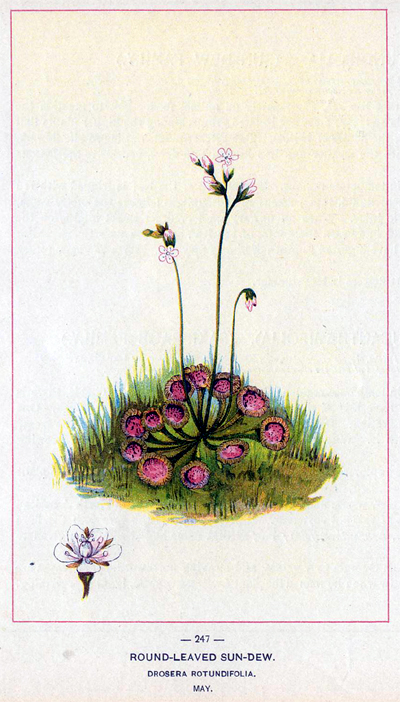


The Cape sundew (Drosera capensis) belongs to the family Droseraceae. Its main morphological feature is a leaf blade with glandular hairs that secrete sticky mucilage in rounded droplets.
The trap does not work like an instant snap trap, but as a slow digestive surface. After contact with an insect, the leaf may curl around it, and enzymes in the secretion help the plant absorb nutrients.
The species is native to Cape Province in South Africa. Its insectivorous habit is linked to life on nutrient-poor substrates: the plant obtains some of its nitrogen, phosphorus, and other elements from prey rather than soil.
How it differs from similar plants
Venus flytrap Dionaea muscipula
- The Venus flytrap is recognizable by its trap leaves, while sundews hold prey with clear droplets of mucilage on glandular hairs.
Pitcher plant Nepenthes alata
- In Nepenthes, the trap is a pitcher that forms part of the leaf, while sundew leaf blades are covered with ‘dew’ made of mucilage on the hairs.
Frequently asked questions
- Is the Cape sundew safe for cats and dogs?
- Yes. The plant is safe for cats and dogs, but it is best to place the pot where pets cannot damage the leaf traps.
- Why are the leaves drying out?
- This is most often a response to drying out, an unsuitable growing medium, or low light. Older leaves also gradually die off naturally.
- Does it need to be fed insects?
- There is no need to feed it deliberately. Active traps catch small insects on their own if any are nearby.
- Can I fertilize it?
- It is best not to. Fertilizers for ordinary houseplants are unsuitable for sundews and can damage the roots.
- Are sticky droplets on the leaves a sign of disease?
- No, they are a normal part of the trap. The sticky droplets are mucilage containing digestive substances that helps hold prey.


