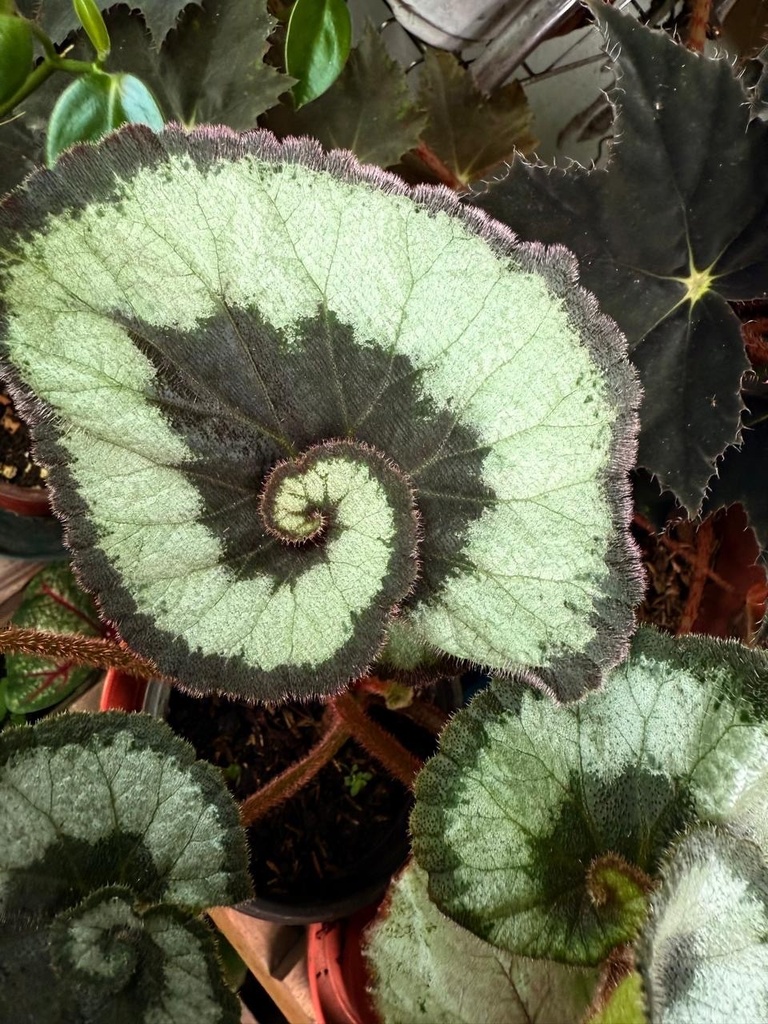
Rex begonia
In the humid subtropical conditions of Assam in northeastern India, Begonia rex developed a rhizomatous growth habit and large, asymmetrical leaves. Indoors, it needs indirect light, a light potting mix, and careful watering.


Structure and leaves
This is a rhizomatous herbaceous plant: its aboveground growth is supported by an elongated rhizome rather than woody stems. As a houseplant, the species is valued primarily for its leaves rather than its flowers.
The leaves are basal, with long, hairy petioles. The blade is asymmetrical, with an oblique, heart-shaped base and a toothed edge fringed with hairs. In the wild species, the upper surface is dark green with a grayish-green or silvery horseshoe-shaped patch, and the underside is purple.
- rhizomatous growth habit
- asymmetrical leaf blades
- palmate veins
- hairy petioles
- tiny seeds in a capsule
Because of their hairs, the leaves do not tolerate rough rubbing or droplets that linger on the surface. Handle the leaves gently: a soft, damp cloth is enough, without leaf shine products.
Origin and natural conditions
The species is native to northeastern India (Assam). It was there, in 1856, that the plant later described as Begonia rex Putz. was found.
The genus Begonia is generally associated with tropical and subtropical regions, particularly humid forests. For indoor growing, this means gentle light, a light potting mix, and careful watering without standing water.
| In the wild | Indoors |
|---|---|
| humid forests and subtropical biomes | indirect light without direct sun |
| rhizome in a loose organic layer | a light mix with good drainage |
| high environmental humidity | humid air without wet leaves |
Its origins do not mean the plant likes a constantly wet pot. Water does not stagnate in the loose layer where it grows naturally, so drainage holes and an airy potting mix are important indoors.
Light and placement
Bright indirect light or partial shade works best. In deep shade, the leaves lose their distinctive coloring, while direct sun can scorch them.
On a balcony or terrace, place the plant in a partially shaded spot sheltered from wind. Bring it indoors in September to avoid cold nights and abrupt changes in conditions.
- an east- or north-facing windowsill
- a spot behind a sheer curtain
- a table near a bright window
- a partially shaded balcony in summer
- protection from drafts
If the leaves lean toward the light on one side, you can rotate the pot periodically. Avoid moving it abruptly from shade to a sunny spot: the leaf tissue does not have time to adapt.
Watering and potting mix
Water after the top layer of the potting mix has dried. A constantly wet rhizome quickly becomes vulnerable to rot, especially in a heavy pot without adequate drainage.
A soft, light mix based on leaf mold, peat, and sand is suitable for planting. Sources on indoor begonias give a ratio of 1:1:2, with the proportion of sand helping to keep the mix loose.
| Ingredient | Purpose |
|---|---|
| leaf mold | provides an organic base |
| peat | retains moderate moisture |
| sand | improves aeration |
Misting the leaves is no substitute for proper watering. If the air is dry, it is better to raise humidity around the plant without leaving droplets on the hairy leaf surfaces.
Propagation
Begonias are well suited to vegetative propagation. For rhizomatous forms, propagation from a leaf or part of a leaf blade is especially convenient, provided the material contains tissue capable of producing a new plant.
- seeds
- stem cutting
- leaf with a bud
- part of a leaf
- rhizome division
Stem cuttings can root in water, after which they are planted in a light mix. Leaf propagation is slower, but it makes good use of the genus's natural ability to regenerate from leaf fragments.
Do not move young plants into a large pot immediately after rooting. Excess potting mix stays moist for a long time, increasing the risk of rhizome rot.
Spots, rot, and yellowing
The most common problems are related to water: overwatering, poor drainage, or wet patches on the leaves. Ringspot, bacterial leaf spot, and powdery mildew are reported in the genus Begonia.
Yellowing leaves usually indicate unsuitable conditions: the rhizome may be sitting in wet potting mix, or the plant may be in a spot that is too dark or cool. Dry edges are more common where the air is dry and watering is inconsistent.
- wet potting mix that never dries
- droplets on hairy leaves
- a heavy mix without drainage
- sudden exposure to direct sun
- a cold draft
Damaged leaves do not repair their old tissue, so assess the new growth instead. If it develops evenly and without spots, conditions have gradually stabilized.
Flowering and dormancy
Begonia flowers are unisexual, and the fruit is a capsule containing very small seeds. In Begonia rex, the flower cluster is described as almost hairless, with pink or pinkish flowers, but indoors the species is grown mainly for its foliage.
A dormant period from October to February is reported for herbaceous and shrubby begonias in cultivation. During this time, reduce watering, remove dry leaves, and do not try to stimulate active growth with excess water.
| Period | What changes |
|---|---|
| October-February | growth slows; water more cautiously |
| spring-summer | new leaves form more actively |
If the plant flowers, it does not need a different care routine from one grown for its foliage. The essentials remain steady indirect light, moderate moisture, and an airy potting mix.
- Light
- partial shade or shade
- Temperature
- +13…+22 °C
- Watering
- after the top layer dries
- Soil
- light, well-drained
- Difficulty
- moderate
- Cats and dogs
- toxic
- Size indoors
- up to 40 cm
- Leaves indoors
- 6-33 × 5-21 cm
- Native range
- northeastern India (Assam)
Care
This foliage begonia needs stable conditions: gentle light, a loose potting mix, and watering that avoids standing water. Most problems come not from brief dry spells but from a wet rhizome and droplets on the leaves.
- Light
- Provide bright indirect light or partial shade. Direct sun can damage the leaf blades, while deep shade weakens their color and slows growth.
- Temperature
- Keep at +13…+22 °C. This is a comfortable range for growth. Growth slows in winter, so reduce watering and keep the plant out of cold drafts.
- Watering
- Water when the top of the potting mix has dried. The rhizome must not sit in wet potting mix. Drain excess water after watering to avoid encouraging rot.
- Soil
- Use a light mix with good drainage. A loose mix of leaf mold, peat, and sand works well. A heavy mix holds water around the rhizome for too long.
- Leaves
- Avoid leaf shine products. Wipe the hairy leaves with a soft, damp cloth. Droplets and leaf shine solutions can leave spots or burns.
- Repotting
- Repot as needed. Repot when the rhizome is crowded or the potting mix has compacted. An oversized pot increases the risk of waterlogging.
- Support
- No support needed. The plant has basal leaves and a rhizomatous growth habit, so it does not need a support.
Botany
4 ill.- Family
- Begoniaceae
- Genus
- Begonia
- Species
- Begonia rex
- Author and year
- Putz.


Rex begonia (Begonia rex) belongs to the family Begoniaceae. It is a rhizomatous herbaceous plant with basal leaves, an elongated rhizome, and asymmetrical leaf blades.
The wild species comes from northeastern India (Assam). Its leaves have intricate coloring: the underside is purple, while the upper surface is dark green with a grayish-green or silvery horseshoe-shaped pattern.
Begonia flowers are unisexual, and after pollination a capsule containing very small seeds forms. The species has given rise to ornamental forms, but its basic biology remains rhizomatous and moisture-loving, without tolerance for standing water.
Popular cultivars
6- Ever-flowering begoniaBegonia semperflorens
- a compact plant with glossy leaves and red, pink, or white flowers
- Rex begoniaBegonia rex
- leaves patterned in silver, purple, and green
- Tuberous begoniaBegonia tuberhybrida
- has large, brightly colored flowers
- Polka dot begoniaBegonia maculata
- angel-wing-shaped leaves with silver spots; pink or white flowers
- Bolivian begoniaBegonia boliviensis
- bright orange or red tubular flowers
- Begonia cucullataBegonia cucullata
- single flowers and heart-shaped leaves
How it differs from similar plants
ZZ plant Zamioculcas zamiifolia
- Rex begonia has prominent, large, asymmetrical leaf blades, while the 'stems' of zamioculcas are compound leaves.
Snake plant Dracaena trifasciata
- Rex begonia is easy to recognize by its large, asymmetrical leaves, and sansevieria by its long, stiff leaf blades.
Monstera Monstera deliciosa
- Rex begonia remains a short rhizomatous plant with asymmetrical leaves, while monstera grows as a vine and develops split leaves with age.
Frequently asked questions
- Can I keep it at home if I have a cat?
- Yes, but the plant is toxic to cats and dogs. It is best to place the pot where pets cannot chew the leaves or rhizome.
- Why are the leaves turning yellow?
- Most often because the potting mix is too wet, the location is cold, or there is too little light. First check the moisture level and the condition of the rhizome.
- Can I mist it?
- It is better not to mist the leaves. Use a tray or humidifier to raise humidity without leaving droplets on the leaves.
- How do I propagate it from a leaf?
- Use a leaf with a bud or part of a leaf; in begonias, a new plant can develop even from a fragment of a leaf blade.
- How often should I repot it?
- As needed, when the potting mix has compacted or the rhizome is crowded. A rhizomatous form does not need annual repotting without a reason.