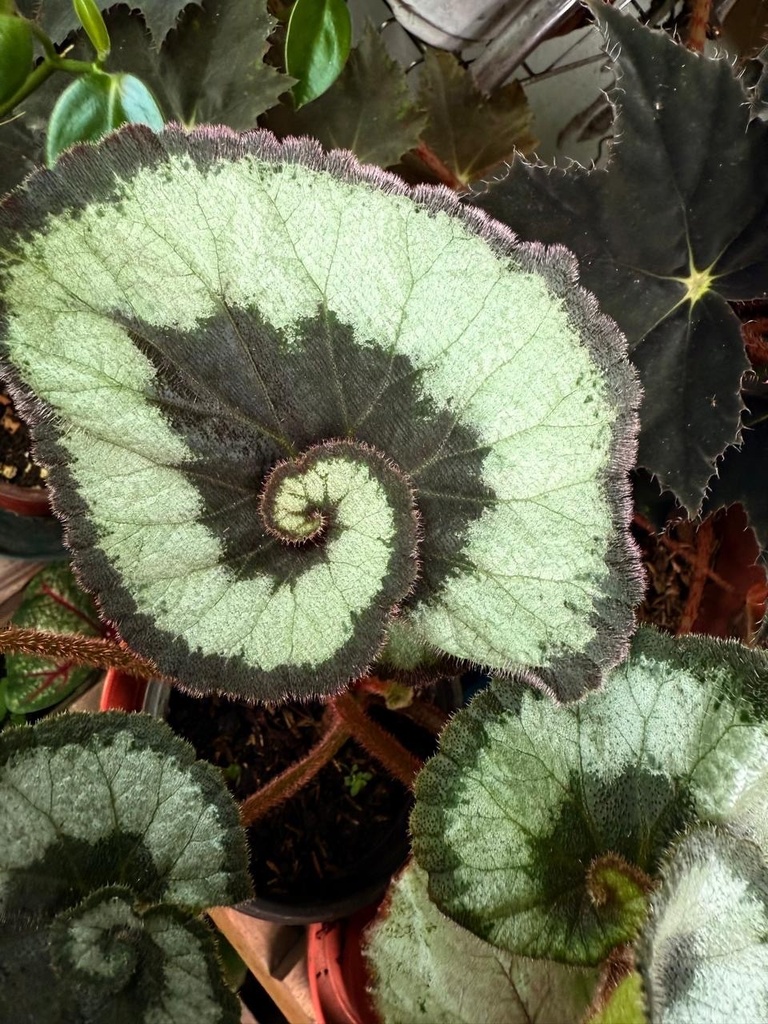
Polka dot begonia
The most common mistake is putting polka dot begonia (Begonia maculata) in direct sun to make its spots brighter. Its leaves actually need indirect light: in hot weather, they are more likely to scorch than develop a stronger pattern.


Foliage and growth habit
This species is recognizable by its contrasting leaves: the dark green upper surface is covered in silvery spots, while the underside is red. The leaves are elongated, asymmetrical, and up to 20 cm long.
The plant grows upright, with fleshy stems and a fibrous root system. Indoors, a mature plant usually reaches 60-90 cm tall and 30-45 cm wide; long stems may trail.
In everyday use and in the plant trade, this species is often called by the Ukrainian name meaning “begonia with polka dots,” or polka dot begonia, for the silvery spots on its leaves. The Ukrainian equivalent of Begonia comes from the Latin genus name, which honors Michel Bégon.
Origin and natural habitat
This species is native to southeastern Brazil. In the wild, it grows in tropical forests, where light filters through the tree canopy rather than striking the leaves as direct midday sun.
This background explains its needs indoors: the plant needs a bright spot but is sensitive to overheating and drying of the leaves. Its roots are not adapted to waterlogging, so high humidity does not mean the potting mix should stay constantly wet.
Light and placement
Bright indirect light is ideal. At an east-facing window, the plant gets enough light without prolonged overheating; at a south-facing window, it needs shade from direct sun.
If light is insufficient, the stems become leggy and the spots on the leaves look less distinct. Too much sun can cause dry, damaged patches on the leaves.
- bright indirect light
- protection from direct midday sun
- a spot free of cold drafts
Consider the season when placing the plant right next to window glass: it can be cold there in winter, while in summer the leaves can quickly overheat.
Watering, humidity, and potting mix
Water when the top 2-3 cm of potting mix is dry. Two extremes are harmful to this species: prolonged dryness weakens the leaves, while constant wetness around the roots increases the risk of rot.
The potting mix should be light, slightly acidic, and well-drained. An African violet mix with peat, perlite, and vermiculite is suitable, as is another airy potting mix for foliage plants.
| Condition | What matters |
|---|---|
| Watering | When the top 2-3 cm is dry |
| Humidity | 50% or higher |
| Potting mix | Light, well-drained, slightly acidic |
| Pot | Not oversized, with drainage |
A tray of damp pebbles or a humidifier helps maintain humidity, but the bottom of the pot must not sit in water.
Pruning and propagation
The stems lengthen with age, so shape the plant by pruning or pinching. In spring, remove weak and overly long stems to encourage branching from the leaf axils.
The plant is most often propagated by stem cuttings. Choose a strong stem with 2-3 nodes, cut below a node, and root it in water or in moist, well-drained potting mix.
- a healthy stem without blemishes or rot
- 2-3 nodes per cutting
- bright indirect light
- moderately moist potting mix
- ventilation under the cover
Spring or early summer is the best time to take cuttings. At +22…+25 °C, roots usually develop faster, but excessive moisture under the cover can cause rot.
Flowering and seasonal growth
Indoors, the plant may produce small pinkish-white flowers on pinkish-red stems. It flowers from spring to fall, most actively during the warmer part of the year.
Growth slows in fall and winter, so reduce feeding. During active growth, apply fertilizer every 2-3 weeks at half strength.
| Season | Care |
|---|---|
| Spring-summer | Bright indirect light, watering after the top layer dries, feeding |
| Fall-winter | Less feeding, protection from cold and waterlogging |
Problems and pet safety
Yellowing, soft stems, and an unpleasant smell from the potting mix are most often linked to overwatering and poor drainage. Dry, pale patches on the leaves usually appear after exposure to direct sun or overheating near window glass.
Possible pests include whiteflies, spider mites, and aphids. Isolate the plant, rinse the leaves with water, and remove pests by hand or with a soap solution.
This species is mildly toxic to cats and dogs. Begonia sap contains substances that can irritate mucous membranes when chewed, so it is best to keep the pot out of pets’ reach.
- Light
- bright indirect light
- Temperature
- +18…+24 °C
- Watering
- when the top 2-3 cm is dry
- Soil
- light, well-drained
- Difficulty
- moderate
- Cats and dogs
- mildly toxic
- Size indoors
- 60-90 cm
- Leaves indoors
- up to 20 cm
- Native range
- southeastern Brazil
Care
This species grows best where the light is ample but not harsh, and the potting mix can dry out partially between waterings. The main risk in its care is the combination of cold, wet roots, and poor ventilation.
- Light
- Provide bright indirect light. Direct sun can damage the leaves; in low light, stems become leggy and the spots less distinct.
- Temperature
- Keep at +18…+24 °C. This is the range for active growth. Avoid drafts and temperatures below +15 °C, especially near cold window glass.
- Watering
- Water when the top 2-3 cm is dry. Do not keep the potting mix constantly wet: the roots are sensitive to waterlogging and may rot.
- Soil
- Use a light, well-drained potting mix. A slightly acidic potting mix with peat, perlite, and vermiculite, or an African violet mix, is suitable.
- Feeding
- Feed every 2-3 weeks. Use fertilizer at half strength during the growing season; reduce feeding in fall and winter.
- Leaves
- Wipe off dust. Clean the leaves with a damp cloth. Avoid misting the leaves when ventilation is poor.
- Repotting
- Repot into a slightly larger pot. Repot as needed, and avoid an oversized container: the extra potting mix stays wet longer.
Botany
- Family
- Begoniaceae
- Genus
- Begonia
- Species
- Begonia maculata
- Author and year
- Raddi
Polka dot begonia (Begonia maculata) belongs to the family Begoniaceae. It is a member of the genus Begonia, which includes herbaceous plants, shrubs, and subshrubs with asymmetrical leaves.
The species comes from southeastern Brazil. Its appeal as a houseplant lies not only in its spotted foliage but also in the red undersides of its leaves, which become visible as the stems grow and lean slightly.
The root system is fibrous and sensitive to waterlogging. For this reason, a wide but not oversized pot and an airy potting mix are more important than frequent watering.
Frequently asked questions
- Why are the leaves turning yellow?
- Most often because of overwatering or poor drainage. Let the top 2-3 cm of potting mix dry before watering again.
- Can I put it in direct sun?
- No, direct sun can leave dry, damaged patches on the leaves. The plant needs bright indirect light.
- Is it safe for cats and dogs?
- The plant is mildly toxic to cats and dogs. When chewed, its sap can irritate mucous membranes, so it is best to keep the pot out of pets’ reach.
- How do I propagate it?
- It is most often propagated by stem cuttings with 2-3 nodes. Root them in water or in moist, well-drained potting mix.
- How often should I repot it?
- Repot as needed into a slightly larger pot. An oversized container increases the risk of waterlogging around the roots.