Air plant
Native to Mexico and Central America, the air plant (Tillandsia ionantha) evolved in an open, airy environment: indoors, it needs light, moisture on its leaves, and quick drying.


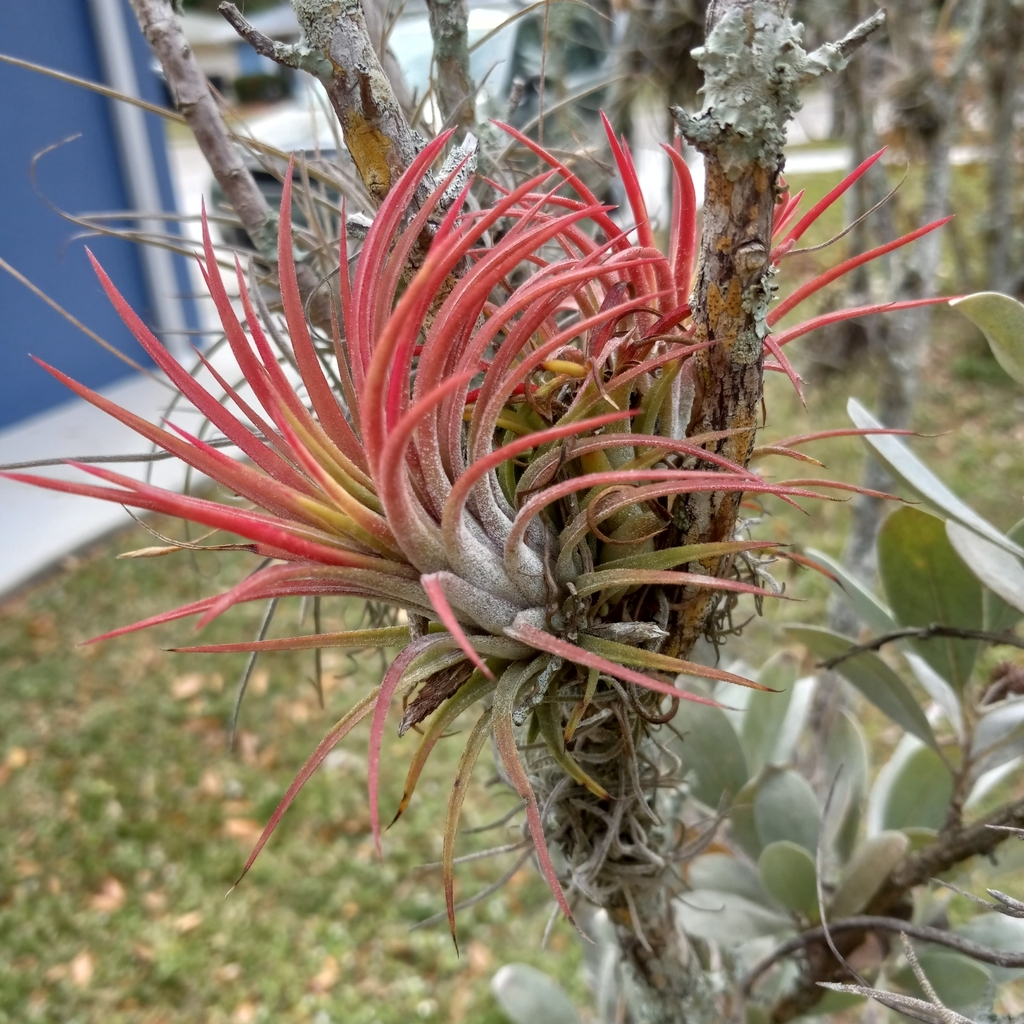
Rosette structure
The air plant belongs to the bromeliad family, but indoors it does not behave like a typical potted plant. Its structure centers on a dense leaf rosette, with overlapping leaves forming a compact shape.
The roots of these plants should not be seen as their main means of taking up nutrients from a growing medium. It is more important to give the leaf rosette moisture and let it dry quickly afterward, without water collecting around the base.
Origin and natural conditions
This species is native to Mexico and Central America. Its origins explain why it does better in an open, well-ventilated setup than in a dense, wet growing medium.
Indoors, this calls for a simple approach: plenty of light without overheating, regular wetting of the leaves, and complete drying after watering. A constantly wet base is more dangerous than a short break between waterings.
Light and placement
Bright indirect light is needed for normal growth. The plant will not necessarily die farther back in a room, but growth becomes weaker and the rosette gradually becomes less compact.
- a spot near a bright window without overheating at midday
- an open shelf with air circulation
- a hanging mount that does not touch a wet surface
- a glass container only with good ventilation
- a position away from radiators and air conditioner airflow
Closed terrariums are risky for this species: moisture builds up easily, and there is almost no air movement. If the plant is displayed in a decorative container, it is best to return it only once it is dry after watering.
Watering and drying
Watering this plant is different from watering a pot. Water is applied to the leaf rosette: mist the plant or immerse it in water, then shake off excess moisture and leave it somewhere with air circulation.
The main sign of a suitable watering routine is that the rosette does not stay wet for long. If water sits between the leaves, the base may darken and soften; if the plant receives too little moisture, the leaf tips dry out.
- wet the entire rosette
- shake off droplets after watering
- let it dry in a well-ventilated spot
- avoid water collecting in the center
- adjust watering according to the condition of the leaves
Mounting without a growing medium
This plant does not need regular soil. Secure it to bark, stone, or a wooden base, or place it in an open stand where water cannot collect around the lower part of the rosette.
The attachment should hold the plant without pinching its base. Glue, wire, or thread must not cover the growing area or trap water after watering.
Leaf problems
Dry tips most often appear when the plant spends a long time in dry air or is watered inconsistently. Darkening at the base is more often linked to the opposite problem: water remains between the leaves and the rosette does not dry out.
- pale leaves — too little light
- soft base — trapped water
- dry tips — inconsistent watering
- distorted rosette — a tight or rigid attachment
- slow growth — low light
Look for the cause in the combination of growing conditions rather than in a single symptom: light, water, ventilation, and mounting all work together. The plant may look dry not only from a lack of water, but also after damage to the base caused by excess moisture.
Flowering and offsets
A mature rosette may produce a flower spike, after which the plant often develops offsets at its sides. The mother rosette gradually declines, which is a natural part of its life cycle, not always a care mistake.
Do not separate offsets too early: they need to become stronger and hold their shape on their own. Leaving the group together produces a denser clump, but increases the need for ventilation.
- Light
- bright indirect light
- Watering
- misting or soaking
- Soil
- no regular soil
- Difficulty
- moderate
- Cats and dogs
- safe
- Native range
- Mexico and Central America
Care
This species does not follow the usual rules for potted plants: it needs light, water on its leaf rosette, and quick drying. Problems most often arise not from too little care, but from trapped moisture.
- Light
- Provide bright indirect light. Keep it near a bright window without letting it overheat. In low light, the rosette grows more slowly and stretches.
- Temperature
- Keep it in a warm spot away from cold drafts during growth. No specific temperature range is given.
- Watering
- Mist or soak. Wet the leaf rosette, then shake off the water and let the plant dry completely in a well-ventilated spot.
- Soil
- Grow without regular soil. Mount the plant in an open position on bark, stone, or a stand. A dense, wet growing medium increases the risk of rot at the base.
- Feeding
- Feed the leaves sparingly. If you use fertilizer, apply it at a weak dilution and only during active growth. Excess salts harm the leaf rosette.
- Support
- Secure gently. The support should hold the plant without pinching its base. Water must not collect around the attachment after watering.
- Leaves
- Let it dry after watering. The leaves should not stay wet for long. Water trapped in the center of the rosette can cause the base to darken.
- Repotting
- Do not repot. There is no need to transplant it into a pot. If necessary, change only the mount or stand, without burying the plant's base.
Botany
2 ill.- Family
- Bromeliaceae
- Genus
- Tillandsia
- Species
- Tillandsia ionantha
- Author and year
- Planch.

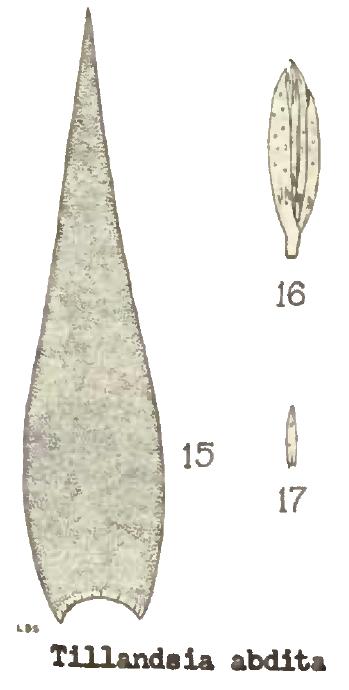
The air plant (Tillandsia ionantha) is a member of the Bromeliaceae family. This species has a rosette structure: its leaves are tightly clustered, and water applied during care reaches mainly the aboveground part of the plant.
Its natural range covers Mexico and Central America. This matters when growing it indoors: the plant needs light, air circulation, and a setup without a constantly wet growing medium.
This species is safe for cats and dogs. That does not mean it should be left for them to chew: physical damage to the leaf rosette can stop growth or damage the growing point.
How it differs from similar plants
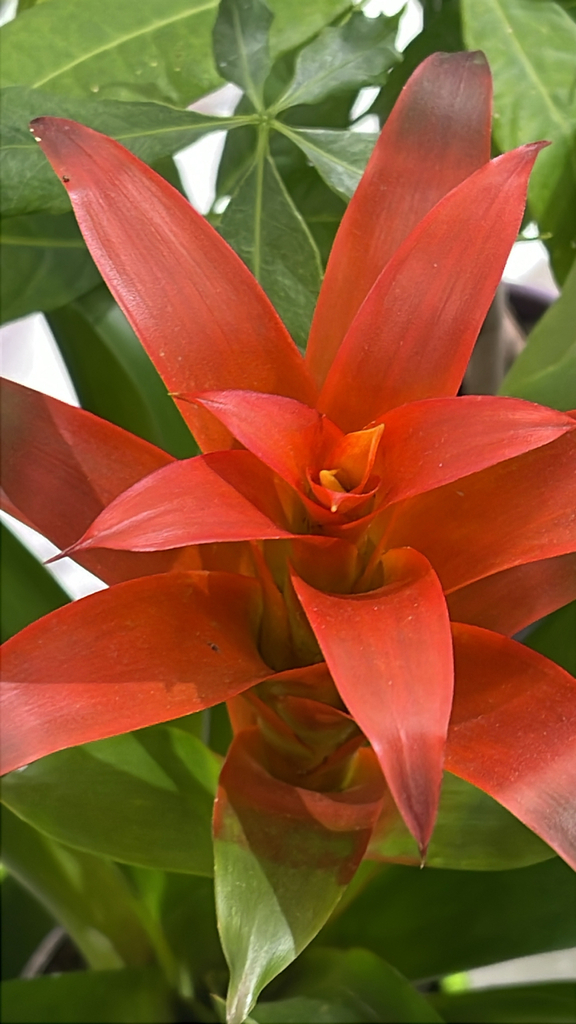 Scarlet star
Guzmania lingulata
Scarlet star
Guzmania lingulata- The air plant needs bright indirect light, while Guzmania is described simply as a plant for indirect light.
 Urn plant
Aechmea fasciata
Urn plant
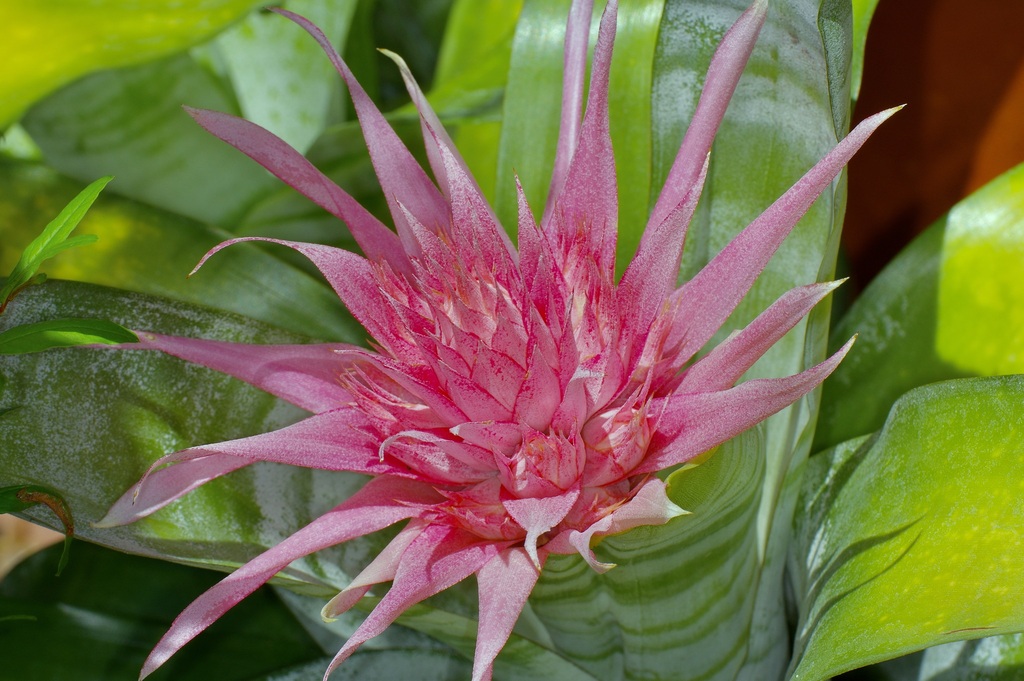
Aechmea fasciata- Aechmea is recognizable by the silvery bands across its firm leaf blades.
Frequently asked questions
- Does it need soil?
- No. Keep it in an open setup without regular soil so the base of the rosette does not stay wet.
- How do I water it?
- Water the leaves by misting the plant or immersing it in water, then always let it dry.
- Is it safe for cats and dogs?
- Yes, the plant is safe for cats and dogs. Chewing is still best avoided because it damages the rosette.
- Why are the leaf tips drying out?
- This is most often caused by dry air, inconsistent watering, or damage to the root area of the rosette.
- What should I do after flowering?
- After flowering, the rosette may gradually decline and produce offsets at its sides. This is its natural growth cycle.