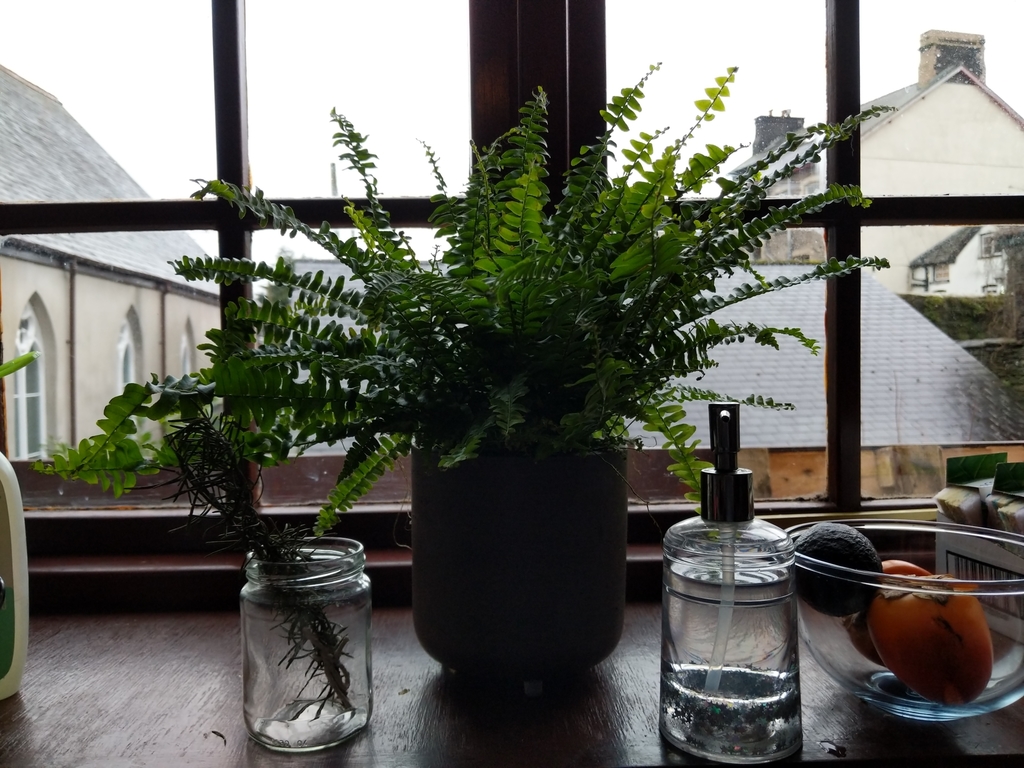
Krauss's spikemoss
Krauss's spikemoss (Selaginella kraussiana) is native to Africa and the Azores. It is a small lycophyte with creeping shoots. Indoors, its main requirement is the same as in its natural life cycle: steady moisture without drying out.


Shoot and leaf structure
The shoots creep or grow upward and branch dichotomously: each tip appears to split in two, and these repeated divisions form a dense green mat. Indoors, this structure defines the plant's appearance—it spreads horizontally rather than growing as a single upright stem.
The leaf blades are small and green, with a single vein and smooth or finely toothed edges. At the base of each leaf is a ligule—a tiny scale characteristic of Selaginella and an important part of its structure, though it is not always visible without magnification.
- creeping or ascending stems
- dichotomously branching shoots
- small leaf blades with a single vein
- a ligule at the base of each leaf
- branching roots associated with rhizophores
The roots also branch dichotomously and often develop at the ends of rhizophores. This structure makes the plant sensitive to rough loosening of the potting mix and abrupt disturbance of the root ball.
Origin and natural life cycle
The species is native to Africa and the Azores. For indoor growing, this is not simply background information but a guide to its care: the plant is not adapted to prolonged drying, and its life cycle depends on moisture.
The genus Selaginella contains 750 species and occurs in various parts of the world, mostly in the tropics. Some species are grown as greenhouse plants because their delicate foliage stays in better condition where humidity and other conditions are stable.
| In nature | Indoors |
|---|---|
| Shoots spread close to the surface | Looks better in a wide container |
| Spore reproduction depends on moisture | Drying out quickly damages the foliage |
| Roots and rhizophores anchor the plant in the substrate | Repot carefully without breaking up the root ball |
Indoor care therefore centers on maintaining a consistent environment rather than encouraging rapid growth. Sudden changes in humidity and light show up sooner on such a small plant than on species with large storage organs.
Names and classification
In everyday writing, the genus Selaginella is sometimes referred to by Ukrainian folk names meaning "little thread" and "little clubmoss," but no separate folk or trade name is established for Selaginella kraussiana; these terms describe the group, not this particular species. In a reference guide, it is more accurate to use the species name, Selaginella kraussiana.
The plant belongs to the family Selaginellaceae. It is neither a moss nor a fern in the strict sense, but a lycophyte that reproduces by spores and has distinctive leaf, stem, and spore-bearing structures.
Species within the genus have different shoot forms, from creeping to upright. In indoor cultivation, the most noticeable feature remains the fine branching that makes the plant look like a continuous green surface.
Light and placement
The small leaf blades easily lose their good looks if the air and potting mix dry out at the same time. Choose a spot without overheating or sudden blasts of dry air.
No support is needed: creeping and ascending shoots form its natural growth habit. Keep the plant where it can be watered carefully, without washing away the surface of the potting mix or breaking the fine branches.
- gentle, indirect light
- protection from overheating near glass
- no cold drafts
If the shoots become sparse, check the conditions around the plant before considering fertilizer. For Krauss's spikemoss, even moisture, stable conditions, and avoiding drying out are more often the deciding factors.
Watering and humidity
Fertilization in Selaginella takes place in a moist environment, and this biological trait helps explain its sensitivity to dryness. Indoors, keep the potting mix moist without letting it become a stagnant, soggy mass.
Water consistently: sudden drying affects the small leaves, while constantly standing water around the roots disrupts the fine root system. Water should flow through the potting mix rather than remain trapped in it.
- the root ball drying out completely
- standing water around the roots
- sudden changes in humidity
The potting mix needs to be light and moisture-retentive. Avoid compacting its surface during care, as the surface foliage and fine branches are easily damaged.
Propagation by spores
Selaginella produces microspores and megaspores on the same plant. Microspores develop into male gametophytes, and megaspores into female gametophytes; these gametophytes do not resemble the familiar flowers or seeds of houseplants.
The female gametophyte is multicellular, turns green, can photosynthesize, and produces rhizoids for attachment. After fertilization, an embryo forms with small leaves, a foot, a stem, and a root.
- microspores
- megaspores
- male gametophytes
- female gametophytes
- an embryo after fertilization
In indoor cultivation, the spore cycle is difficult to control because it depends on moisture and the plant's condition. For this reason, Krauss's spikemoss is more often regarded as a plant to maintain under stable conditions than as a species for quick propagation at home.
Common problems
Problems usually show up in the foliage: the small leaf blades respond quickly to drying out, overheating, or rough disturbance of the potting mix. A damaged patch does not always regain its appearance, so it is best not to let the plant wilt completely.
Assess yellowing, drying, and sparse shoots in the context of growing conditions rather than treating them as a single disease. Before applying treatments, check watering, compaction of the potting mix, airflow, and the stability of its location.
- leaf edges drying in dry conditions
- yellowing after water stagnates
- sparse shoots in an unsuitable spot
- damage after rough repotting
- loss of density after drying out
The plant is safe for cats and dogs, but that does not mean it should be placed where its shoots are constantly touched or pulled out of the potting mix. For a small creeping plant, physical damage is often more of a concern than toxicity.
- Watering
- even moisture
- Soil
- light, moisture-retentive
- Difficulty
- moderate
- Cats and dogs
- safe
- Leaves indoors
- small leaves
- Native range
- Africa and the Azores
Care
Krauss's spikemoss depends on consistency: it needs even moisture, gentle light, and careful handling of its delicate shoots. Drying out and rough disturbance of the root ball cause more harm than a lack of fertilizer.
- Light
- Provide gentle, indirect light. The small leaf blades stay in better condition without overheating or sudden blasts of dry air.
- Watering
- Keep the potting mix moist. Do not let the root ball dry out completely, but do not leave water standing around the roots either.
- Soil
- Use a light, moisture-retentive mix. The potting mix should hold moisture while allowing air to reach the fine root system.
- Feeding
- Feed minimally. Excess salts in the potting mix are undesirable for the small root system; feeding should not be the main focus of care.
- Support
- No support needed. The shoots creep or grow upward, so a support does not suit the plant's natural growth habit.
- Leaves
- Do not let it dry out. The delicate foliage quickly loses its good looks after drying out, overheating, or rough handling.
- Repotting
- Repot carefully. Keep the root ball intact when repotting to avoid damaging the fine roots, rhizophores, and surface shoots.
Botany
4 ill.- Family
- Selaginellaceae
- Genus
- Selaginella
- Species
- Selaginella kraussiana
- Author and year
- (Kunze) A.Braun


Krauss's spikemoss (Selaginella kraussiana) belongs to the family Selaginellaceae. It has small green leaf blades, dichotomously branching shoots, and roots that may develop at the ends of rhizophores.
The species is native to Africa and the Azores. There are 750 known species in the genus Selaginella, with the greatest diversity in the tropics.
Reproduction involves spores: microspores produce male gametophytes, and megaspores produce female gametophytes. Fertilization requires a moist environment, so steady moisture matters not only in its care but also in the plant's biology.
How it differs from similar plants
ZZ plant Zamioculcas zamiifolia
- Krauss's spikemoss has creeping shoots with small leaves, while the "stems" of Zamioculcas are compound leaves with larger leaflets measuring 7–15 cm.
Rex begonia Begonia rex
- Krauss's spikemoss has small leaves on creeping shoots, while begonia is recognizable by its large, asymmetrical leaves measuring 6–33 cm.
Snake plant Dracaena trifasciata
- Krauss's spikemoss is a creeping plant with small leaves, while Sansevieria forms a clump of long, stiff leaf blades.
Frequently asked questions
- Is Krauss's spikemoss safe for cats and dogs?
- Yes, the plant is safe for cats and dogs.
- Is Krauss's spikemoss a moss or a fern?
- Neither. It is a lycophyte, not a moss or a fern in the strict sense.
- Why are the shoots drying out?
- Most often because the potting mix has dried out, the air is dry, or the plant is overheating in an unsuitable spot.
- How should I water Krauss's spikemoss?
- The potting mix should stay evenly moist, without drying out completely or holding standing water.
- How does it reproduce?
- In its natural life cycle, it reproduces through microspores and megaspores; fertilization requires a moist environment.