Satin pothos
In the humid tropical biomes of Southeast Asia, this vine climbs tree trunks using aerial roots. Indoors, Scindapsus pictus retains the same climbing habit and matte, variegated foliage.

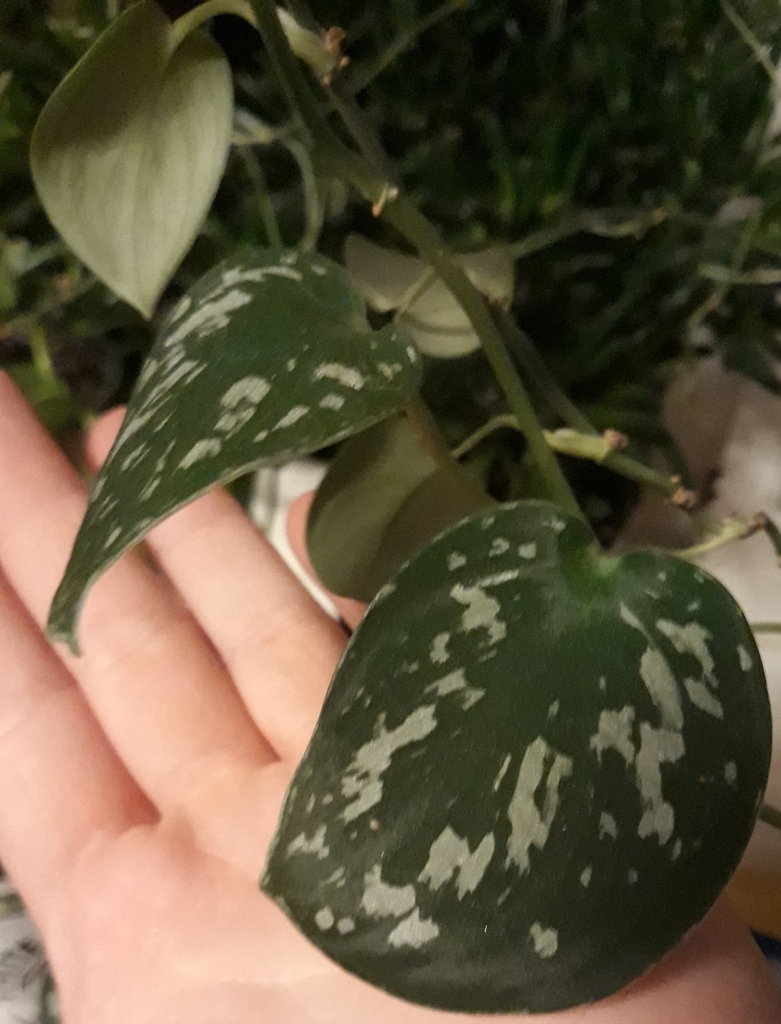

Growth habit and foliage
The stems grow as a vine and can climb to 3 m in the wild. Indoors, the plant usually stays more compact — around 90 cm.
The leaves are matte green and leathery, with silver spots. These markings are not damage: the variegation is part of the leaf's structure and is more visible in indirect light.
- matte green leaves
- silver spots of varying shapes
- aerial roots along the stems
Origin and natural habitat
It is native to Southeast Asia — from Bangladesh to Indonesia and the Philippines. There, the vine inhabits humid tropical biomes and grows among trees, using their trunks for support.
An epiphytic or semi-epiphytic growth habit does not mean the plant is parasitic. Its aerial roots anchor it and help it climb toward the light, rather than draw nutrients from the tree.
| In the wild | Indoors |
|---|---|
| humid tropical forest | indirect light without direct midday sun |
| tree trunks for support | a moss pole, trellis, or hanging pot |
| aerial roots along the stems | anchoring stems and making them easier to train |
Names and confusion in the plant trade
In the plant trade, it may be sold under a Ukrainian name meaning “painted scindapsus”: this reflects the specific epithet pictus — “painted.”
The genus Scindapsus is often confused with Epipremnum because both belong to Araceae and have a similar vining habit. This is not critical for care, but a reference guide should not group different genera under one name.
Light and placement
The foliage retains its coloring most consistently in bright indirect light. The plant tolerates partial shade, but its silver markings may become less distinct and its internodes longer.
Avoid direct midday sun: it causes dry, pale patches on the leaves. Near a south-facing window, move the pot back from the glass or shade it during the strongest sunlight.
- an east- or west-facing window
- a shaded spot near a south-facing window
- a hanging pot in bright partial shade
Watering and potting mix
Water moderately: between waterings, the potting mix should dry out to roughly a third of the pot's depth. Roots that stay wet quickly develop rot, especially in a cool room.
The potting mix should be loose and slightly acidic, without compacting after watering. Leaf mold, lowland peat, well-rotted manure, and river sand are suitable ingredients; the main requirement is that water does not sit around the roots.
- water after a third of the potting mix has dried out
- empty excess water from the saucer
- keep the mix loose so water does not stagnate
Pruning and propagation
Stems can lengthen considerably over a season, so shape the plant by pruning or pinching. You do not need to discard the pruned sections: they can be used as cuttings.
For vegetative propagation, take a stem cutting with 2-3 nodes and root it in water or moist potting mix. A node must be in contact with moisture, since this is where new roots form.
- tip cuttings
- stem sections
- layering
Leaf problems
Yellowing is often linked to overwatering or a cold draft. If a leaf loses its variegation, the cause is usually insufficient light rather than a lack of fertilizer.
Dry leaf edges are more common near heaters or after a sudden change in conditions. Wipe dust off the leaves: this makes it easier to spot pests early.
- aphids
- thrips
- spider mites
- mealybugs
- scale insects
Flowering and dormancy
As a member of Araceae, the plant produces a spadix with a spathe. Flowering is rare indoors, so its ornamental value is judged mainly by the condition of its leaves and stems.
Growth usually slows in winter, especially with lower temperatures and shorter days. Reduce watering and feed less often during this period to avoid encouraging weak, elongated stems.
| Period | Conditions |
|---|---|
| spring-summer | +20…+25 °C and active growth |
| winter | +15…+18 °C and more cautious watering |
| short days | less feeding and no overwatering |
- Light
- indirect light, partial shade
- Temperature
- +20…+25 °C
- Watering
- when the potting mix is a third dry
- Soil
- loose, slightly acidic potting mix
- Difficulty
- easy
- Cats and dogs
- mildly toxic
- Size indoors
- up to 90 cm
- Native range
- Southeast Asia — from Bangladesh to Indonesia and the Philippines
Care
This vine comes from humid tropical forests, so it needs warmth, indirect light, and an airy potting mix. It is particularly sensitive to water sitting around its roots and cold drafts.
- Light
- Provide indirect light or partial shade. Direct midday sun can scorch the leaves; in shade, the silver markings become less distinct.
- Temperature
- Keep at +20…+25 °C during the growing season. In winter, keep it around +15…+18 °C and protect it from cold drafts.
- Watering
- Water when the potting mix is a third dry. Water once roughly a third of the potting mix has dried out; standing water encourages root rot.
- Soil
- Use a loose, slightly acidic potting mix. A mix of leaf mold, peat, well-rotted manure, and sand works well, provided it does not compact.
- Feeding
- Feed every 15-20 days. Apply a compound fertilizer at a reduced dose during the growing season; feed less often in winter.
- Support
- Provide a support or use a hanging pot. Train the stems along a trellis or moss pole, or let them trail down.
- Leaves
- Wipe dust off the leaves. Wiping with a damp cloth keeps the leaves clean and helps you spot pests early.
- Repotting
- Repot young plants annually. Repot mature plants less often, roughly every 2-3 years or when the roots become crowded.
Botany
- Family
- Araceae
- Genus
- Scindapsus
- Species
- Scindapsus pictus
- Author and year
- Hassk.
Scindapsus pictus belongs to the family Araceae and grows as a vine with aerial roots. In the wild, its stems climb trees; indoors, the same mechanism allows it to be trained along a support.
The silver spots on the matte green leaves are part of the species' natural variegation. In low light, new leaves may have less contrast as the plant develops more green tissue for photosynthesis.
The sap is mildly toxic to cats and dogs: insoluble oxalic acid raphides irritate mucous membranes when the plant is chewed. Contact with the sap can also cause localized skin irritation in people.
Frequently asked questions
- How often should I water it?
- Water once the potting mix has dried out to roughly a third of the pot's depth. More frequent watering increases the risk of rot.
- Why are the leaves losing their silver markings?
- Most often, this is due to insufficient light. Moving it into brighter indirect light helps new leaves develop more contrast.
- Can I keep it at home if I have a cat?
- The plant is mildly toxic to cats and dogs: its sap irritates mucous membranes when chewed. Keep the pot out of pets' reach.
- Why are the leaves turning yellow?
- Overwatering or a cold draft is often the cause. Check the moisture level of the potting mix and the temperature near the pot.
- How do I propagate it?
- Cuttings with 2-3 nodes are most commonly used. Root them in water or a moist, loose potting mix.


