Golden pothos
Shade does not make variegated leaves look more subdued—it gradually erases the yellow pattern. Golden pothos (Epipremnum aureum) tolerates partial shade but needs bright indirect light to maintain its variegation.


Climbing stems and aerial roots
Golden pothos is a perennial evergreen herbaceous climber in the Araceae family. In the wild, its stems climb trees or other supports using aerial roots, so the plant cannot stay upright without support.
In its natural habitat, the stems can reach about 20 m, and mature stems have been described as up to 4 cm thick. Indoors, growth is usually controlled by pruning, which keeps the plant in its juvenile form with smaller leaf blades for longer.
- heart-shaped leaf blades on petioles
- aerial roots at stem nodes
- ability to attach to a support
- undivided leaves on young plants
- divided leaf blades on older specimens
Young plants usually have leaf blades smaller than 20 cm, while mature plants in the wild can have leaves up to 100 cm long and 45 cm wide. This transition depends not only on age but also on the ability to climb a sturdy support.
Origin and natural habitat
The species is native to Moorea island in French Polynesia. Sources also mention the Society Islands and the wet tropical biome, where the vine uses trunks and branches for support.
| In the wild | Indoors |
|---|---|
| grows in a wet tropical biome | needs consistent warmth without cold drafts |
| climbs trees or supports | can trail from a planter or climb a support |
| mature leaves become much larger | pruning keeps the leaves juvenile |
Aerial roots do not make the plant a parasite: they help it attach and make use of the moist environment around its support. Indoors, a moss pole, trellis, or another sturdy structure partly serves this role.
Light and variegation
Green-leaved forms tolerate partial shade, but variegated cultivars retain their pattern better in bright indirect light. In deep shade, yellow or cream areas become less noticeable as the plant produces more green tissue.
Avoid direct sun for all forms: it can damage the leaf blades, especially when the plant is close to the glass. The most reliable spot is a bright windowsill without midday sun or a space near a window.
- fading variegation
- longer internodes
- smaller new leaves
If the plant has spent a long time in shade, do not move it straight into intense light. The new spot should be brighter, but the leaves should not overheat in direct sun.
Watering and potting mix
Water moderately: the potting mix should dry slightly below the surface rather than stay constantly wet. Excess water combined with low temperatures is especially dangerous—the roots can easily rot in these conditions.
Use a light, nutrient-rich, well-drained potting mix. Sources on indoor growing mention a mix based on peat, well-rotted manure, leaf mold, and sand, along with an essential drainage hole in the pot.
- allowing the top layer of potting mix to dry
- leaving no water in the saucer after watering
- using soft water that has been left to stand
- reducing watering during cooler periods
- keeping the drainage hole clear
Droplets sometimes appear on the leaves after overwatering. This is not a reason to water more often: if the potting mix is wet, the plant needs a break, not more water.
Pruning, support, and repotting
Without support, the stems hang down and the plant grows as a trailing plant. For upright growth, install a support when planting or repotting so the aerial roots have something to grip.
Pruning helps control stem length and maintain the juvenile form for longer. The pruned tips can be used for vegetative propagation if each cutting has a node.
- removing overly long stems
- shortening bare stems
- securing stems to a support
- repotting young plants in spring
- repotting mature plants every 2-3 years
Young plants need repotting more often because their roots fill the pot faster. Mature specimens usually need repotting only every 2-3 years, provided the potting mix has not compacted and the roots have not filled the entire pot.
Propagation and flowering
Indoors, the species is propagated vegetatively using tip cuttings, layering, or stems cut into sections. The main requirement for a cutting is a node from which roots can develop.
Flowering is rare indoors, so the plant is grown mainly for its foliage. As an aroid, it produces an inflorescence with a spathe; the spathe is reported to reach up to 23 cm in this species.
- tip cuttings
- stem sections with a node
- layering
After rooting, young plants develop faster in warm conditions with indirect light. Excessively wet potting mix is just as undesirable at this stage as it is for a mature plant.
Why leaves turn yellow
Yellowing leaves are most often linked to growing conditions rather than the plant's age itself. If the lower leaves turn yellow after overwatering, first check the potting mix and the condition of the roots.
Brown spots can appear when the plant gets too cold, especially if temperatures fall below +15 °C. A cold windowsill and wet potting mix are a poor combination for this warmth-loving climber.
- constantly wet potting mix
- cold drafts
- insufficient light for variegated forms
- drying out after a long interval between waterings
- spider mites, thrips, or scale insects
Pests are often first noticed through tiny pale spots, sticky residue, or fine webbing on the stems. If these appear, isolate the plant and inspect the undersides of the leaves and the nodes.
- Light
- indirect light, partial shade
- Temperature
- +20…+25 °C
- Watering
- moderate
- Soil
- light, well-drained
- Difficulty
- easy
- Cats and dogs
- toxic
- Size indoors
- 100-200 cm
- Leaves indoors
- 10-15 cm
- Native range
- French Polynesia, Moorea island
Care
Golden pothos tolerates partial shade and moderate intervals between waterings but reacts poorly to cold, wet potting mix. Variegated forms retain their color better in bright indirect light.
- Light
- Provide bright indirect light or partial shade. Variegated forms need more light; otherwise, the yellow pattern fades. Avoid direct sun.
- Temperature
- Keep at +20…+25 °C. Keep warm during the growing season. In winter, avoid temperatures below +15 °C, as brown spots may develop on the leaves.
- Watering
- Water when the top of the potting mix has dried. Water moderately with soft water that has been left to stand. Reduce watering during cooler periods so the roots do not sit in wet potting mix.
- Soil
- Use a light, well-drained potting mix. Use a loose, nutrient-rich potting mix and a pot with a drainage hole. Water pooling around the roots is dangerous.
- Feeding
- Feed April-September, 2 times/month. During active growth, use a liquid mineral fertilizer for climbing plants. During dormancy, feed no more than 1 time per month.
- Support
- Provide a support or use a hanging planter. The stems can trail or climb. For upright growth, provide a support that the aerial roots can grip.
- Leaves
- Prune to maintain the juvenile form. Regularly shortening the stems limits growth and helps keep the leaf blades smaller.
- Repotting
- Repot young plants yearly, mature plants less often. Repot young plants in spring. Repot mature plants every 2-3 years or when the potting mix has compacted and the roots have filled the pot.
Botany
4 ill.- Family
- Araceae
- Genus
- Epipremnum
- Species
- Epipremnum aureum
- Author and year
- (Linden & André) G.S.Bunting

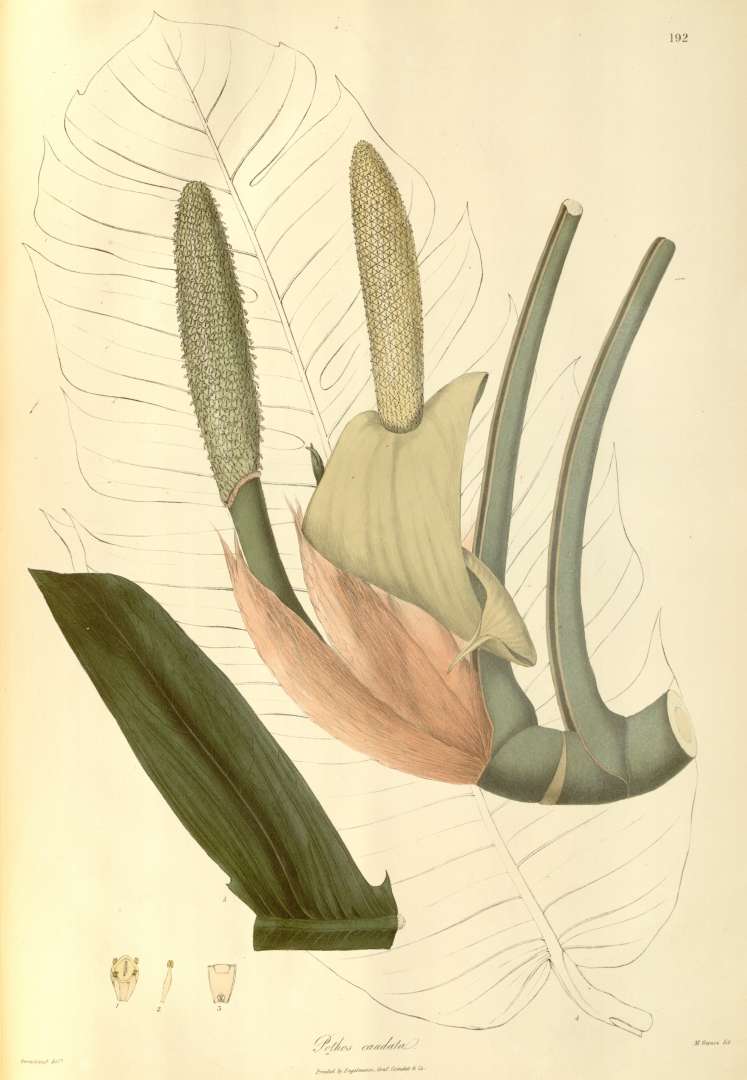


Golden pothos (Epipremnum aureum) belongs to the Araceae family. It is an evergreen herbaceous climber with alternate leaves on petioles and aerial roots that help its stems attach to supports.
The species is native to Moorea island in French Polynesia. In the wild, it grows in a wet tropical biome and can climb trees, developing much larger leaf blades than those usually seen indoors.
In older plants, the leaf blades may become unevenly divided, while young leaves remain undivided and heart-shaped. Indoors, this mature appearance often does not develop because the stems are regularly pruned or grown without a tall support.
How it differs from similar plants
ZZ plant Zamioculcas zamiifolia
- Golden pothos is recognizable by the yellow variegation on its leaves, while what look like stems on zamioculcas are actually compound leaves.
Peace lily Spathiphyllum wallisii
- Yellow leaf variegation distinguishes golden pothos from spathiphyllum, which has a white spathe beside the spadix and a basal clump of leaves with no visible stem.
Anthurium Anthurium andraeanum
- Golden pothos tolerates partial shade, though it loses its yellow pattern there, while anthurium needs bright indirect light.
Frequently asked questions
- Can I keep it in shade?
- Yes, but in deep shade the variegation fades, and new leaves may be smaller.
- Why are the leaves turning yellow?
- Most often because of overwatering, a cold draft, or insufficient light. Check the potting mix and roots first.
- Is it safe for cats and dogs?
- The plant is toxic to cats and dogs. Place the pot where pets cannot chew the leaves and stems.
- How do I propagate it from cuttings?
- Use tip cuttings or stem sections with a node. New roots develop from the node.
- How often should I repot it?
- Repot young plants yearly and mature plants every 2-3 years or once the roots have filled the pot.


