Mini monstera
Native to southern Thailand and the Malay Peninsula, mini monstera (Rhaphidophora tetrasperma) is an aroid vine: it climbs upward, needs support, and grows best in bright indirect light without water pooling around its roots.

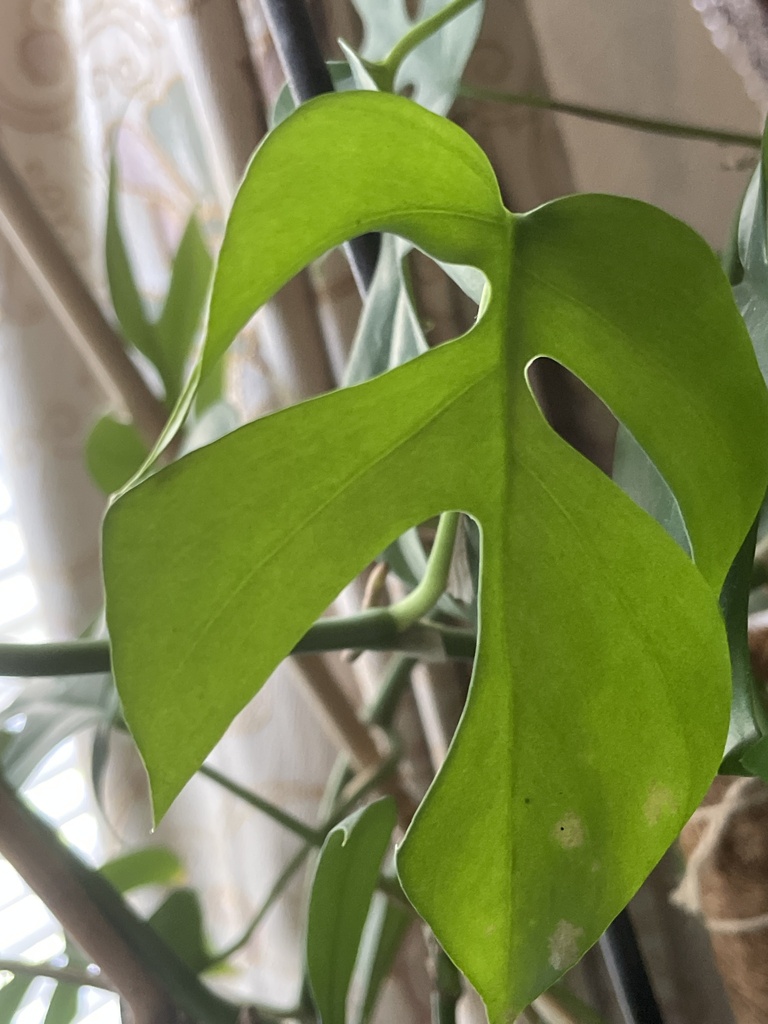

Structure and growth
Mini monstera (Rhaphidophora tetrasperma) belongs to the family Araceae and the genus Rhaphidophora. Indoors, it is grown as a climbing vine: train its stems along a support, or they will trail or flop sideways.
The leaves become split as they mature, which is why the plant is often confused with monstera, philodendron, or epipremnum. It is not a miniature form of Monstera deliciosa but a separate aroid species.
- split leaves
- climbing stems
- need for support
- membership in the aroid family
- resemblance to several genera
These features explain why names on plant labels sometimes vary. What matters for care is not the comparison used to sell it, but the fact that it is a vine whose roots are sensitive to waterlogging.
Origin and names
The species is native to southern Thailand and the Malay Peninsula. For indoor growing, this points to the basics of its care: warmth, indirect light, and moist but not waterlogged potting mix.
The trade name “monstera minima” arose because its split leaves resemble those of a monstera. The name does not reflect its botanical identity: the plant belongs to a different genus.
Light and placement
The plant grows best in bright indirect light. It tolerates partial shade, but in low light growth slows and new leaves may be less distinctly split.
Avoid direct sun during the hottest hours, as it can scorch the leaves. Near a south- or east-facing window, the light needs to be filtered, especially in summer.
- bright indirect light
- protection from midday sun
- distance from cold window glass
- support for the stems
- a draft-free spot
If a stem stretches and the internodes become longer, the plant usually needs more light. Move it gradually so the leaves are not exposed to a sudden change in conditions.
Watering and potting mix
Water to keep the potting mix moderately moist, without leaving water in the saucer. In summer, wait for the top layer to dry; in winter, let the mix dry to a depth of 2-3 cm.
Waterlogging is more dangerous than briefly allowing the top layer to dry. If the roots remain constantly wet, the risk of rot and loss of leaf firmness increases.
- light, well-draining potting mix
- a drainage layer at the bottom of the pot
- perlite or sand in the mix
- no standing water in the saucer
- soft, warm water for watering
A loose mix of garden soil, peat, and perlite or sand is suitable for planting. The key is for water to drain through the mix rather than collect around the roots.
Temperature and feeding
During active growth, the preferred range is +18…+24 °C. In winter, avoid temperatures below +10 °C, especially in combination with drafts.
| Season or stage | Conditions |
|---|---|
| Spring-summer | +18…+24 °C and regular watering |
| Winter | No lower than +10 °C; water less often |
| Active growth | Feed once a month |
Feed during the growing season, usually with a compound fertilizer for foliage plants. Reduce or stop feeding in winter to avoid encouraging weak growth when light is limited.
Leaf and root problems
Yellowing leaves are often linked to watering mistakes or a sudden change in conditions. If the potting mix stays wet for a long time, the roots suffer first, followed by leaves that lose firmness and develop spots.
Dry leaf edges and a stressed appearance can worsen in dry air. A tray of damp expanded clay pebbles or a humidifier helps keep conditions stable but does not replace correct watering.
- leaf scorch from direct sun
- root rot from waterlogging
- loss of leaf firmness from cold
- growth stopping in cold conditions
- spider mites in dry air
Cut off damaged or dried-out leaves with a clean tool. If the problem recurs, check several conditions at once: light, the state of the potting mix, temperature, and the presence of pests.
Propagation and repotting
Propagate the plant vegetatively with a cutting that includes a node. The node is needed to produce new roots and a shoot; a piece of leaf without a node will not develop into a complete plant.
Repot young plants every 1-2 years, when the roots become crowded or the potting mix loses its structure. Repot mature plants as needed, without making too large a jump in pot size.
- a cutting with a node
- a clean cut
- loose potting mix
- moderate moisture
- support after rooting
Do not overwater after repotting: the roots need an airy growing medium. The first signs of a normal recovery are new growth and leaves that remain firm.
- Light
- bright indirect light
- Temperature
- +18…+24 °C
- Watering
- moderate
- Soil
- light, well-draining
- Difficulty
- moderate
- Cats and dogs
- mildly toxic
- Native range
- southern Thailand and the Malay Peninsula
Care
This aroid vine grows best in a bright, warm spot with support. The most common problems come not from brief dry spells but from waterlogging and chilled roots.
- Light
- Provide bright indirect light. It tolerates partial shade but grows better near a bright window out of direct midday sun.
- Temperature
- Keep at +18…+24 °C. This is the range for the growing season. In winter, avoid temperatures below +10 °C and drafts.
- Watering
- Water when the top layer dries. Keep the potting mix slightly moist in summer; in winter, let the top 2-3 cm dry out. Empty any water from the saucer.
- Soil
- Use a light, well-draining mix. A loose mix of garden soil, peat, and perlite or sand is suitable, with a drainage layer essential.
- Feeding
- Feed once a month during growth. Apply a compound fertilizer from spring to early fall. Reduce or stop feeding in winter.
- Support
- Provide support. Train the stems up a moss pole, trellis, or other vertical support to keep the vine more compact.
- Leaves
- Inspect and remove damaged leaves. Cut off damaged leaves and check the plant regularly for spider mites and aphids.
- Repotting
- Repot young plants every 1-2 years. Repot mature plants as needed, when the roots are crowded or the potting mix has become compacted.
Botany
- Family
- Araceae
- Genus
- Rhaphidophora
- Species
- Rhaphidophora tetrasperma
- Author and year
- Hook.f.
Mini monstera is a member of Araceae, a family characterized by flowers borne on a spadix surrounded by a spathe. Indoors, it is valued not for its flowers but for the form of its stems and its split leaves.
The species comes from southern Thailand and the Malay Peninsula. As a vine, it shows its form best on a vertical support, where the leaf stalks and blades receive more even light.
Confusion with monsteras, philodendrons, and epipremnums arose from the similar appearance of their mature leaves. Taxonomically, it belongs to a different genus, so the correct name matters not just for the label but also for an accurate description of the plant.
Frequently asked questions
- Can I keep it at home if I have a cat?
- Yes, but the plant is mildly toxic to cats and dogs. Aroid sap can irritate mucous membranes, so keep the pot out of pets’ reach.
- Why are the leaves turning yellow?
- The most common causes are overwatering, cold, or a sudden change in light. First check the moisture level of the potting mix and the temperature near the pot.
- How often should I water it?
- During the growing season, water when the top layer dries. In winter, let the top 2-3 cm of potting mix dry out.
- What light does it need?
- It needs bright indirect light. Direct sun during the hottest hours can scorch the leaves.
- How do I propagate it from a cutting?
- Use a cutting with a node. The node is essential because new roots and a shoot develop from it.


