Monstera
In the humid tropical forests of southern Mexico and Central America, monstera (Monstera deliciosa) grows as an epiphytic vine: it clings to supports, climbs upward, and develops large, split leaves as it matures.


Structure of the vine
In the wild, this is an epiphytic vine with a soft, herbaceous stem. The stem can be 6-7.5 cm thick and climb up a support; branching becomes more frequent as it ages.
The leaf blades are oval to heart-shaped and borne on long, slender petioles. In mature plants, openings called fenestrations extend outward from the middle of the blade; in young leaves, they may be less pronounced or absent.
- leathery, smooth leaf blade
- long, slender petiole
- aerial roots along the stem
- splits extending from the middle of the leaf blade
- ability to climb up a support
Origin and growth habit
The species is native to southern Mexico and Central America. There, the vine evolved as a plant of humid tropical forests, where tree trunks provide support for its shoots.
An epiphytic growth habit does not mean the plant is parasitic: it uses its support to climb, not as a source of nutrients. Without support, a shoot may temporarily trail along the ground, but its natural direction of growth is upward.
| In the wild | Indoors |
|---|---|
| the vine can reach 9-10 m | usually limited to about 3 m |
| mature leaf blades up to 1.5 m | leaf blades up to 40-60 cm |
| support: tropical forest trees | support: a post, trellis, or moss pole |
Light and placement
Normal growth requires bright indirect light or light shade. Direct sun can damage the leaves, while insufficient light often produces smaller new leaves without distinct fenestrations.
Because of its climbing habit, the plant takes up vertical space as well as the footprint of its pot. When choosing a spot, account for the future support and the size of mature leaves.
- bright indirect light
- protection from direct midday sun
- space for support and aerial roots
Watering and potting mix
Watering works best on the principle of watering thoroughly and letting the top layer dry out. During active growth, dryness to a depth of 3-5 cm can serve as a guide, but the drying rate depends on light, temperature, and pot size.
Constantly wet roots are a common cause of yellowing, dark spots, and stem rot. In winter, when growth slows, the interval between waterings is usually increased to 10-14 days.
Support, feeding, and repotting
The vine needs support because of its growth habit, not for decoration. Tie the stem to a ladder trellis, artificial trunk, or moss-filled pole; this makes it easier for the plant to support its heavy leaves.
Feeding is appropriate during the active growing season, when new leaves appear. Plant care sources recommend a compound mineral fertilizer for foliage plants twice a month from March to August; feeding is not needed at other times of year.
| Plant age | Repotting |
|---|---|
| young plants | annually |
| four-year-old plants | every 2-3 years |
| old, large plants | every 5 years, with the top 5 cm of potting mix replaced annually |
Yellowing, spots, and pests
Yellow leaves are most often linked to watering or depleted old potting mix. Brown, wet spots and a darkening stem are more serious: they may indicate rot after prolonged waterlogging.
- waterlogged potting mix
- prolonged lack of light
- a pot that is too small
- infestation by scale insects, thrips, mealybugs, or spider mites
- delayed repotting of large specimens
If you suspect pests, inspect the undersides of the leaves, the petioles, and the points where aerial roots emerge. These are the places where scale insects, mealybugs, or spider mites are most often visible.
Flowers, fruit, and safety
Indoors, the plant usually does not flower and therefore does not produce fruit. In tropical climates, the species can bear fruit, described as a large berry 20-30 cm long and 5-9 cm wide.
Unripe fruit contains high levels of calcium oxalate, which causes a burning sensation in the mouth. The plant is mildly toxic to cats and dogs: chewing its parts can irritate mucous membranes, so it is best to limit pets' access.
- mild toxicity to cats and dogs
- irritation of mucous membranes caused by calcium oxalates
- no biological basis for beliefs that the plant is an "energy vampire"
- Light
- bright indirect light
- Temperature
- room temperature in summer
- Watering
- when the top 3-5 cm is dry
- Soil
- free-draining
- Difficulty
- moderate
- Cats and dogs
- mildly toxic
- Size indoors
- up to 3 m indoors
- Leaves indoors
- 40-60 cm indoors
- Native range
- southern Mexico and Central America
Care
This is a large epiphytic vine that needs light, space, and support. The greatest risk indoors is the combination of low light and constantly wet potting mix.
- Light
- Provide bright indirect light. Direct sun can scorch the leaves, while shade produces smaller new leaves that stay unsplit for longer.
- Temperature
- Keep at room temperature in summer. Cooler conditions of +12…+14 °C are acceptable in winter; this is a winter regime, not a range for active growth.
- Watering
- Water when the top 3-5 cm is dry. Water thoroughly, but do not let water collect around the roots; in winter, the interval usually increases to 10-14 days.
- Soil
- Use a free-draining potting mix. The potting mix must allow water and air to pass through. Constantly wet roots increase the risk of stem rot.
- Feeding
- Feed from March to August. During the growing season, apply a compound mineral fertilizer for foliage plants twice a month.
- Support
- Provide sturdy support. Tie the stem to a ladder trellis, moss pole, or artificial trunk so the vine can grow upward.
- Leaves
- Clean with a damp sponge. The large, smooth leaves collect dust; regular wiping also helps you inspect them for pests.
- Repotting
- Repot young plants annually. Repot four-year-old plants every 2-3 years and old plants every 5 years; replace the top 5 cm of potting mix annually.
Botany
4 ill.- Family
- Araceae
- Genus
- Monstera
- Species
- Monstera deliciosa
- Author and year
- Liebm.
- Life form
- epiphytic vine


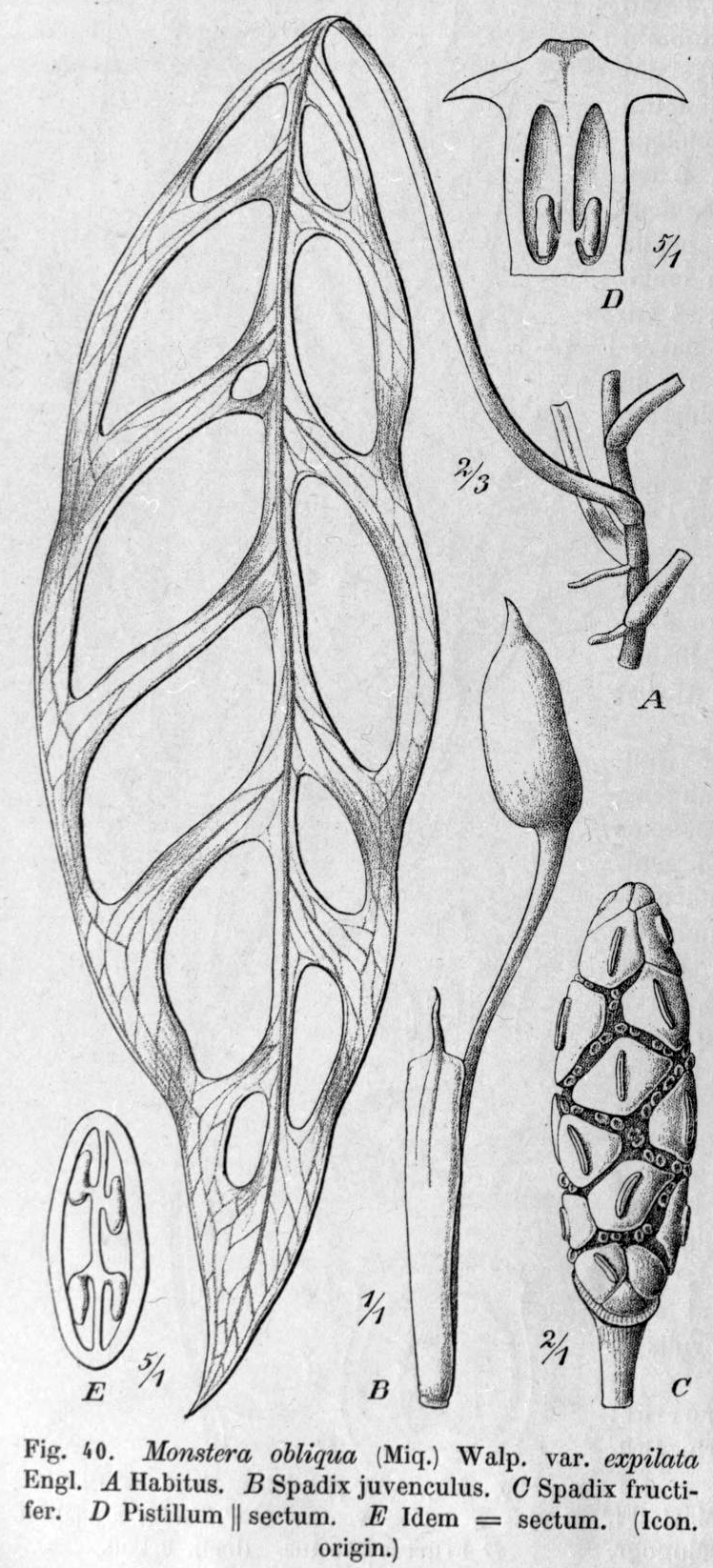

Monstera (Monstera deliciosa) is an epiphytic vine in the family Araceae. It climbs up supports, produces aerial roots, and develops increasingly large leaves with characteristic splits as it matures.
The species is native to southern Mexico and Central America. In the wild, the stem can reach 9-10 m, while indoors the plant is usually limited to about 3 m.
Fruit usually does not develop indoors. Unripe berries contain calcium oxalate, which can cause burning and irritation of mucous membranes.
How it differs from similar plants
ZZ plant Zamioculcas zamiifolia
- Monstera is recognizable by its large, split leaf blades measuring 40–60 cm, while zamioculcas has a compound leaf that is much smaller at 7–15 cm.
Peace lily Spathiphyllum wallisii
- Monstera grows as a vine and clings to a support, while spathiphyllum forms a clump of basal leaves without a visible stem.
Frequently asked questions
- Can I keep it at home if I have a cat or dog?
- Yes, but the plant is mildly toxic to cats and dogs. Chewing the leaves or stem can irritate mucous membranes because of the calcium oxalates.
- Why are the leaves turning yellow?
- The most common cause is overwatering or water collecting around the roots. Yellowing can also occur with depleted potting mix or insufficient light.
- Why are there no splits in the leaves?
- Young leaves often emerge without splits. Distinct splits usually develop in more mature leaves with sufficient indirect light and normal growth.
- How often should I repot it?
- Repot young plants annually. Repot four-year-old plants every 2-3 years and old, large plants every 5 years, replacing the top 5 cm of potting mix annually.
- Does it flower indoors?
- Indoors, the plant usually does not flower or produce fruit. Fruiting is typical of plants in tropical climates.


