Pin-stripe calathea
It is often placed in deep shade, on the assumption that this recreates “tropical” conditions. Pin-stripe calathea (Goeppertia ornata) does not tolerate direct sun, but without bright indirect light, its stripes fade and growth weakens.


Leaves and their movement
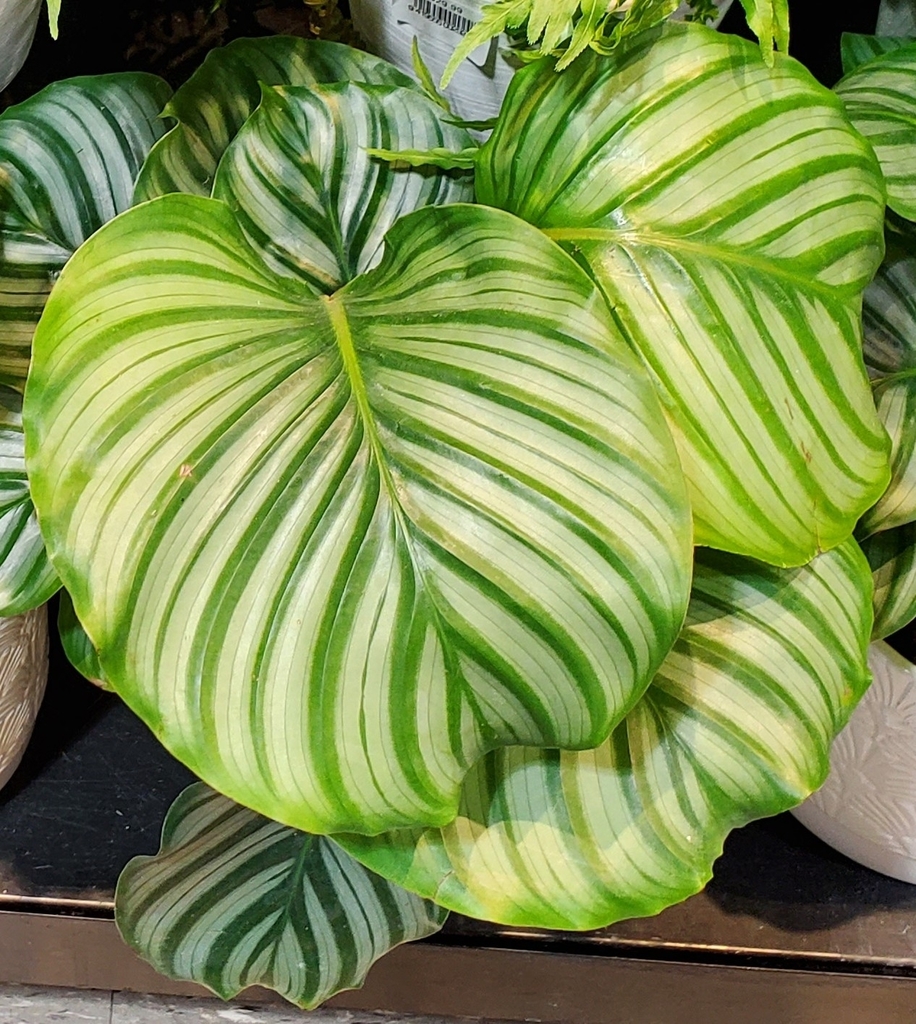
The species is distinguished by mature dark green leaves with fine, pale pink-white stripes on the upper surface. The undersides have a purple hue, so the plant's appearance changes with the angle of the light and the position of its leaves.
Mature leaves can reach up to 60 cm in length. Young leaves are broader, oval, smooth, glossy, and bright green; the characteristic contrast becomes more pronounced with age.
- dark green upper surfaces with fine stripes
- a purple hue on the undersides
- leaves folding at night
As with other Goeppertia species, the leaves respond to changes in light and temperature: they rise or fold at night and open again at dawn. This is a normal daily response, not a sign of disease.
Origin and name
Its native range is southeastern Colombia and southwestern Venezuela. The species grows mainly in a humid tropical biome, where light filters through the forest canopy rather than reaching the leaves as direct sunlight.
It is still sold under the name Calathea ornata: this is an older botanical combination that has remained in use as a trade name since the species was moved to the genus Goeppertia.
The specific epithet ornata comes from Latin and means “adorned” or “decorated.” The name refers to the leaf pattern, not the flowers: indoors, the plant is grown primarily for its foliage.
Light and placement
The plant needs bright indirect light or partial shade. Direct sun dries out the leaves, causing dry patches and reducing the contrast of the stripes. This happens especially quickly in dry air.
- bright indirect light
- partial shade without deep shade
- protection from direct sun
In a spot that is too dark, the plant will not necessarily die quickly, but its appearance suffers: the stripes may look less distinct, and growth slows. Major changes in placement are best made gradually so the leaves have time to adjust to the new light level.
Watering, humidity, and potting mix
The potting mix should be moist but not waterlogged. Too little water causes the leaves to curl, while standing water around the roots creates conditions for rot.
| Parameter | What to maintain |
|---|---|
| Watering | when the top layer dries out |
| Humidity | around 60 % |
| Potting mix | peat-based mix with perlite or vermiculite |
Use soft water that is not cold—water left to stand, rainwater, or distilled water. A peat-based mix with perlite or vermiculite retains some moisture while allowing excess water to drain away.
Why leaves become damaged
The leaves are the first to show care problems. Dry edges, curling, or loss of contrast are more often related to water, humidity, cold, or light than to infections.
- curling—lack of moisture
- dry edges—dry air or a cold draft
- dry patches—too much direct sun
- yellowing—possible spider mites
- fading—insufficient light
If the problem appeared after a change in location, watering, or temperature, start by correcting the conditions. Damaged edges will not turn green again, but new leaves should develop more evenly with consistent care.
Repotting and rhizome division
Repot every 2-3 years or when the roots become crowded and the potting mix becomes compacted in the pot. This is also a convenient time for vegetative propagation by dividing the rhizome.
- remove the plant from its pot
- divide the root ball into sections with roots and leaves
- plant the sections at the same depth
- water after planting
- place in a warm spot with indirect light
Avoid dividing the plant into very small sections: a weak division takes longer to recover after repotting. Afterward, keep the potting mix consistently moist and maintain humidity, with no cold drafts.
Flowering and pests
The species produces small white flowers in spike-like clusters. Indoors, flowering is not the main indicator of good health: the leaves respond much more noticeably to growing conditions.
- spider mites
- thrips
- mealybugs
- whiteflies
- scale insects
Pests are easier to spot on the undersides of the leaves and where the leaf stalks emerge from the rosette. Regular inspection is useful after a spell of dry air or when sticky, pale, or cotton-like traces appear.
- Light
- bright indirect light, partial shade
- Temperature
- +18…+24 °C
- Watering
- when the surface dries out
- Soil
- well-drained peat-based mix
- Difficulty
- moderate
- Cats and dogs
- safe
- Size indoors
- 60-90 cm
- Leaves indoors
- up to 60 cm
- Native range
- southeastern Colombia and southwestern Venezuela
Care
This species comes from a humid tropical biome, so consistent humidity, warm air, and protection from direct sun are the priorities indoors. Its leaves respond quickly to drying out, cold drafts, and waterlogged conditions.
- Light
- Provide bright indirect light. Bright indirect light or partial shade suits this plant. Direct sun can dry out the leaves and impair their color.
- Temperature
- Keep at +18…+24 °C. This is the range for active growth. Cold drafts can cause dry edges and curling leaves.
- Watering
- Water when the surface dries out. Keep the potting mix moderately moist, but not wet. Soft water left to stand, rainwater, or distilled water is best for watering.
- Soil
- Use a light, well-drained mix. A peat-based mix with perlite or vermiculite works well: it retains moisture while allowing excess water to drain.
- Feeding
- Feed once a month. Apply a compound fertilizer during the growing period. Do not apply fertilizer to dry potting mix.
- Leaves
- Keep humidity around 60 %. Leaf edges dry out in dry air. Dust can be wiped from the leaves with a damp cloth.
- Repotting
- Repot every 2-3 years. Repot when the roots become crowded or the potting mix becomes compacted, dividing the rhizome at the same time if the plant has grown large.
- Support
- No support needed. Its upright, bushy habit means support is usually unnecessary. A stable pot and consistent watering are more important.
Botany
- Family
- Marantaceae
- Genus
- Goeppertia
- Species
- Goeppertia ornata
- Author and year
- (Linden) Borchs. & S.Suárez
Pin-stripe calathea belongs to the family Marantaceae and is classified in the genus Goeppertia under current taxonomy. The plant forms an upright, bushy rosette with large leaves on stalks.
Its appeal comes from the contrast between the upper and lower leaf surfaces. Fine, pale pink-white stripes against a dark green background gave the species its name, which means “decorated.”
Daily leaf movement is characteristic of many members of Marantaceae. The leaves change position in response to light and temperature, so their rising in the evening requires no intervention.
Frequently asked questions
- Why are the leaves curling?
- This is most often a response to a lack of moisture in the potting mix or dry air. Check the top layer of the mix and the humidity around the plant.
- Why are the leaf edges drying out?
- Cold drafts, low humidity, or too much direct sunlight may be responsible. Damaged edges will not recover, but new leaves may grow more evenly.
- What water should I use?
- Soft water left to stand, rainwater, or distilled water is best. Cold water is not good for the roots.
- Can I keep it at home if I have a cat?
- The plant is safe for cats and dogs. Even so, chewed leaves lose their appeal, so it is best to place the pot away from pets' usual routes.
- How do I propagate it?
- The main method is rhizome division during repotting. Each section must have its own roots and leaves.