Rattlesnake plant
Rattlesnake plant (Goeppertia insignis) evolved in the humid forests of southeastern Brazil, under filtered light and in steady warmth. Indoors, it reacts quickly to dry air, cold, and hard water.


Leaf structure and growth
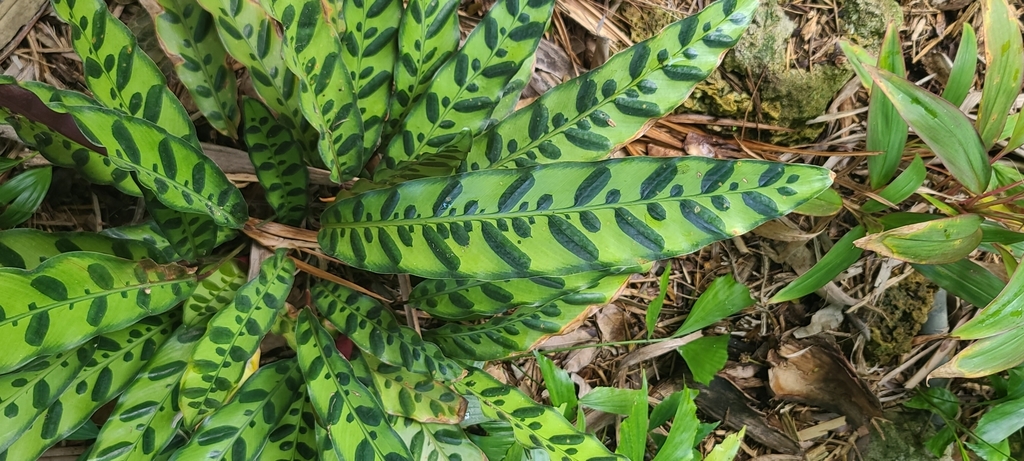
This species belongs to the Marantaceae family and forms a dense clump from underground shoots. The long petioles have movable joints, so the leaf blades change position throughout the day: they rise in the evening and spread out more widely during the day.
The leaf blade is narrow and elongated, with a wavy edge and dark markings against a green background. The foliage is the plant's main ornamental feature; flowering indoors is rare and does not define its appearance. When buying a plant, check the condition of the leaves:
- straight petioles without creases
- clean leaf blades without sticky residue
- distinct markings without pronounced fading
Origin and names
The species is native to southeastern Brazil. In the wild, members of the genus Goeppertia grow in the warm, humid conditions of tropical America, where light often filters through the upper layers of vegetation.
The names Calathea lancifolia and “calathea lancifolia” remain in use from the time when many of these plants were sold and described as calatheas. Following botanical and genetic studies, a large proportion of the former calatheas were moved to the genus Goeppertia.
| In the wild | Indoors |
|---|---|
| filtered light beneath the canopy | a spot out of direct sun |
| warm, humid air | a stable microclimate |
| a loose, moist layer of organic matter | an airy potting mix |
Light and placement
The plant needs bright indirect light. Direct sun is too intense for the leaf blades: the markings may fade, and pale damaged patches may appear.
A north- or east-facing window usually provides gentler light than a south-facing one. Light may be insufficient in winter: calatheas do not tolerate daylight periods shorter than 10 hours well, so move the plant closer to a window or provide supplemental lighting.
- a north-facing windowsill
- a spot near an east-facing window
- some distance from a south-facing window
- protection from drafts
- no hot radiator nearby
Watering and potting mix
Water according to the condition of the potting mix, not a calendar. Water once the top layer has dried out, and empty any excess from the saucer so the roots do not sit in standing water.
Soft water that has been filtered or left to stand is best for watering. Hard water and abrupt temperature differences often show up as dry leaf edges or curling.
The potting mix needs to be light and airy. Dense peat may look dry on top while retaining wet pockets inside, leaving the root system without air for longer.
Temperature and humidity
During the growing period, steady warmth around +20…+24 °C is suitable, without sudden fluctuations. A drop below +15 °C is undesirable, especially if not only the air but also the potting mix gets cold.
Humidity matters more to this plant than to many thick-leaved houseplants. A target of 60-70% helps reduce dry leaf edges, though maintaining this level with central heating often requires additional measures.
- a humidifier
- a tray of damp sphagnum moss or pebbles
- grouping plants together
- misting the air with a fine spray
- keeping the plant away from radiators
Why leaves deteriorate
Curling and dry edges are most often linked to dry air, hard water, or inconsistent watering. If the problem appears in winter, check the temperature near the window and radiator separately.
Yellowing accompanied by soft petioles more often points to overwatering. Dark spots can appear after exposure to a cold draft, while spider mites can be recognized by webbing, yellowing, and small pale marks on the leaf blades.
- dry air
- standing water in the saucer
- dense potting mix
- cold drafts
- spider mites
Propagation and repotting
The most practical method of vegetative propagation is dividing the clump during repotting. Take a section with its own roots and several growing points, making cuts with a clean, sharp knife.
Late spring is better than the cold season: roots recover more quickly in warmth and with longer daylight hours. After repotting, evenly moist potting mix, indirect light, and freedom from sudden temperature changes are important.
- prepare an airy potting mix
- remove the clump without roughly tearing the roots
- separate sections with their own roots
- plant without burying the petioles
- place in a warm spot with indirect light
- Light
- bright indirect light
- Temperature
- +20…+24 °C
- Watering
- when the top layer dries out
- Soil
- light and airy
- Difficulty
- moderate
- Cats and dogs
- safe
- Leaves indoors
- narrow and elongated
- Native range
- southeastern Brazil
Care
This plant is sensitive not to any single factor, but to sudden changes in conditions. Steady warmth, gentle indirect light, humid air, and a potting mix that does not stay waterlogged matter most.
- Light
- Provide bright indirect light. Keep out of direct sun. In winter, move the plant closer to a window or provide supplemental lighting if daylight hours are short.
- Temperature
- Keep at +20…+24 °C. Steady warmth is essential. Temperatures below +15 °C are undesirable, especially when the potting mix gets cold.
- Watering
- Water when the top layer dries out. Use soft water that has been left to stand or filtered. Empty any excess from the saucer.
- Soil
- Use a light, airy potting mix. Dense peat holds water deep inside for a long time. Materials such as perlite and bark help keep the mix open.
- Feeding
- Feed at low doses. Feed moderately: excess fertilizer can deform the leaves and does not encourage flowering.
- Support
- No support needed. The leaves are held up by their own petioles. Protecting the plant from drafts and abrupt moves is more important.
- Leaves
- Wipe off dust. Do not let dust build up on the leaf blades. Wipe gently without leaving cold droplets on the leaves.
- Repotting
- Repot as needed. Combine repotting with dividing the clump. Late spring is a better time than the cold season.
Botany
- Family
- Marantaceae
- Genus
- Goeppertia
- Species
- Goeppertia insignis
- Author and year
- (W.Bull ex W.E.Marshall) J.M.A.Braga, L.J.T.Cardoso & R.Couto
Rattlesnake plant (Goeppertia insignis) belongs to the family Marantaceae and the genus Goeppertia. The genus was named after Heinrich Goeppert, a German botanist and paleontologist.
The genus Goeppertia contains 243 accepted species; a large proportion are former calatheas transferred here after the genus boundaries were revised.
Members of Marantaceae are characterized by distinctive leaf blades and movable petioles. As a houseplant, this species is grown mainly for its narrow, wavy leaves with contrasting markings.
Frequently asked questions
- Why are the leaves curling?
- The most common causes are dry air, hard water, or the top layer of potting mix drying out. Also check for cold drafts.
- Why are the leaf edges drying out?
- Dry edges develop because of low humidity, hard water, or a nearby radiator. Misting the leaves does not replace steady humidity around the plant.
- How often should I water it?
- Water once the top layer of potting mix has dried out. Use soft water and empty any excess from the saucer.
- Can I keep it at home if I have a cat?
- Goeppertia plants are generally nontoxic to cats and dogs. If a pet chews the leaves, move the pot out of reach—mainly for the plant's sake.
- How do I propagate it?
- Propagate by dividing the clump during repotting, ideally in late spring. Each section must have its own roots and growing points.