Goeppertia orbifolia
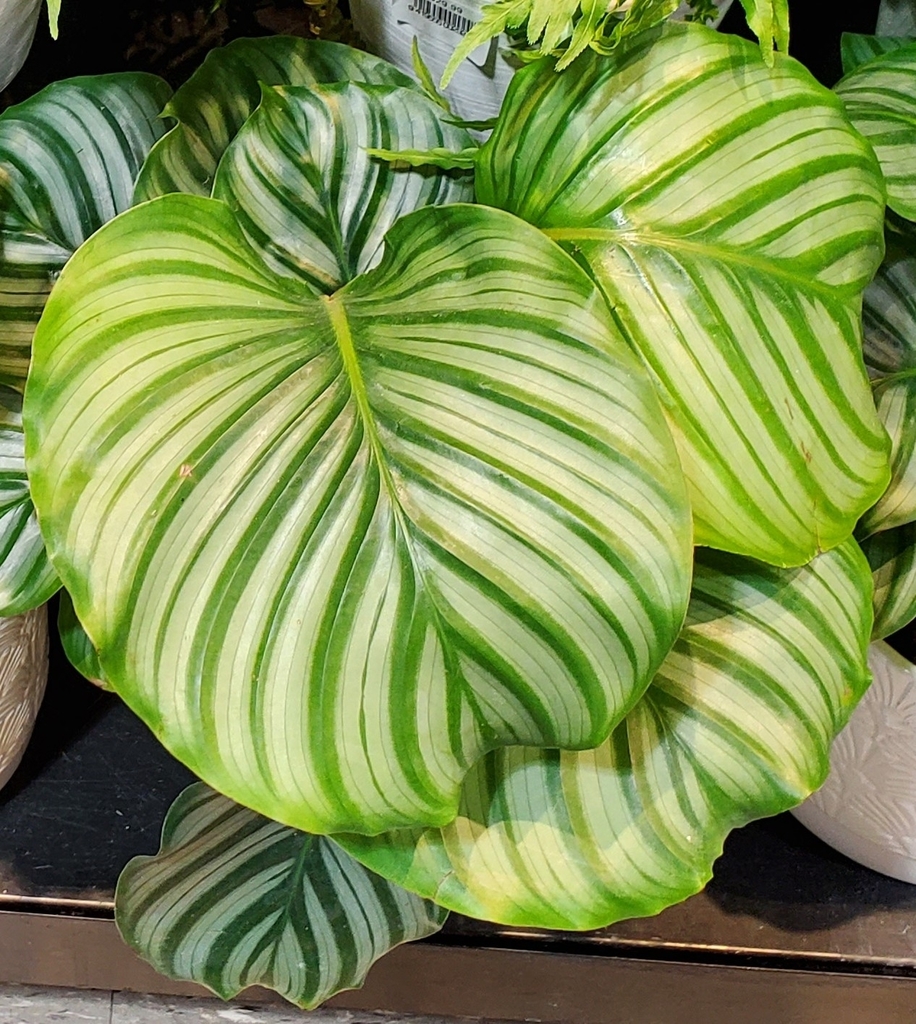
Broad, almost round leaves with a dark green background and silvery-green stripes are the defining feature of Goeppertia orbifolia. Indoors, it forms a dense, upright clump and reacts strongly to dry air.

Leaves and growth habit
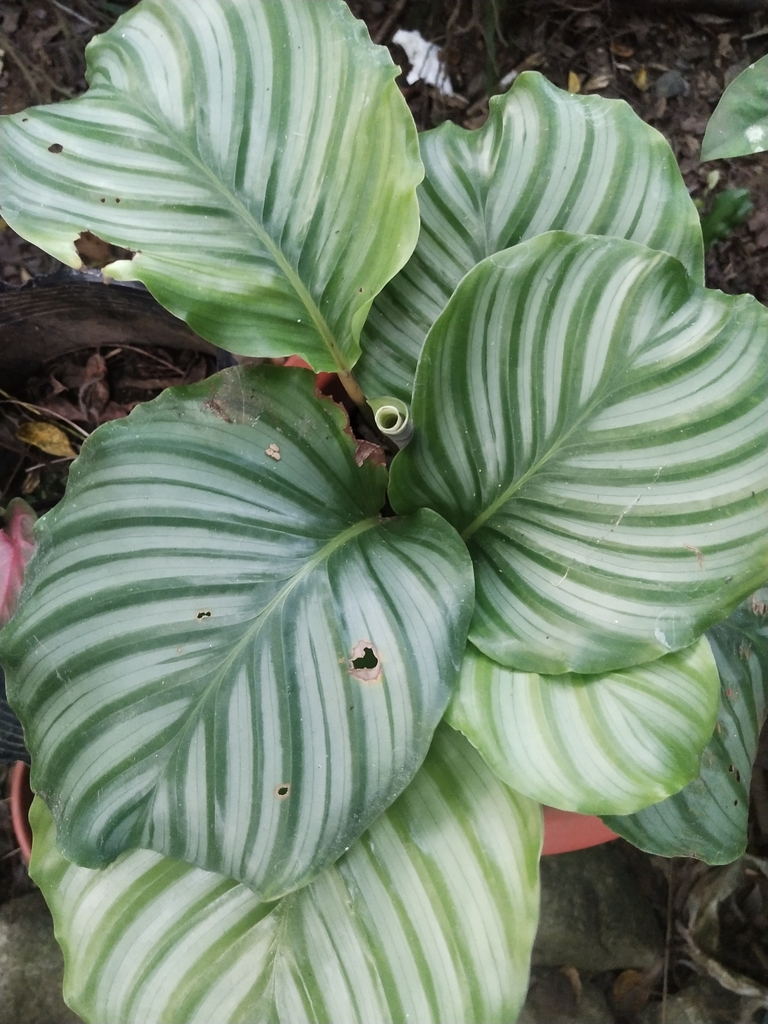
The leaves are broad and rounded, with a dark green background and silvery-green stripes. Their undersides are pale green or silvery, so the plant's appearance changes noticeably with the angle of the light.
The plant forms a dense, upright clump with a columnar growth habit. Indoors, it can reach 60-90 cm tall and 30-60 cm wide, with individual leaves up to 30 cm wide.
The specific epithet orbifolia comes from the Latin words orbis, meaning “circle,” and folium, meaning “leaf.” It is sometimes sold as “Calathea orbifolia”: this trade name reflects its former placement in the genus Calathea; under current classification, the species belongs to Goeppertia.
Origin and growing conditions
The species is native to eastern Brazil. In the wild, it is associated with a humid tropical biome, so indoors it reacts more strongly to prolonged dry air, cold, and abrupt changes in conditions than to a single care mistake.
| In the wild | Indoors |
|---|---|
| humid tropical biome | high humidity |
| indirect light beneath the vegetation canopy | bright indirect light or partial shade |
| steady warmth | temperature of +18…+24 °C during the growing season |
This origin explains its main requirements: no direct sun, no overly dry air, and no standing water around the roots. Its large leaves quickly show problems with growing conditions at their edges and tips.
Light and placement
Bright indirect light or partial shade works best. Direct sun can scorch the leaves, especially when the plant stands close to a window during hot weather.
- bright indirect light
- partial shade, but not deep shade
- a spot away from drafts and cold windowsills
In deep shade, the plant may keep its leaves, but growth becomes weaker. It is best to move the pot gradually: an abrupt change in light often affects the condition of its broad leaves.
Watering and potting mix
Base watering on the condition of the top layer of potting mix rather than a schedule. If it is still moist, do not add water: excess moisture in the pot increases the risk of root rot.
- drainage holes in the pot
- a well-drained, slightly acidic potting mix
- emptying excess water from the saucer
Tap water can be one cause of brown leaf tips. If this keeps happening, consider not only how often you water, but also water quality and humidity.
Humidity and leaf condition
To keep the leaves looking consistent, humidity needs to be at least 60 %. When the air is dry, leaf edges and tips dry out, and the leaves may curl.
- brown tips from dry air
- scorching from direct sun
- root rot from overwatering
Misting does not always solve the problem if the room is constantly dry. It is more important to keep the plant away from hot air currents and places with sudden temperature changes.
Repotting and propagation
Repot when the roots fill the pot; indoors, this is often done every 1-2 years. Division is the recommended propagation method and can conveniently be combined with routine repotting.
- Remove the clump from its pot during repotting.
- Divide the root mass into separate sections.
- Plant the divisions in separate pots with fresh potting mix.
Flowering and pests
The flowers are small and white, but indoors the plant is grown mainly for its foliage. The flower clusters are not its main ornamental feature, so a lack of flowering does not in itself indicate a care problem.
Possible pests include mealybugs, spider mites, and aphids. They are most often spotted on leaf stalks, the undersides of leaves, and places where leaves sit close together.
- Light
- indirect light, partial shade
- Temperature
- +18…+24 °C
- Watering
- when the top layer dries out
- Soil
- well-drained, slightly acidic
- Difficulty
- moderate
- Cats and dogs
- safe
- Size indoors
- 60-90 cm tall
- Leaves indoors
- up to 30 cm wide
- Native range
- eastern Brazil
Care
This plant comes from a humid tropical biome. Indoors, it needs steady warmth, soft indirect light, and air that does not become too dry. Problems usually show up along the leaf edges first.
- Light
- Provide bright indirect light. Indirect light or partial shade is suitable. Direct sun can scorch the leaves.
- Temperature
- Keep at +18…+24 °C. This is the range for the growing season. In winter, do not let the temperature fall below +15 °C or place the pot on a cold windowsill.
- Watering
- Water when the top layer dries out. Water once the top layer of potting mix has dried out. Empty excess water from the saucer to avoid root rot.
- Soil
- Use a well-drained, slightly acidic mix. The potting mix must allow water and air to pass through. For this species, a constantly wet mix around the roots is more dangerous than letting the top layer dry out briefly.
- Leaves
- Keep humidity at 60 % or higher. Dry air causes leaf tips and edges to dry out. Tap water can also cause brown tips.
- Repotting
- Repot every 1-2 years. Repot when the roots fill the pot. A mature clump can be divided during repotting.
Botany
- Family
- Marantaceae
- Genus
- Goeppertia
- Species
- Goeppertia orbifolia
- Author and year
- (Linden) Borchs. & S.Suárez
Goeppertia orbifolia belongs to the family Marantaceae and the genus Goeppertia. It is a foliage plant with large, rounded leaves whose silvery-green stripes follow the shape of the leaf.
The plant forms a compact, dense, upright clump. Its size indoors is usually limited by the pot, light, and humidity, but the species can grow to 60-90 cm tall.
Its origin in eastern Brazil and association with a humid tropical biome explain its sensitivity to dry air. The most noticeable response appears not on the stems, but along the edges of its broad leaves.
Frequently asked questions
- Why are the leaf tips drying out?
- The most common cause is dry air or tap water. It needs humidity of at least 60 % and consistent watering without standing water.
- Can I place it in direct sun?
- No, direct sun can scorch the leaves. Bright indirect light or partial shade is better.
- Is the plant safe for cats and dogs?
- Yes, the plant is safe for cats and dogs.
- How can I propagate the plant at home?
- The recommended method is to divide the clump during repotting. Plant the divisions in separate pots with fresh potting mix.
- How often should I repot it?
- Usually every 1-2 years, when the roots fill the pot. After repotting, it is important not to overwater the potting mix.