Fiddle-leaf fig
The leaf blade narrows in the middle and widens toward the tip, giving it the outline of a lyre or violin. Indoors, the fiddle-leaf fig (Ficus lyrata) is grown as an evergreen tree with large, leathery leaves.


Leaf and crown structure
The main identifying feature is the large leaf blade, which narrows in the middle and widens toward the tip. This outline is why the leaves are compared to a lyre or violin; their shape, rather than their color, makes the species easy to recognize.
In the wild, it is an evergreen tree. Indoors, it is usually grown as a single upright plant or a small tree. New leaves emerge from tightly wrapped reddish-brown stipules, gradually unfurling and taking on their characteristic shape.
- leaf blades up to 45 cm long and up to 30 cm wide
- narrowing in the middle of the leaf blade
- leathery surface with a waxy coating
- wavy leaf edges
- green fig fruits up to 3 cm
How it grows in the wild
The species is native to western tropical Africa, where it grows in lowland tropical forests. These origins explain its need for bright light, warmth, and higher humidity than a dry room provides in winter.
Young plants often begin life as epiphytes in the crowns of other trees. Aerial roots grow downward, wrap around the supporting tree's trunk, and may eventually suppress its growth; this is not parasitism but competition for space and support.
| In the wild | Indoors |
|---|---|
| A tree 12-15 m tall | Size is limited by the pot and pruning |
| May begin life as an epiphyte | Grows in potting mix as a potted plant |
| Uses other trees for support | Often needs a stake or sturdy support |
Light and placement
This light-loving plant grows best near a well-lit window. Farther into the room, growth usually slows, and new leaf blades may be smaller.
Avoid moving the pot frequently without a reason: the large leaves orient themselves toward the light source, and the trunk gradually leans toward the window. If the crown becomes one-sided, rotate the plant gradually without abruptly changing its conditions.
- a bright spot near a window
- no constant deep shade
- a stable pot for the heavy crown
Watering and humidity
The condition of the potting mix matters more than a fixed watering schedule. Water once the top layer has partly dried: the large leaves lose plenty of moisture, but constantly wet roots are undesirable for a potted plant.
This species benefits from higher humidity, so regular misting or another way of increasing humidity is appropriate in a dry room. At the same time, water should not be left standing in the cachepot or saucer after watering.
- a partly dried top layer of potting mix before watering
- moderately moist roots, not waterlogged
- higher humidity during the dry season
- misting without leaving droplets on cold leaves
- emptying excess water from the saucer
Support and leaf care
The large leaves and upright growth can make the plant unstable. Support is needed not for decoration but to keep the trunk straight and reduce the risk of the pot tipping over.
The broad leaves quickly collect dust, so wipe them periodically with a soft, damp cloth. This does not replace watering or treat root problems, but it helps the leaves receive light properly.
- placing a sturdy support beside the trunk
- tying the trunk without constricting the bark
- wiping dust off the leaf blades
Propagation
Vegetative propagation is done with stem cuttings or air layering. Both methods use a section of stem with a node, since the node allows new roots and a shoot to develop.
A single leaf without a section of stem may retain its appearance for a while, but it will not produce a complete new plant. Air layering is useful for a mature specimen with a bare or overly tall trunk.
- a stem cutting with a node
- air layering a mature stem
- rooting without letting the tissues dry out
Pet safety
The plant is toxic to cats and dogs. Chewing a leaf or stem can cause irritation of the mucous membranes and digestive upset, so keep the pot out of reach.
When pruning and rooting cuttings, avoid getting sap on the skin or mucous membranes. Do not leave cut plant parts where pets can reach them.
- Light
- bright light
- Watering
- after the potting mix has partly dried
- Soil
- well-drained potting mix
- Difficulty
- moderate
- Cats and dogs
- toxic
- Leaves indoors
- up to 45 × 30 cm
- Native range
- western tropical Africa
Care
The fiddle-leaf fig needs stable conditions: plenty of light, moderate watering, and higher humidity matter more than frequent moves. A mature plant with large leaves often needs support.
- Light
- Provide bright indirect light. This light-loving species grows best near a well-lit window; in deep shade, new leaves develop more slowly.
- Temperature
- Keep consistently warm. Its tropical forest origins mean it needs steady warmth; avoid sudden temperature changes and cold drafts.
- Watering
- Water when the top layer has partly dried. Water according to the condition of the potting mix, not the calendar. The roots should not sit in water continuously.
- Soil
- Use a loose, well-drained potting mix. The mix should let water and air through so the roots are not left in stagnant moisture after watering.
- Support
- Provide support for stability. Large leaves and an upright trunk can make the pot top-heavy, so a mature plant often needs support.
- Leaves
- Wipe dust off the leaves. The broad leaves collect dust; wipe them with a soft, damp cloth without damaging the surface.
- Repotting
- Repot when the roots are crowded. Repot once the roots have filled the pot; an excessively large volume of potting mix takes longer to dry after watering.
Botany
4 ill.- Family
- Moraceae
- Genus
- Ficus
- Species
- Ficus lyrata
- Author and year
- Warb.

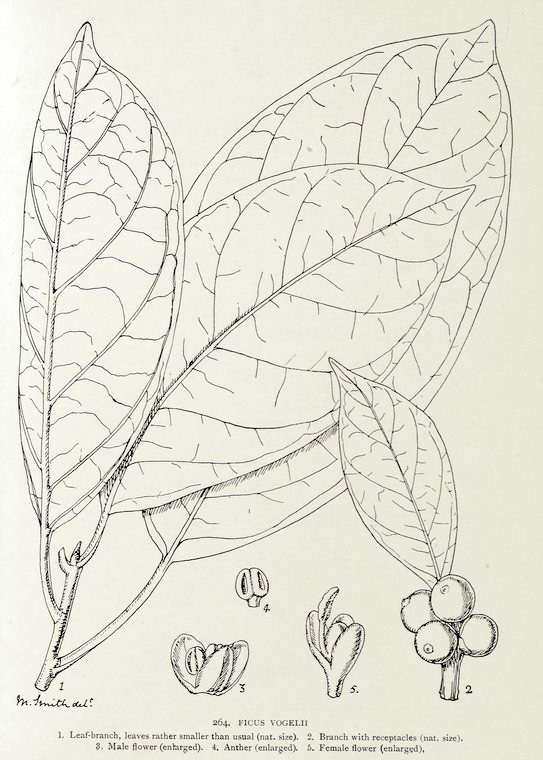


The fiddle-leaf fig (Ficus lyrata) belongs to the genus Ficus and the family Moraceae. In the wild, it is an evergreen tree that can reach 12-15 m tall.
The leaf blade is large, up to 45 cm long and up to 30 cm wide, and usually narrows in the middle. The fig fruits are green and measure up to 3 cm.
The species may begin life as an epiphyte in tree crowns. Aerial roots grow downward, wrap around the supporting tree, and gradually compete with it for space.
How it differs from similar plants
Weeping fig Ficus benjamina
- The fiddle-leaf fig has large, lyre-shaped leaves that narrow in the middle, while Ficus benjamina has much smaller, oval leaves with pointed tips and drooping branches.
Rubber plant Ficus elastica
- The fiddle-leaf fig is recognized by its leaf blades, which narrow in the middle and widen toward the tip, while Ficus elastica is described primarily by its leathery, glossy leaves.
Indian laurel fig Ficus microcarpa
- The fiddle-leaf fig has very large, lyre-shaped leaves, while Ficus microcarpa has smooth, elliptical leaves and prominent aerial roots.
Frequently asked questions
- Can I keep it at home if I have a cat or dog?
- Yes, but the plant is toxic to cats and dogs, so pets must not be able to reach the leaves or cut plant parts.
- Why are the leaf edges drying out?
- This is most often a response to dry air, uneven watering, or stress after a change of location. Check the moisture in the potting mix and the conditions near the window.
- Do the leaves need misting?
- It is recommended, especially in a dry room. The species comes from tropical forests and does better with higher humidity.
- Does it need support?
- A mature plant often needs it: the large leaves make the crown heavy, and the trunk may lean.
- How do I propagate it?
- With stem cuttings or air layering. A single leaf without a node will not develop into a complete new plant.