Mexican snowball
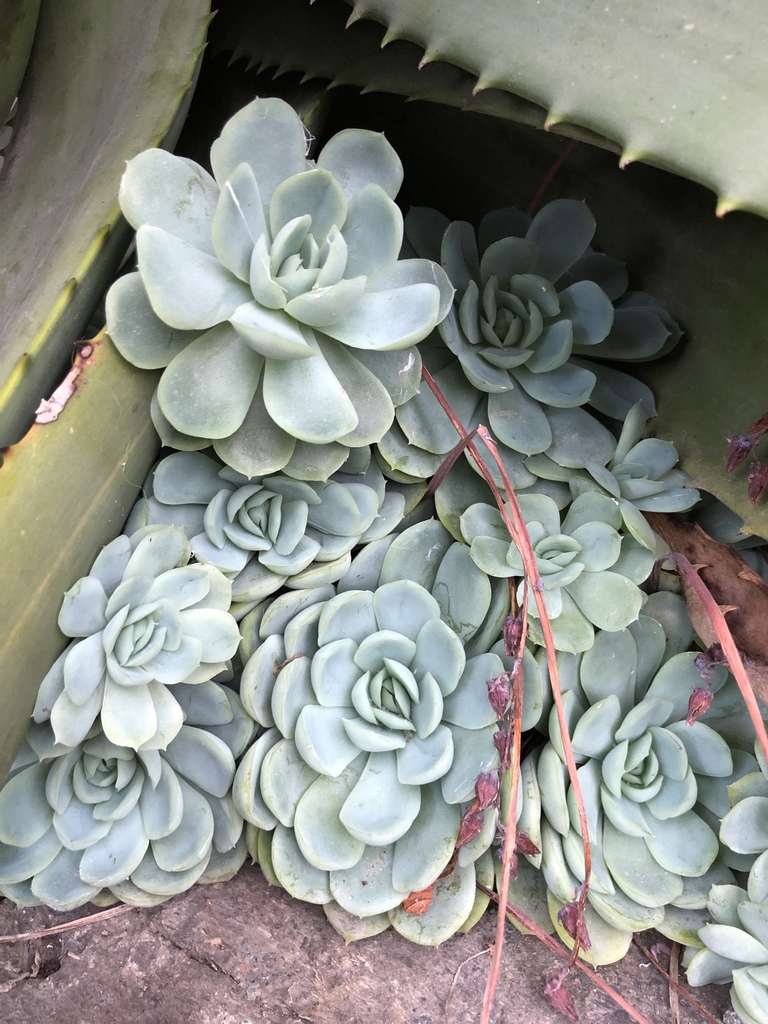
A dense rosette of fleshy, light green leaves with a bluish-white waxy coating is the defining feature of Mexican snowball (Echeveria elegans), a succulent from the semi-deserts of Mexico.

Rosette structure
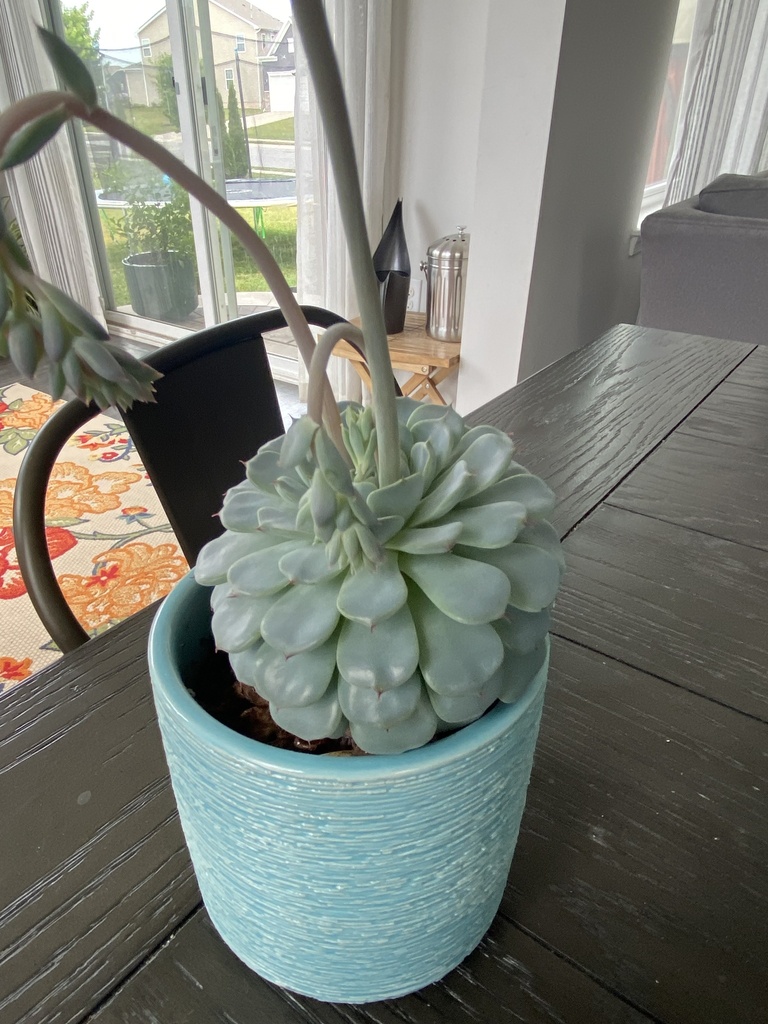
The leaves form a dense rosette, making the plant look almost stemless. It does have a short stem: in this species, it reaches 5 cm and may produce offsets as it ages.
The leaves are elongated and fleshy, 3-6 cm long and about 1 cm wide. Their light green color is muted by a bluish-white waxy coating that reduces water loss and rubs off easily when touched.
Origin and natural conditions
The species is native to the semi-deserts of Mexico. This origin explains its two main traits as a houseplant: a need for bright light and sensitivity to water collecting around the roots.
| In the wild | Indoors |
|---|---|
| Semi-desert habitats with plenty of light | The brightest available spot is best |
| Moisture does not linger | Needs a well-drained potting mix and a pot with drainage holes |
| Leaves store water | Water after the potting mix has dried out |
Light and growth habit
In low light, the internodes stretch and the rosette loses its density. The stem becomes exposed between the leaves, and the plant starts to look like an elongated shoot rather than a compact rosette.
- a bright, sunny spot
- gradual acclimation after moving
- turning the pot for even growth
- no prolonged shade
- protection from constant moisture on the leaves
Watering and potting mix
The fleshy leaves store water, so constantly wet potting mix is more dangerous for this species than a brief break from watering. Watering can be more generous in summer, but water must not collect in the pot.
The potting mix needs to be airy and well drained: add sand, perlite, or other mineral ingredients. A shallow pot with drainage holes is suitable, since this succulent's root system does not need a deep container.
Flowering
This species has red-and-yellow flowers. In members of the genus, the flowers are borne on a flower stalk growing from the side, and their shade may vary depending on light levels while the buds develop.
Indoors, flowering usually depends on sufficient light and the plant's overall condition. If the rosette is stretched or weakened by excess water, its energy more often goes toward survival rather than producing a flower stalk.
Propagation and repotting
The species produces offsets that can be separated for vegetative propagation. Members of the genus are also propagated from leaf and stem cuttings; the cut or broken surface must dry before rooting to reduce the risk of rot.
- offsets
- leaf cuttings
- stem cuttings
- Light
- bright sunlight
- Watering
- generously in summer, moderately in winter
- Soil
- well-drained potting mix
- Difficulty
- moderate
- Cats and dogs
- safe
- Size indoors
- stem up to 5 cm
- Leaves indoors
- 3-6 × 1 cm
- Native range
- semi-deserts of Mexico
Care
This succulent comes from semi-desert habitats and tolerates brief dry spells better than constant moisture. Indoors, its main needs are plenty of light, a well-drained potting mix, and careful watering.
- Light
- Provide bright sunlight. In low light, the internodes stretch, the rosette becomes loose, and the stem becomes more visible between the leaves.
- Temperature
- Keep warm. Grows well in conditions similar to a dry subtropical climate. Avoid cold drafts and constant dampness.
- Watering
- Water generously in summer, moderately in winter. Water after the potting mix has dried out. Water must not collect around the roots or in the center of the rosette.
- Soil
- Use a well-drained potting mix. A succulent mix with sand or perlite is suitable. Excess organic matter and heavy, wet soil increase the risk of rot.
- Feeding
- Feed moderately. Feed only during active growth. Excess nutrients can make the tissues watery.
- Support
- No support needed. The rosette is compact and the stem is short. Only stretched plants need support when being rejuvenated or when the top is being rooted.
- Leaves
- Do not rub off the waxy coating. The bluish-white coating on the leaves is easily damaged. It is best to blow dust off or remove it with a very soft, dry brush.
- Repotting
- Repot in spring or early summer. Repot into a pot with drainage holes and fresh, well-drained potting mix. After planting, wait 3-5 days before watering.
Botany
4 ill.- Family
- Crassulaceae
- Genus
- Echeveria
- Species
- Echeveria elegans
- Author and year
- Rose


Mexican snowball (Echeveria elegans) is a species in the genus Echeveria, in the family Crassulaceae. It is a perennial herbaceous succulent with a short stem, a dense rosette, and fleshy leaves.
The species is endemic to the semi-deserts of Mexico. Its light green leaves are covered with a bluish-white waxy coating that gives the rosette its characteristic matte appearance.
The genus name Echeveria is associated with Atanasio Echeverría, an 18th century Mexican artist and naturalist who illustrated works on the flora of Mexico. The specific epithet elegans comes from Latin and means “elegant.”
Popular cultivars
8- MirandaEcheveria Miranda
- large, symmetrical rosettes resembling a lotus flower; leaves range from soft green to gray-blue with pink edges
- Mexican snowballEcheveria elegans
- dense, silvery-blue rosettes; light green leaves with a bluish-white waxy coating
- Echeveria agavoidesEcheveria agavoides
- resembles a miniature agave; bright green leaves with red tips
- Echeveria setosaEcheveria setosa
- leaves are densely covered with hairs, giving them a velvety texture
- Black prince
- has almost black leaves
- Pearl of Nuremberg
- leaves are pearly pink or pinkish-gray
- Echeveria leucotrichaEcheveria leucotricha
- leaves are densely covered with soft white hairs and have a reddish-brown tip
- Echeveria pulvinataEcheveria pulvinata
- leaves are rich green with a velvety surface; flowers are orange-yellow
How it differs from similar plants
Flaming Katy Kalanchoe blossfeldiana
- Kalanchoe is recognizable by its flat-topped flower clusters and taller, bushy growth of 30–40 cm, while Mexican snowball forms a dense, low rosette with a bluish-white waxy coating.
Jade plant Crassula ovata
- Jade plant differs in size: indoors it grows to 1–1.5 m, while Mexican snowball remains a compact rosette with a stem up to 5 cm.
Burro's tail Sedum morganianum
- Sedum morganianum has fragile, trailing stems 30–120 cm long, while Mexican snowball forms a dense, low rosette.
Frequently asked questions
- Why has the rosette stretched?
- Usually because of insufficient light: the internodes lengthen and the rosette loses its density. The top can be cut off, left to dry, and rooted as a cutting.
- Is it safe for cats and dogs?
- Yes, the plant is safe for cats and dogs. However, damaged leaves easily lose their shape, so it is best to place the pot where pets will not knock it over.
- How often should I water?
- Water after the potting mix has dried out: more generously in summer, more moderately in winter. Water must not sit in the saucer or in the center of the rosette.
- Can it be propagated from a leaf?
- Yes, the species produces offsets. Leaf and stem cuttings are also used, but the cut surface must dry before planting.
- What soil is suitable?
- It needs a well-drained succulent mix with mineral ingredients such as sand or perlite. Heavy, wet soil is unsuitable.


