Four-season orchid
Not every indoor orchid is an epiphyte: the four-season orchid (Cymbidium ensifolium) also grows as a terrestrial plant or lithophyte in the wild. It therefore needs air around its roots, light, and a potting mix that drains quickly.


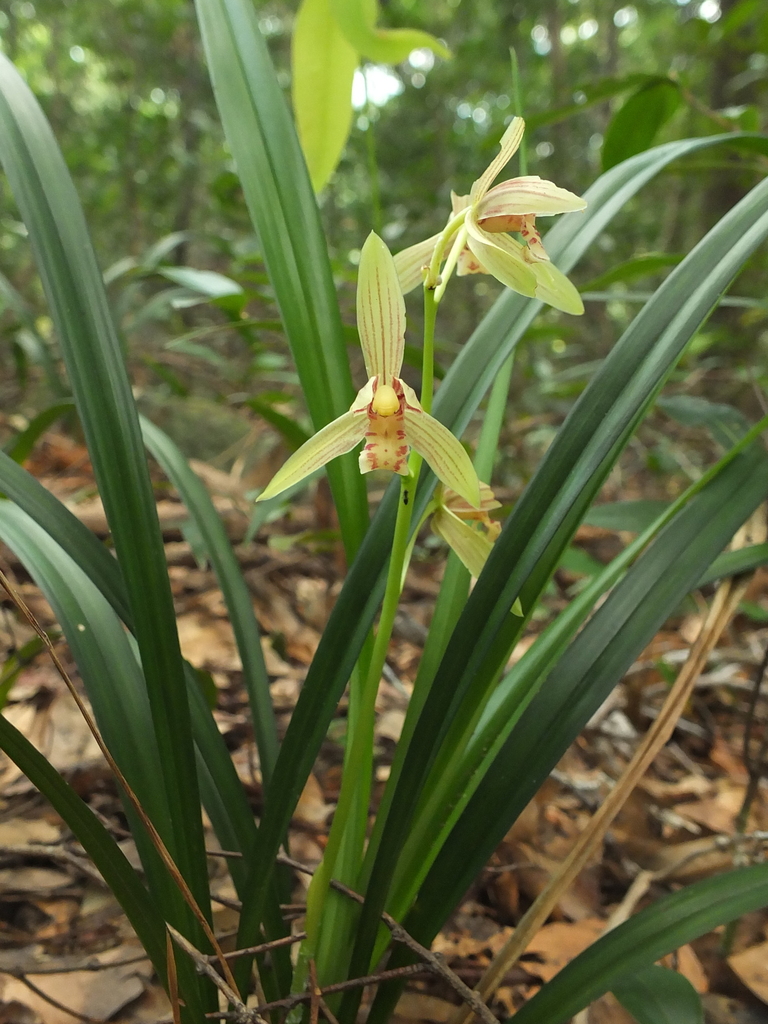
Plant structure
This is a sympodial orchid: new shoots grow alongside the older ones rather than from a single growing tip. The pseudobulbs are egg-shaped, only slightly developed, 1.5-2.5 × 1-1.5 cm, and almost entirely hidden by leaf sheaths.
The roots are fleshy and long, so the plant needs an airy potting mix rather than dense soil. The leaves are narrow, matte, and linear, up to 1.5 cm wide; their tips may be toothed.
- sympodial shoot growth
- slightly developed pseudobulbs
- long, fleshy roots
- narrow, matte leaves
- upright flower cluster arising from the base
The flower cluster emerges from the base of the shoot and grows upright. In the species, it reaches 15-67 cm and bears 3-9 flowers, more rarely up to 13.
Origin and natural habitat
The species is native to an area extending from northeastern India and Indochina to Japan and the Philippines. In the wild, it occurs in open woodland and on grassy slopes.
Air around the roots and freedom from prolonged waterlogging are important for this species. Humidity in its natural habitat stays within 62-78 %, but this does not mean the potting mix should stay constantly wet.
Plants sold in stores as “cymbidium” are almost always hybrids, mostly imported from Holland—plants ranging from 50 cm to a meter tall, with flowers in various colors. Cymbidium ensifolium is a naturally occurring species and one of the parents of these hybrids.
Light and placement
The plant needs bright indirect light. Direct sun in the middle of the day can overheat the leaves, so shading is needed at a south-facing window.
In spring and summer, a very bright spot with air movement is suitable, but do not move the plant abruptly into direct sun. If kept outdoors, acclimate it gradually to brighter light.
| Condition | What matters |
|---|---|
| Bright indirect light | Supports new shoot growth |
| Midday sun | Requires shading |
| Poor ventilation | Increases the risk of leaf and root problems |
Watering and potting mix
Water consistently throughout the year, but reduce watering in winter. Between waterings, the potting mix should not become a wet, heavy mass: under these conditions, the fleshy roots are easily deprived of air.
Use mixes containing fine gravel or lava rock, pine bark, charcoal, sphagnum moss, and Osmunda roots. A simple guide to the mix's structure is that water should soak through the entire mix in about 10 seconds.
- fine gravel or lava rock
- pine bark
- charcoal
- sphagnum moss
- Osmunda roots
Because of their long roots, plants of the species are often grown in tall, vase-shaped pots. In a standard shallow container, the roots may lack space and flowering may be weaker.
Temperature and flowering
The species tolerates a range of temperatures but grows most actively in warmth. The optimum during growth is around +30 °C during the day and +25 °C at night; in winter, around +25 °C during the day and +20 °C at night.
In cooler conditions, around +20 °C during the day and +15 °C at night, shoot growth slows and fewer flower clusters may form. This is not a period of deep dormancy, but rather a slowdown in growth.
In the species, the flowers are 3-5 cm in diameter, fragrant, and straw-yellow with a greenish tint and reddish-brown veins or spots. They usually last 2-3 weeks, but flowering times can shift in cultivation.
Why leaves turn yellow or become damaged
Spots, dry tips, and distorted leaves do not have a single cause. They may result from inconsistent watering, overheating in the sun, feeding mistakes, or pest damage.
Cymbidiums are troubled by spider mites, flat mites, aphids, mealybugs, scale insects, and thrips. Diseases include rots, anthracnose, rust, leaf spots, and viral mosaics.
- yellowing after overwatering
- spots after overheating
- dry leaf tips
- distorted young growth
- webbing or sticky secretions
Propagation and repotting
Repot in spring every 2-3 years. Repotting is needed when the potting mix has become compacted or the roots have outgrown the pot.
The plant can be divided during repotting if it has enough mature shoots. Division is a vegetative propagation method: each section must retain living roots and reserve shoots for further growth.
After repotting, firm the potting mix so that no large gaps remain in the pot. At the same time, the mix must not become a dense mass, because the roots of this species need access to air.
- Light
- bright indirect light
- Temperature
- +25…+30 °C
- Watering
- consistent
- Soil
- airy potting mix
- Difficulty
- moderate
- Cats and dogs
- safe
- Size indoors
- small species
- Leaves indoors
- up to 1.5 cm wide
- Native range
- from northeastern India and Indochina to Japan and the Philippines
Care
This species needs light, an airy potting mix, and careful watering. It dislikes water sitting around its roots, but letting it dry out completely is not a suitable routine either.
- Light
- Provide bright indirect light. It needs good light, but shade it from direct sun in the middle of the day.
- Temperature
- Keep at +25…+30 °C during growth. In winter, aim for around +25 °C during the day and +20 °C at night; at +20/+15 °C, growth and flowering decline.
- Watering
- Water consistently, less in winter. Wet the potting mix thoroughly, but do not leave it wet for long. Reduce watering in winter.
- Soil
- Use an airy potting mix. A mix of bark, mineral components, charcoal, and sphagnum moss is suitable; water should pass quickly through the pot.
- Feeding
- Feed during active growth. Apply orchid fertilizer to moist potting mix. Stop feeding during flowering.
- Support
- Support the flower spike if needed. The flower cluster is upright and can be long, so a light support is useful if the flower spike leans.
- Leaves
- Protect from overheating. Spots and dry leaf tips are often linked to direct sun, inconsistent watering, or feeding mistakes.
- Repotting
- Repot every 2-3 years. Repot in spring when the potting mix has become compacted or the roots have outgrown the pot.
Botany
- Family
- Orchidaceae
- Genus
- Cymbidium
- Species
- Cymbidium ensifolium
- Author and year
- (L.) Sw.
The four-season orchid (Cymbidium ensifolium) belongs to the family Orchidaceae. It is a perennial herbaceous orchid with sympodial shoot growth, concealed pseudobulbs, and long, fleshy roots.
The leaves are narrow, matte, and linear, up to 1.5 cm wide. The flower cluster arises from the base, grows upright, and is 15-67 cm long; the flowers are fragrant, 3-5 cm in diameter, with conspicuous longitudinal veins.
In the wild, the species grows from northeastern India and Indochina to Japan and the Philippines. In cultivation, it responds poorly to dense potting mix and water sitting around its roots.
Frequently asked questions
- Can I keep it at home if I have a cat?
- Yes, the plant is safe for cats and dogs.
- Why are the leaves turning yellow?
- Most often because of overwatering, overheating in direct sun, or inconsistent watering.
- How often should I water?
- Water consistently in spring and summer, and reduce watering in winter. The potting mix should become thoroughly wet and drain excess water quickly.
- What potting mix does it need?
- It needs an airy potting mix containing bark, mineral components, charcoal, and sphagnum moss.
- When should I repot?
- Usually in spring every 2-3 years, when the roots are crowded or the potting mix has lost its structure.


