Cattleya
An orchid with large flowers does not necessarily grow in soil: in the wild, cattleya (Cattleya labiata) clings to trees and captures water and mineral particles through roots covered in velamen. In a pot, it needs an airy potting mix, not soil.

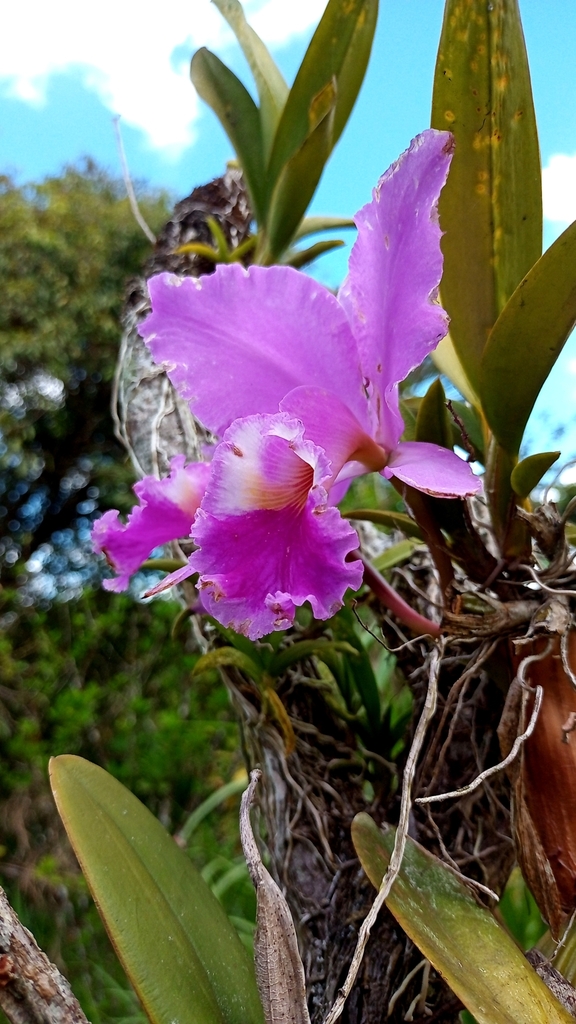
Shoot structure
This is a sympodial orchid: new growths appear in sequence along a rhizome rather than from a single central rosette. Water and nutrients are stored in pseudobulbs, so the plant tolerates short gaps between waterings better than a constantly wet potting mix.
Each pseudobulb usually carries 1-2 fleshy, firm leaves. The terminal flower cluster forms in a leaf axil and is initially covered by a sheath—a dry protective covering at the base of the developing flower spike.
- pseudobulbs that store moisture
- roots covered in velamen to absorb water
- a terminal flower cluster that emerges from a sheath
The roots not only anchor the plant but also absorb moisture from rain, fog and humid air. This is why an airy potting mix is used for growing it rather than dense soil.
Origin and history of its description
The species is native to eastern and northern Brazil. In the wild, these orchids grow on trees or rocky surfaces, where their roots get plenty of air and do not sit in stagnant moisture.
The history of its description is linked to William Swainson, who sent epiphytic orchids from Brazil to Britain in 1817. In November 1818, one of them flowered in William Cattley's greenhouse, and in 1821, John Lindley described the species as Cattleya labiata.
| In the wild | Indoors |
|---|---|
| roots are exposed to air, rain and fog | roots should be in bark and sphagnum moss, not dense soil |
| the plant clings to a support—a tree or rock | use a snug pot and add support if needed |
| moisture drains quickly from the roots | allow the potting mix to dry out between waterings |
The genus is named after William Cattley, the owner of an early English orchid collection. This is not a folk name but part of botanical history linked to the first European collections of tropical orchids.
Light and temperature
Bright indirect light is needed for growth. An east- or southwest-facing window is better than a dark location; during the hottest summer hours, shade direct sun to prevent leaf scorch.
During growth, temperatures can rise to +30 °C. In winter, the target for most cattleyas is lower: +12…+15 °C at night and +18…+22 °C during the day. A day-to-night difference of about 5 °C helps the plant move toward flowering.
A brief drop to +8…+10 °C usually does not kill the plant but may delay flowering. It is important not to combine cool conditions with a wet potting mix: under these conditions, roots absorb water less effectively and are more prone to rot.
Watering and potting mix
Watering depends on how quickly the potting mix dries out, not on a calendar. Roots dry faster in coarse bark, while finer bark, sphagnum moss or coconut chips hold moisture longer.
During active growth, water more generously, but let the potting mix dry out well between waterings. In summer, roughly once every 3 days is a guide; in winter, once every 2-3 weeks, or just lightly moisten the top layer during dormancy.
- pine bark as the base of the potting mix
- sphagnum moss for extra moisture retention
- coconut chips as a moisture-retentive ingredient
- a drainage layer about 2 cm deep
- the base of the rhizome above the surface of the potting mix
Do not bury the base of the rhizome when planting. Wait a few days after repotting before watering so that damaged areas of the roots are not immediately exposed to wet conditions.
Flowering and dormancy
The flower cluster emerges from the top of a mature pseudobulb and passes through the sheath. If a new growth has already finished developing, excessive watering may stimulate new vegetative growth instead of a flower spike.
Cattleyas sold in stores are almost always hybrids, and Cattleya labiata is one of the ancestral species of this group; the same care principles apply. Flowering is followed by dormancy, which often falls in winter or fall in hybrids. During this time, keep the plant in a cooler spot with bright indirect light, reduce watering and stop feeding.
| Stage | What changes |
|---|---|
| a new pseudobulb is growing | water and feed more regularly |
| a mature growth with a sheath | limit watering to avoid encouraging new shoots |
| the flower spike is growing inside the sheath | gradually resume watering |
| dormancy | only lightly moisten the potting mix |
A mature plant with enough pseudobulbs and living roots is more likely to flower. If the root system is weak, the plant is more likely to produce a new shoot with roots rather than a flower spike.
Repotting and propagation
Repot not on a schedule but when the potting mix has compacted or become acidic, or the plant has become too large for its pot. The pot should remain snug: excess unoccupied, moist potting mix around the roots increases the risk of rot.
Propagate by dividing the rhizome. Leave at least three pseudobulbs on each division; otherwise, the division takes longer to recover and has more difficulty resuming normal growth.
- remove the plant from its pot
- soak the roots before dividing
- cut the rhizome between groups of pseudobulbs
- dust the cuts with charcoal
- plant the divisions without burying the base of the rhizome
After division, the plant uses its resources to restore its roots before starting new growth. During this time, consistent light, careful watering and a potting mix free of standing water are important.
Problems and pests
The most common problem is root rot caused by overwatering or a dense potting mix. Signs may include loss of firmness, stalled growth and declining pseudobulbs even after watering.
Pests include thrips, spider mites, scale insects and aphids. They are easier to spot when you regularly inspect the undersides of leaves, leaf axils and new growths.
- root rot
- thrips
- spider mites
- scale insects
- aphids
If you suspect rot, remove the plant from its pot, cut away affected parts and adjust watering. If pests are present, isolate the plant from other orchids and treat it with an appropriate product according to its instructions.
- Light
- bright indirect light
- Temperature
- up to +30 °C
- Watering
- after the potting mix dries out
- Soil
- bark and sphagnum moss
- Difficulty
- moderate
- Cats and dogs
- safe
- Native range
- eastern and northern Brazil
Care
Cattleya grows best in an airy potting mix, with bright light and distinct periods of growth and dormancy. Most problems come not from drying out but from water sitting around the roots.
- Light
- Provide bright indirect light. An east- or southwest-facing window works best; shade direct sun in hot weather to prevent leaf scorch.
- Temperature
- Keep at up to +30 °C in summer. In winter, aim for +12…+15 °C at night and +18…+22 °C during the day. A difference of about 5 °C supports bud formation.
- Watering
- Water after the potting mix dries out. During growth, water after the potting mix dries out; in summer, roughly once every 3 days is a guide, and in winter, once every 2-3 weeks or just a light moistening.
- Soil
- Use bark with sphagnum moss. A mix of pine bark and sphagnum moss is suitable; coarse pieces dry out faster, while fine pieces hold water longer.
- Feeding
- Feed during growth. Apply fertilizer while the pseudobulb is forming and the flower spike is growing; stop during dormancy.
- Support
- Add support if needed. Use a support to keep the pot and shoots upright, especially after repotting or when flower clusters are heavy.
- Leaves
- Inspect regularly. Yellow spots, webbing, sticky scale insects or aphid colonies are reasons to isolate the plant and inspect the leaf axils.
- Repotting
- Repot only when needed. Repot when the potting mix has compacted or become acidic, or the plant has outgrown its pot; add a drainage layer about 2 cm deep at the bottom.
Botany
- Family
- Orchidaceae
- Genus
- Cattleya
- Species
- Cattleya labiata
- Author and year
- Lindl.
Cattleya (Cattleya labiata) belongs to the family Orchidaceae. It is a sympodial orchid with pseudobulbs, 1-2 firm leaves on each mature growth and a terminal flower cluster that develops from a sheath.
The species is native to eastern and northern Brazil. In the wild, its roots are adapted to an airy environment: velamen helps absorb water from rain, fog and moisture around the plant.
The plant is safe for cats and dogs. The main risks when growing it indoors are not related to toxicity but to an overly wet potting mix, insufficient light and root damage during repotting.
Frequently asked questions
- Why isn't it flowering?
- Most often, it lacks bright light, a period of dormancy or a day-to-night temperature difference of about 5 °C. The plant may also not yet have enough mature pseudobulbs and living roots.
- How often should I water it?
- During growth, water after the potting mix has dried out well; in summer, roughly once every 3 days is a guide. In winter, reduce watering to once every 2-3 weeks or just a light moistening.
- What potting mix does it need?
- A mix of pine bark and sphagnum moss is suitable. Dense soil is unsuitable because the roots need air and must dry out quickly.
- Can I keep it at home if I have a cat?
- Yes, the plant is safe for cats and dogs. However, it is best to place the pot where pets cannot damage the roots and new growths.
- When should I repot it?
- Repot when the potting mix has compacted or become acidic, or the plant has outgrown its pot. Do not repot unnecessarily, as the roots are sensitive to damage.


