Coleus
Flowers are not always the main attraction in an ornamental plant: coleus (Coleus scutellarioides) is grown for its colorful foliage, while its small blue, purple, or lilac flowers usually take a back seat.


Structure and color
The stems are upright or slightly ascending, often square in cross section, as in many members of Lamiaceae. Young shoots are fleshy, and the lower portions may become woody with age.
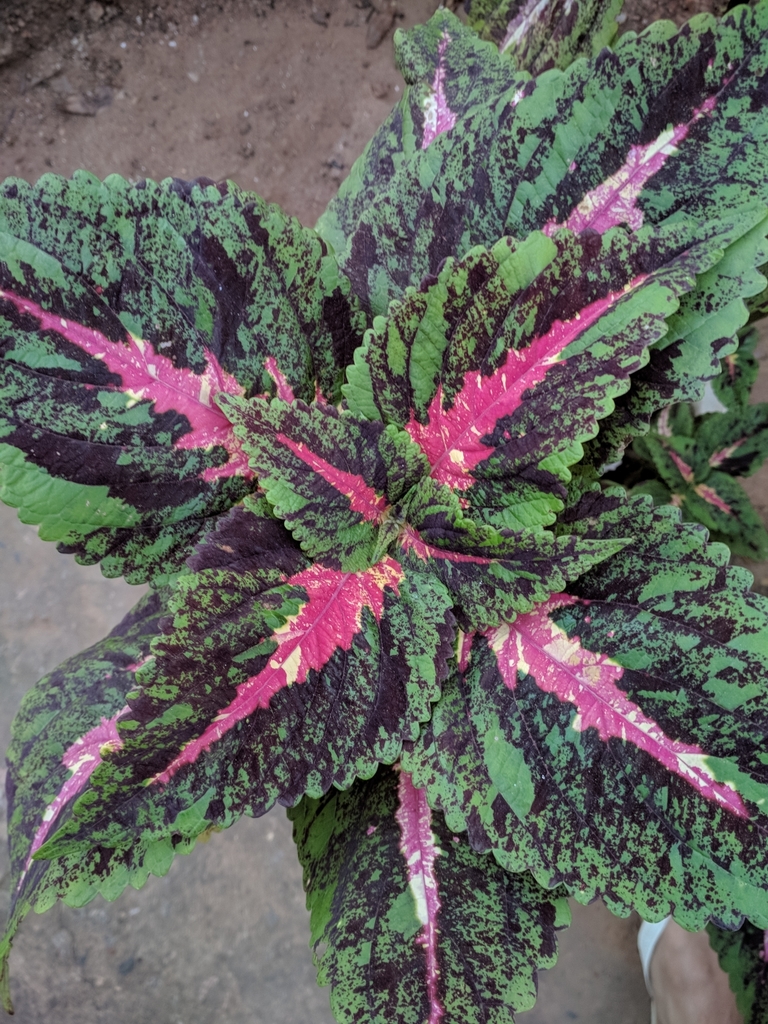
The leaves grow in opposite pairs on leaf stalks and vary greatly in shape and color. Leaf blades range from rounded-triangular to broadly oval, with scalloped, toothed, or lobed edges; cultivated forms combine green, yellow, red, burgundy, and dark purple tones.
- opposite leaf arrangement
- square stems
- toothed or lobed leaf edges
- hairs along the veins and on the undersides
- prominent glands on the surface
Origin and natural conditions
The species is native to Southeast Asia and the western Pacific. These conditions explain its need for warmth, adequate light, and even moisture without cold, waterlogged conditions.
In temperate climates, the plant is often grown outdoors as a foliage annual or indoors as a houseplant. In a pot, it stays attractive longer if growth is regularly renewed through cuttings or pinching.
| In the wild | Indoors |
|---|---|
| A warm environment without winter cold | Needs consistent warmth, especially in winter |
| Bright indirect light beneath a canopy of vegetation | Does well in a bright spot without harsh midday sun |
| Moisture is regularly available | The potting mix must not dry out completely or become sour and waterlogged |
Light and placement
Leaf color depends on light: in an overly dark spot, contrast often fades and shoots become leggy. Bright indirect light supports more compact growth and more distinct leaf patterns.
The plant tolerates direct morning sun better than midday heat. If the leaves turn yellow, wilt, or develop dry patches, move the pot away from the glass or provide shade during the hottest hours.
Indoors, east- and west-facing windows work well, as does a very bright spot near a south-facing window. The plant can survive on a north-facing windowsill, but its color often becomes less distinct.
Watering and potting mix
Water generously and frequently during active growth, but do not let water stagnate around the roots. The shallow root system reacts quickly to both drying out and overwatering, so the condition of the potting mix matters more than a fixed schedule.
The potting mix needs to be light, nutrient-rich, and well-drained. In a heavy mix, roots receive less air, growth slows, and the risk of rot increases, especially in cool conditions.
- a light all-purpose potting mix
- added perlite or sand
- drainage holes in the pot
- a layer of expanded clay pellets or fine gravel
- planting without burying the root collar
Pruning and propagation
Shoots grow quickly, so pinching helps produce a bushy plant rather than a few long stems. Pruning also rejuvenates the plant when the lower portions of the shoots become bare or woody.
Stem cuttings are the most reliable propagation method. Take cuttings about 10 cm long, remove the lower leaves, and root them in a light potting mix or water; roots usually appear in 8-10 days.
Propagation from seed is also possible, but the seedlings may not retain all the cultivar's traits. Sow seeds in February-March, when you can provide enough light for compact seedling growth.
Flowering and overwintering
The flowers are small, blue, purple, or lilac, arranged in spike-like inflorescences, a terminal raceme, or a panicle. In ornamental plantings, flowering is usually not the main attraction, since the foliage provides most of the visual interest.
Dormancy falls in winter. During this time, keep the roots from getting cold: temperatures must not fall below +12 °C, and watering should be reduced enough to prevent the potting mix from staying constantly wet.
Shoots can be cut back before new growth begins. This encourages young growth, whose leaf color usually looks more distinct than that on old, bare stems.
Common problems
Yellowing leaves are often linked to excessive direct sun, drying out, or root problems. If leaves lose color and become distorted, check for pests as well as reviewing care.
Aphids, spider mites, and whiteflies can harm the plant; mealybugs are also reported. Spider mites are more common in dry air, so raising humidity helps in hot weather, without misting in direct sun.
- loss of leaf color
- distorted young leaves
- sticky residue on shoots
- fine webbing between leaf stalks
- slow growth after overwatering
- Light
- bright indirect light
- Temperature
- +18…+20 °C
- Watering
- generous and frequent
- Soil
- light, well-drained
- Difficulty
- moderate
- Cats and dogs
- mildly toxic
- Size indoors
- up to 1.5 m
- Leaves indoors
- 1-17 cm
- Native range
- Southeast Asia and the western Pacific
Care
Coleus grows quickly and recovers well after pinching, but it reacts strongly to extremes in watering and light. The key to care is keeping the foliage growing actively without overheating, cold, or waterlogging.
- Light
- Provide bright indirect light. Light maintains the contrast in the foliage. Midday sun can scorch the leaves, while shade causes leggy growth and fading color.
- Temperature
- Keep at +18…+20 °C. This is the range for active growth. In winter, keep temperatures above +12 °C; cold, wet potting mix increases the risk of root and stem rot.
- Watering
- Water generously and frequently. During the warmer months, keep the potting mix evenly moist without waterlogging. Both drying out and overwatering quickly affect the foliage.
- Soil
- Use a light, well-drained potting mix. A loose, nutrient-rich mix with added perlite or sand works well. The pot must have drainage holes and a layer of expanded clay pellets or gravel.
- Feeding
- Feed weekly in spring and summer. Use a compound mineral fertilizer during active growth. In winter, reduce feeding to once a month.
- Leaves
- Pinch the shoots. Regular pinching encourages branching and rejuvenates the plant. Old, leggy shoots can be cut back before the next growing season.
- Repotting
- Repot in spring. Combine repotting with replacing the potting mix and pruning. Keep the root collar at the surface rather than burying it.
Botany
2 ill.- Family
- Lamiaceae
- Genus
- Coleus
- Species
- Coleus scutellarioides
- Author and year
- (L.) Benth.


Coleus (Coleus scutellarioides) belongs to the family Lamiaceae. It has opposite, stalked leaves, square stems, and small flowers grouped in terminal inflorescences.
The leaf blade is highly variable: shape, edges, hairiness, and pigment distribution differ within the species and its cultivated forms. This natural variation in color provided the basis for numerous ornamental hybrids.
The species comes from Southeast Asia and the western Pacific. Indoors, it needs warmth, bright indirect light, and careful watering, since its succulent shoots and shallow roots are sensitive to extremes.
How it differs from similar plants
ZZ plant Zamioculcas zamiifolia
- The ‘stems’ of zamioculcas are compound leaves, while coleus is grown for its colorful individual leaf blades.
Rex begonia Begonia rex
- Begonia is easily distinguished by its large, asymmetrical leaves and rhizomatous growth, while coleus stands out for its colorful leaf blades.
Snake plant Dracaena trifasciata
- Sansevieria has long, rigid leaf blades, while coleus has colorful, much smaller leaves—1–17 cm.
Frequently asked questions
- Can coleus be grown indoors?
- Yes, with enough bright indirect light. In deep shade, the leaves often lose contrast and the shoots become leggy.
- Why are the leaves turning yellow?
- Direct sun, drying out, or overwatering may be the cause. If the leaves are also distorted, check the plant for pests.
- How do I prune coleus to make it bushier?
- Pinch the shoots during active growth to encourage branching. Cut back old, leggy stems before the next growing season begins.
- How do I propagate coleus from cuttings?
- The easiest method is to take stem cuttings about 10 cm long. Roots usually appear in 8-10 days.
- Is coleus safe for cats and dogs?
- The plant is mildly toxic to cats and dogs. Do not let pets chew the leaves or shoots.