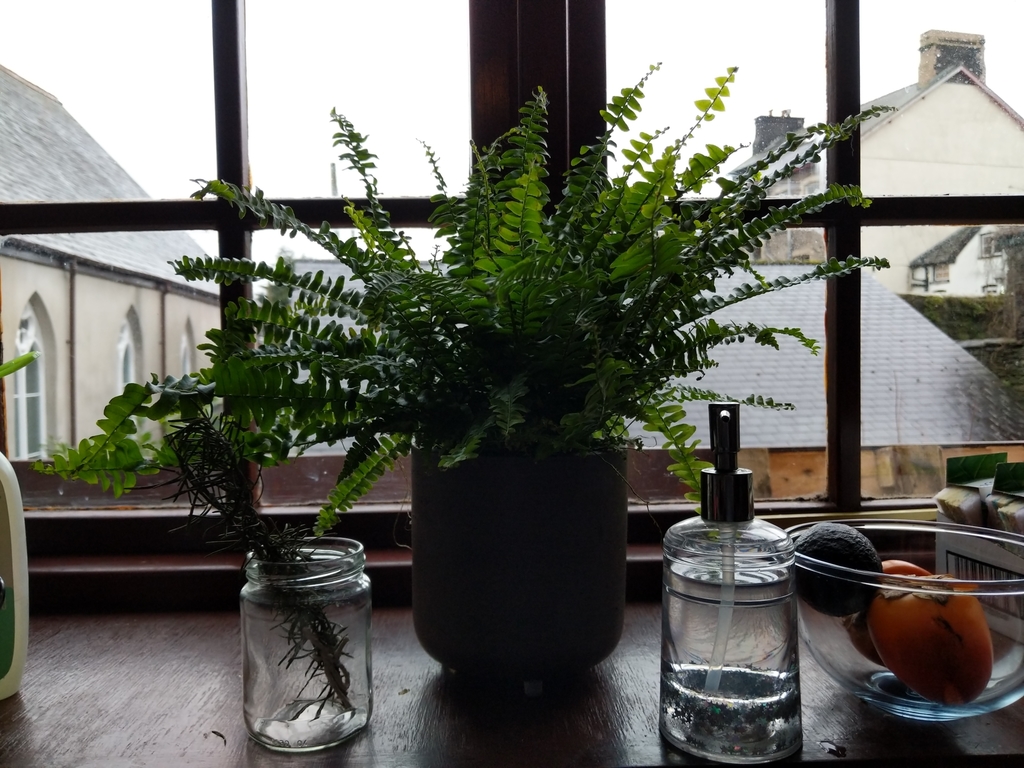
Bird's nest fern
Ferns are often put in a dark corner and watered like ordinary houseplants; bird's nest fern (Asplenium nidus) does not always survive this treatment. It needs shade, humid air, and a loose potting mix because it grows as an epiphyte in tropical forests.


Rosette and fronds
This fern forms a funnel-shaped rosette of undivided, light green fronds. Unlike those of many other ferns, they are not divided, but resemble a long blade with a distinct dark brown midrib.
The fronds reach 60-120 cm long and 7-29 cm wide. The descriptive Ukrainian name meaning "bird's nest" comes from the shape of the rosette: the fronds gather around the center to form a bowl.
- undivided, light green fronds
- dark brown midrib
- linear sori on the underside of the frond
Sori are areas containing sporangia, where spores form. In this species, they lie in regular lines along the side veins and are clearly visible on mature fronds.
Origin and natural conditions
The plant is native to tropical Asia, eastern Africa, and Australia. In the wild, it grows in tropical forests, where the air is humid and tree canopies filter some of the direct sunlight.
It is an epiphyte: it anchors itself to tree trunks but does not feed on their sap. Its roots grow in a layer of organic debris and moisture that accumulates around the rosette.
| In the wild | Indoors |
|---|---|
| Grows on tree trunks | Needs an airy potting mix |
| Receives indirect light | Does best in shade or gentle light |
| The rosette collects rainwater | Does not tolerate prolonged drying out |
Its epiphytic way of life explains why a dense, heavy mix is unsuitable for this fern. The roots need both moisture and air.
Light and placement
In tropical forests, the plant does not grow in full sun. Indoors, this means shade or gentle indirect light that does not overheat the fronds.
Deep darkness is not a substitute for forest shade: beneath the tree canopy, light is diffuse, not absent. The spot should be bright enough for the plant to maintain an even green color and produce new fronds.
- a north- or east-facing window
- away from direct midday sun
- a spot without hot, dry airflow
If the fronds become distorted or their edges dry out, look beyond watering for the cause. This fern needs the right combination of light, humidity, and potting mix conditions.
Watering and humidity
In the wild, the rosette acts as a rainwater collector: moisture flows toward the center and then down to the roots. This is why the fern grows better where the potting mix does not stay dry for long.
At the same time, epiphytic roots are not adapted to a dense, wet mass with no access to air. Watering should maintain even moisture, not turn the potting mix into a stagnant, boggy mass.
- evenly moist potting mix
- humid air around the fronds
- drainage without standing water
For this plant, the effects of dry air are often more noticeable than those of infrequent watering. The fronds are large and undivided, so their edges quickly show the effects of prolonged dry conditions indoors.
Potting mix and repotting
The species' epiphytic nature calls for a loose, airy potting mix. Its job is to retain moderate moisture without blocking oxygen from reaching the rhizome and roots.
Repot when the roots run out of space or the potting mix has become compacted and dries slowly. Do not bury the rosette when repotting: the growing point must remain exposed.
- a loose structure
- consistent moisture
- no compaction around the rhizome
An overly heavy mix changes conditions around the roots more than it might seem. For a fern that grows on trees, this is a common cause of declining frond health.
Why fronds turn yellow or dry out
Yellowing fronds are usually linked to an imbalance between moisture and air around the roots. If the potting mix stays wet and dense for a long time, the roots function less effectively.
Dry edges are more common where the air is dry or the plant is poorly placed. An individual old frond may die naturally, but widespread decline calls for a check of the growing conditions.
- compacted potting mix
- prolonged drying out
- dry air
- overly harsh light
- standing water around the roots
Remove only fully damaged or dead fronds. Avoid damaging the center of the rosette, as this is where new fronds unfurl.
Spores and propagation
Like other ferns, this plant does not produce seeds. Its reproductive structures are spores, which form in sori on the undersides of mature fronds.
The linear arrangement of sori along the side veins is a distinctive botanical feature of the species. Vegetative propagation by dividing the rosette is unsuitable for this growth habit, because damage to the growing point can easily stop growth.
- sori maturing on the underside of the frond
- spores forming instead of seeds
- keeping the center of the rosette intact
When grown indoors, propagation from spores requires clean conditions and patience. For routine care, keeping the rosette healthy is more important than trying to physically divide the plant.
- Light
- shade
- Watering
- even moisture
- Soil
- airy potting mix
- Difficulty
- moderate
- Cats and dogs
- safe
- Leaves indoors
- 60-120 × 7-29 cm
- Native range
- tropical Asia, eastern Africa, and Australia
Care
This tropical epiphytic fern forms a large rosette, so its care comes down to three things: gentle light, humid air, and an airy potting mix. Drying out and a dense, wet mix are equally harmful to its roots.
- Light
- Provide shade or gentle light. In the wild, it grows beneath the tropical forest canopy. Indirect light without harsh direct sun suits it best.
- Watering
- Keep evenly moist. Do not let the potting mix stay dry for long. This epiphyte's roots also need air, so avoid standing water.
- Soil
- Use a loose potting mix. Epiphytic roots function better in an airy mix. A dense mix holds water around the rhizome for a long time.
- Leaves
- Maintain humidity. The large, undivided fronds develop dry edges in dry air. Avoid damaging the center of the rosette.
- Support
- No support needed. The plant grows as a rosette and does not produce climbing or long stems that need tying up.
- Repotting
- Repot when the mix becomes compacted. Repot without burying the center of the rosette. The main aim is to keep the mix loose and allow air to reach the roots.
Botany
4 ill.- Family
- Aspleniaceae
- Genus
- Asplenium
- Species
- Asplenium nidus
- Author and year
- L.


Bird's nest fern (Asplenium nidus) belongs to the family Aspleniaceae. It is a fern with a nest-shaped rosette, undivided sword-shaped fronds, and a short rhizome surrounded by a mass of roots.
In the wild, the species grows as an epiphyte: it anchors itself to tree trunks in tropical forests and uses the moisture and organic debris caught in its rosette. This structure explains its need for an airy, uncompacted root environment.
The spores are arranged not randomly, but in even lines on the underside of the frond. These linear sori and undivided fronds distinguish the species from many ferns with pinnately divided fronds.
How it differs from similar plants
ZZ plant Zamioculcas zamiifolia
- Bird's nest fern is recognizable by its much larger fronds, 60–120 cm, while zamioculcas foliage is described as 7–15 cm and is also compound.
Rex begonia Begonia rex
- Begonia is recognizable by its large, asymmetrical leaves, while the description of bird's nest fern emphasizes its long fronds, 60–120 × 7–29 cm.
Snake plant Dracaena trifasciata
- Sansevieria has long, stiff leaves and needs bright light or partial shade, while bird's nest fern is described as a plant for shade.
Frequently asked questions
- Is bird's nest fern safe for cats and dogs?
- Yes, bird's nest fern is safe for cats and dogs. The only potential problem is physical damage to the fronds by a pet.
- Why are the fronds turning yellow?
- The most common causes are drying out, dry air, or a dense, wet potting mix. Check both the roots and the plant's location.
- How often should I water it?
- Avoid letting the potting mix dry out completely. Watering should maintain even moisture without standing water around the roots.
- Can I keep it in shade?
- Yes, this fern comes from shaded tropical forests. But it needs a spot with gentle indirect light, not a dark corner.
- What are the brown stripes on the underside of the frond?
- The brown lines on the undersides of mature fronds are sori containing spores. This is a normal reproductive feature of the fern.