Aloe vera
On the Arabian Peninsula, aloe vera (Aloe vera) evolved as a succulent adapted to dry periods: it stores water in its fleshy leaves, and excess moisture around its roots is more dangerous than a pause in watering.

Rosette structure
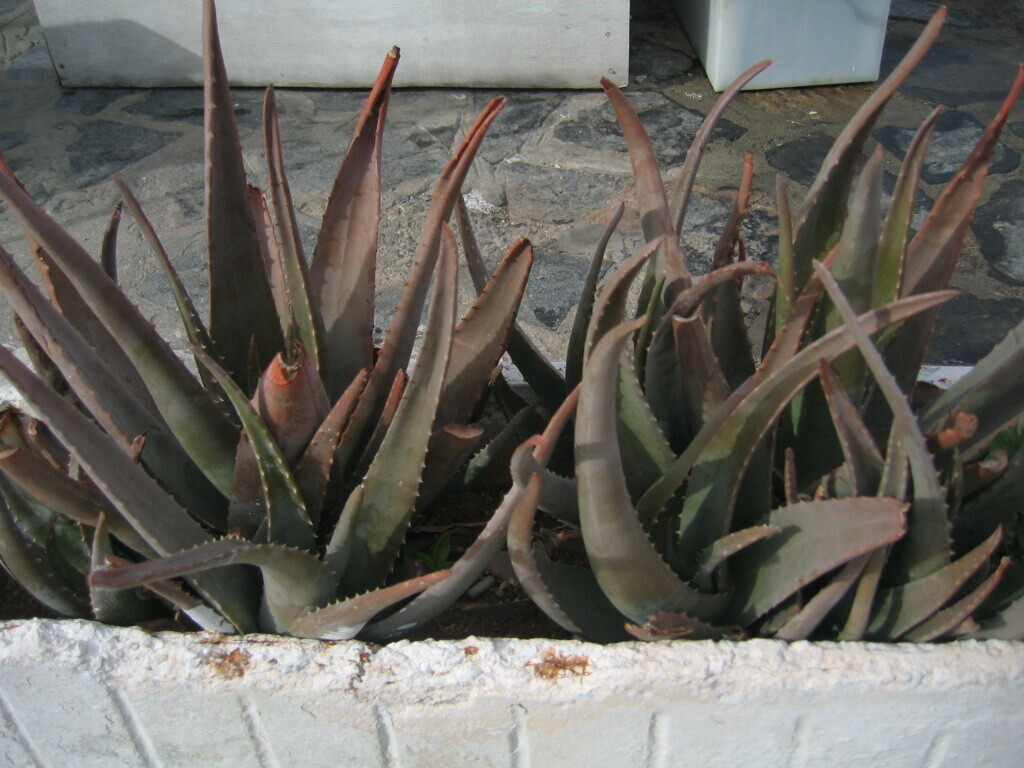
The plant forms a compact rosette with a very short stem. The leaves are lance-shaped, fleshy, grayish-green, and sometimes spotted with white; on mature plants, they can reach up to 50 cm long and 6-7 cm wide.
The leaf edges are sharply toothed, with small spines and sometimes a pink tinge. The leaf tissue acts as a water reservoir, so the plant's appearance depends directly on light, watering, and root health.
- very short stem
- dense leaf rosette
- fleshy, lance-shaped leaves
- small spines along the edges
- bitter sap in the leaf tissue
Origin and dry conditions
The species is native to the Arabian Peninsula. This origin explains its key succulent trait: rather than being adapted to a constantly damp potting mix, it stores water in its leaves and uses it gradually.
Under stress, aloe vera can reduce moisture loss by closing its stomata. Indoors, this means the plant tolerates a brief dry spell better than water sitting around its roots.
| In the wild | Indoors |
|---|---|
| dry periods between wet spells | a pause between waterings after the potting mix dries out |
| intense sunlight | the brightest available spot |
| water stored in the leaves | no misting of the rosette |
Light and temperature
Bright sunlight is needed for normal growth. In a shaded spot, the rosette stretches, new leaves become weaker, and stored water can no longer compensate for the lack of energy.
Normal household temperatures are suitable in spring and summer. For winter, sources recommend cooler conditions for aloe vera—no higher than +14 °C; this is not the usual summer regime, but a condition for the quieter season.
Watering and potting mix
Water according to the condition of the potting mix, not the calendar. If the mix is still damp deep in the pot, more water increases the risk of root problems.
The potting mix needs to let water through quickly and resist compaction after repeated watering. What matters for this succulent is not frequent watering, but complete drying between waterings and no standing water in the saucer.
- let the potting mix dry out completely before watering
- use a pot with a drainage hole
- empty excess water from the saucer
- do not mist the rosette
- water cautiously during the cool season
Flowering and flower clusters
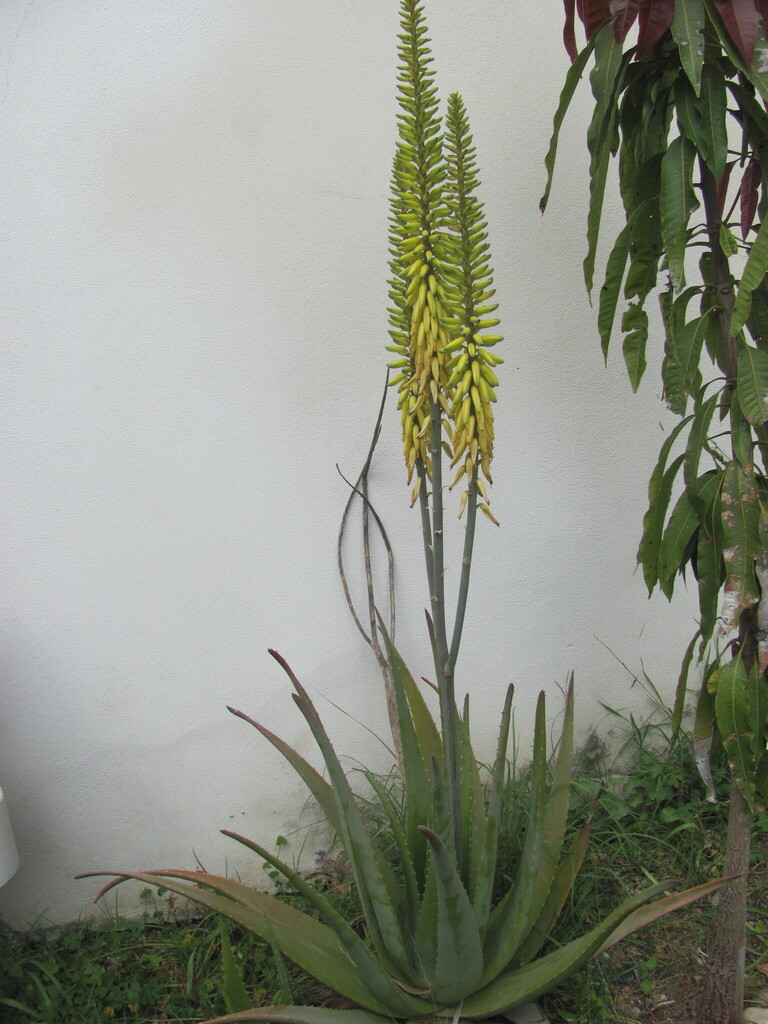
In its natural cycle, a flower stalk up to 90 cm tall may emerge from the center of the rosette in early summer. It is usually branched and bears 2-4 racemes of tubular flowers.
The flowers are about 3 cm long and most often shades of yellow; bright red flowers have been described in some local or artificially bred forms. Flowering is uncommon indoors and depends more on light and seasonal conditions than on feeding.
Propagation and repotting
The species produces offsets, forming dense groups of rosettes over time. These offer the most straightforward way to propagate it vegetatively: separate a developed shoot with its own base, rather than a single leaf.
Propagation from seed is possible, but is less common indoors because it requires flowering and the formation of a seed capsule. Repot when the rosette or offsets fill the pot and the plant becomes unstable.
- separate offsets
- repot once the pot is full
- choose a stable container
- retain a drainage hole
- handle the fleshy leaves carefully
Why leaves deteriorate
Soft, watery, or dark patches on the leaves are most often linked to excess moisture in the potting mix. This succulent's roots are not adapted to staying wet, so leaf symptoms may appear after a watering mistake.
- constantly wet potting mix
- insufficient sunlight
- water in the center of the rosette
- an overcrowded pot
- damage to the leaf blade
Yellowing without rot may occur after a sudden change in conditions or a prolonged lack of light. If the leaves lose firmness, check the potting mix, roots, and light first, rather than how often the plant is fed.
- Light
- bright sunlight
- Temperature
- room temperature in spring and summer
- Watering
- after the potting mix dries out
- Soil
- well-drained
- Difficulty
- easy
- Cats and dogs
- mildly toxic
- Size indoors
- rosette up to 60 cm
- Leaves indoors
- up to 50 cm long
- Native range
- Arabian Peninsula
Care
This succulent stores water in its leaves, so care centers on light and careful watering. Constant moisture does more harm than a short period without water.
- Light
- Provide bright sunlight. Needs a very bright spot; supplemental lighting may be needed in winter if sunlight is insufficient.
- Temperature
- Keep at room temperature during growth. Normal household temperatures are suitable in spring and summer; sources recommend no higher than +14 °C for aloe vera in winter.
- Watering
- Water after the potting mix dries out. The fleshy leaves store water, so a constantly damp potting mix is more dangerous than a brief dry period.
- Soil
- Use a mix that drains well and dries out. The potting mix should drain quickly and dry out completely between waterings; water should not sit around the roots.
- Feeding
- Feed moderately. Feed only during active growth; fertilizer cannot compensate for insufficient light or watering mistakes.
- Support
- No support needed. The stem is very short, and the leaves form a rosette; support serves no practical purpose.
- Leaves
- Do not mist. The plant is adapted to store moisture in its leaves; water should not collect in the center of the rosette.
- Repotting
- Repot when the pot is crowded. Repot when the rosette or offsets fill the container; drainage and a stable pot are important.
Botany
3 ill.- Family
- Asphodelaceae
- Genus
- Aloe
- Species
- Aloe vera
- Author and year
- (L.) Burm.f.
- Life form
- succulent
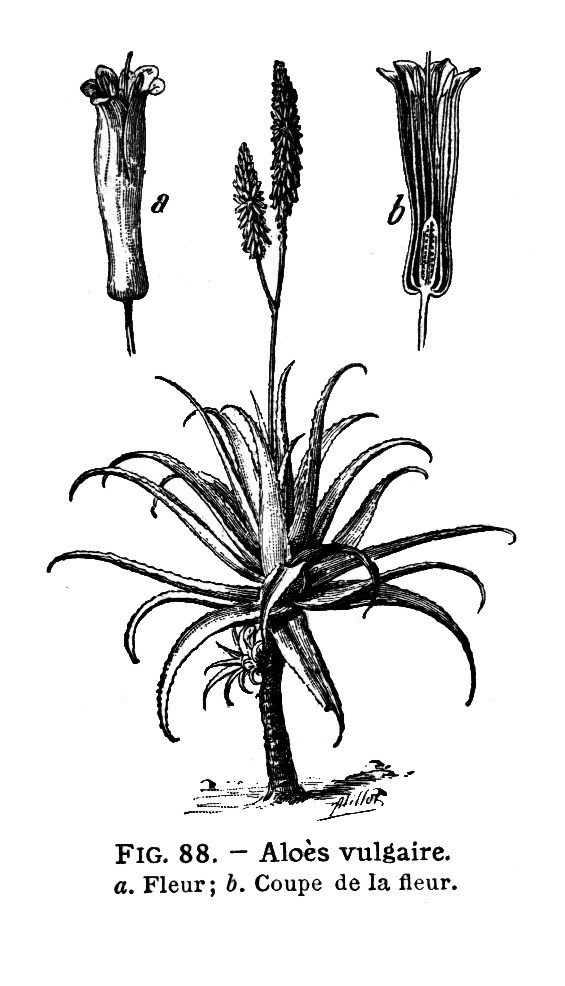


Aloe vera (Aloe vera) is a succulent in the family Asphodelaceae and genus Aloe. It is a herbaceous perennial with a short stem, offsets, and rosettes of fleshy leaves.
The leaves are lance-shaped, slightly ridged, grayish-green, and sometimes spotted with white. Small spines line the edges, while the leaf tissue contains mucilage, polysaccharides, and bitter sap.
The species is native to the Arabian Peninsula. It has long been cultivated as a medicinal and foliage plant, but using its sap at home is no substitute for medical advice.
How it differs from similar plants
Haworthiopsis attenuata Haworthiopsis attenuata
- Haworthia is much smaller: its leaves are only 5–8 cm long, while aloe vera leaves reach 50 cm and form a rosette up to 60 cm across.
Gasteria Gasteria obliqua
- Gasteria is distinguished by thick, tongue-shaped leaves with whitish spots, initially arranged in two rows rather than immediately forming an aloe vera rosette.
Flaming Katy Kalanchoe blossfeldiana
- Kalanchoe is easy to distinguish by its corymb-like flower clusters and more compact size of 30–40 cm, while aloe vera is described as a leaf rosette up to 60 cm across.
Frequently asked questions
- Is Aloe vera the same as the plant called “centenarian” in Ukrainian?
- The Ukrainian folk name “centenarian” is used for various aloes. The botanical name of the plant on this page is Aloe vera, not tree aloe.
- Can I keep it at home if I have a cat or dog?
- Yes, but the plant is mildly toxic to cats and dogs. If eaten, its sap can irritate mucous membranes and the digestive tract.
- How often should I water?
- Water after the potting mix dries out. Frequent watering without allowing it to dry is a common cause of soft leaves and root problems.
- Why are the leaves turning yellow?
- Yellowing is often linked to insufficient light, overwatering, or a sudden change in conditions. Check the potting mix and the plant's location first.
- Why isn't it flowering?
- Flowering is uncommon indoors. It requires strong light and more pronounced seasonal changes, including a cooler winter.


