Purple velvet plant
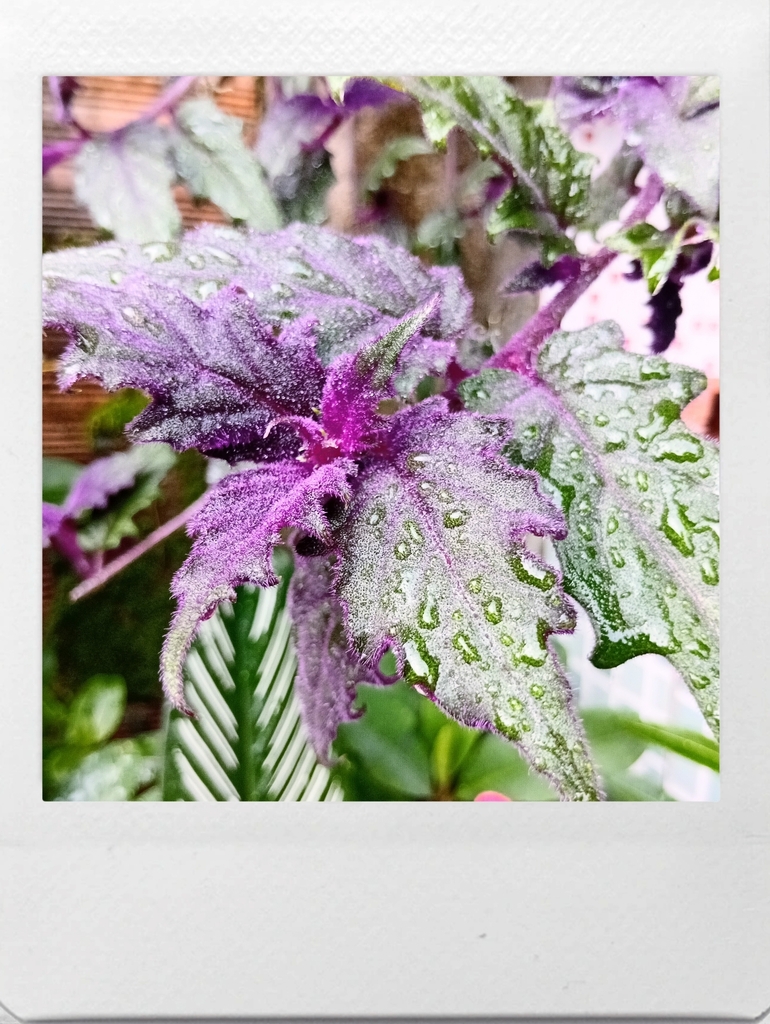
The fuzzy leaves are easily damaged by something that seems beneficial for many plants: misting. On purple velvet plant (Gynura aurantiaca), water on the hairy leaf surface can leave brown spots, and the purple color lasts only with enough light.
Name and botanical classification
Purple velvet plant belongs to Asteraceae, the aster or composite family. This matters when interpreting its flowers: the decorative ‘flower’ in these plants is usually not a single flower but a flower head.
The genus name Gynura comes from Greek and is associated with the image of a ‘woman with a tail.’ This refers to the characteristic long, whiplike stems that can make the plant lose its compact shape as it ages.
Leaves and hairs
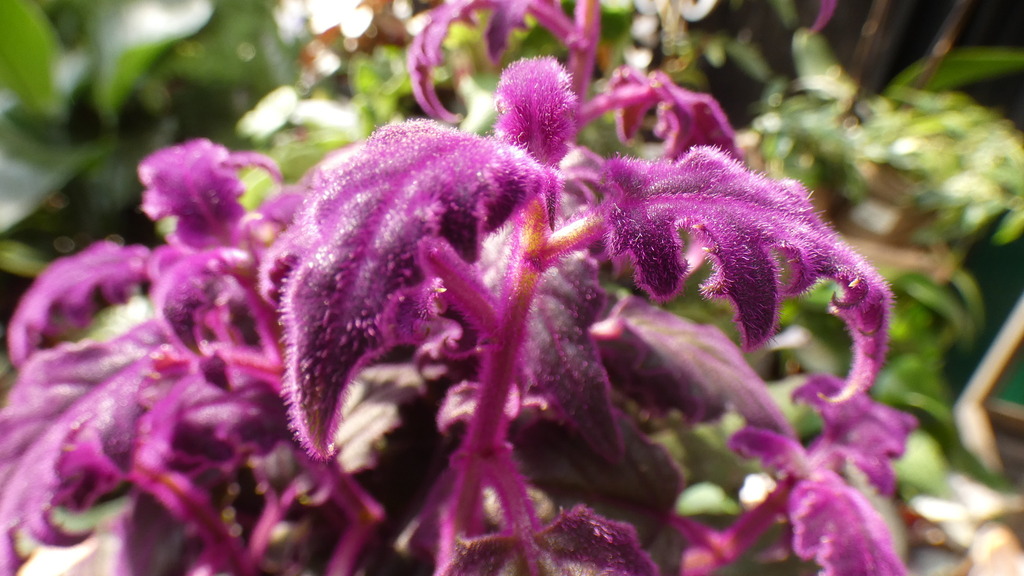
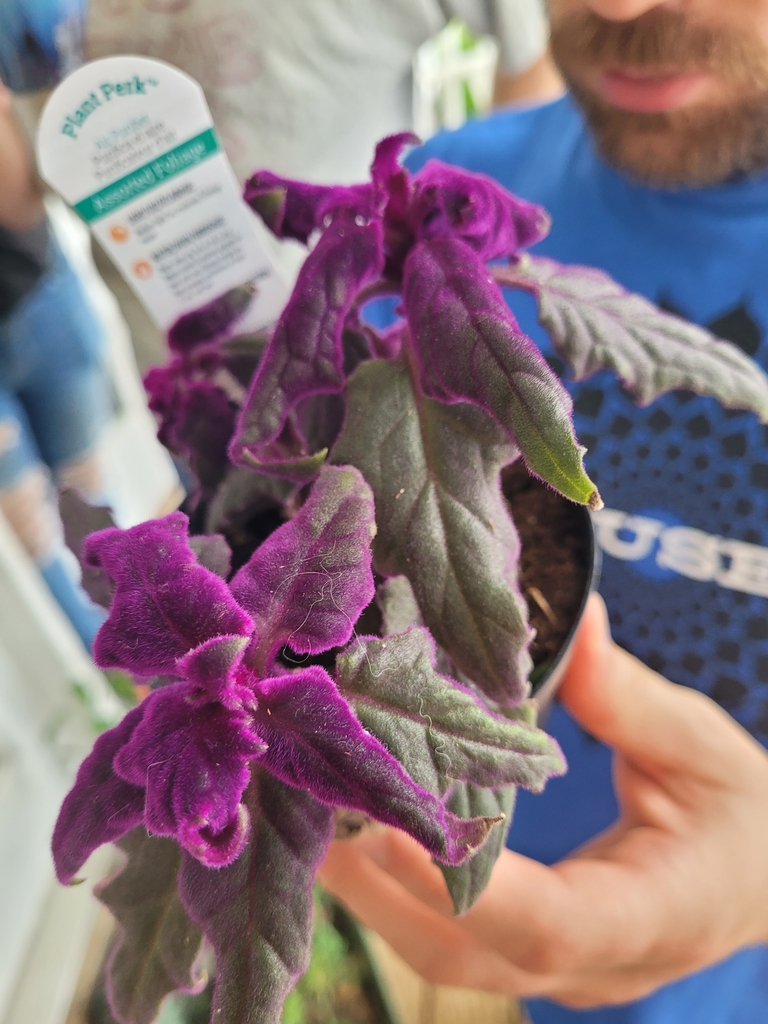
Indoors, the plant is valued mainly for its leaves: they are simple, arranged alternately, and may have a purple tint. The hairs give them a textured surface, so water behaves differently on them than on glossy leaves.
- the purple color fades with too little light
- stems become leggy in a spot that is too dark
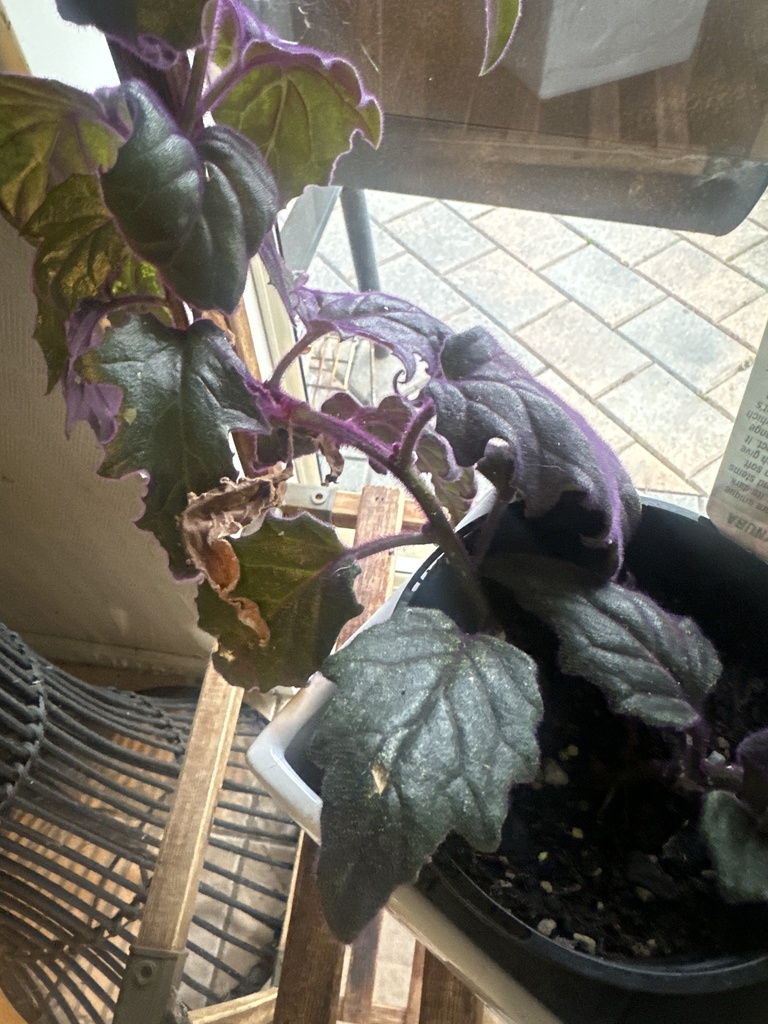
- brown spots may appear after misting
These changes are not always signs of disease. More often, they indicate that the plant is in an unsuitable spot or that its leaves are regularly getting wet.
Origin and growing conditions
The species is native to Southeast Asia. Indoors, this means it needs stable conditions without sharp extremes, but precise temperature limits for this species should not be inferred without specific data.
The genus Gynura includes plants from tropical regions of Africa and Asia. Some are ornamental and others are edible, but Gynura aurantiaca is grown indoors specifically for its leaves and stems.
| Feature | In the wild | Indoors |
|---|---|---|
| Stems | upright, spreading, or climbing | may need support or trail |
| Leaves | simple, alternate, sometimes with a purple tint | lose their vivid color with too little light |
| Flower heads | heads with numerous bisexual flowers | buds are sometimes removed because of the smell |
Light and color
The leaves retain their purple tint better with enough light. In low light, the leaf surface becomes dull and the stems grow noticeably leggy.
A spot with bright indirect light is suitable. Assess not only the brightness but also the plant’s shape: long, weak stems usually indicate too little light.
Watering and leaf surfaces
Water more generously from spring to fall, when the plant is actively producing stems and leaves. In winter, reduce watering to a moderate level, but do not let the root ball dry out completely.
Do not mist the fuzzy leaves. Water droplets can leave brown spots, so wetting the leaves to raise humidity is not a suitable approach for this species.
Stems and shaping
The stems can grow upward or trail, so the plant can be grown with support or in a hanging planter. As it ages, the stems may become less herbaceous and the plant less dense.
Maintaining its shape depends on how it is grown. Add a support for upright growth, or let the stems trail over the edge of a hanging planter.
- support for upward-growing stems
- a hanging position for trailing stems
- a bright spot for denser growth
If the plant quickly becomes leggy, check the light first. Shaping it without enough light has only a short-lived effect, because new stems will become elongated again.
Flower heads and smell
As a member of the aster family, the plant produces flower heads. In the genus Gynura, these can be disc-shaped or narrowly bell-shaped, with numerous yellow, orange, and sometimes red or purple flowers.
Indoors, flowering is described as abundant from spring to late fall. The flowers have an unpleasant smell, so the buds are sometimes removed before they open.
- Light
- bright indirect light
- Watering
- water generously during the growing season
- Difficulty
- moderate
- Cats and dogs
- safe
- Native range
- Southeast Asia
Care
Caring for purple velvet plant comes down to two things: enough light and careful handling of its fuzzy leaves. The plant reacts poorly not to watering itself, but to water left on the leaf surface.
- Light
- Provide bright indirect light. With too little light, the purple color fades and the stems become leggy. Aim for a bright spot without prolonged shade.
- Watering
- Water generously from spring to fall. Water more generously during active growth. In winter, water moderately, but do not let the root ball dry out completely.
- Support
- Provide support or let it trail. The stems can grow upward or trail. Add a support for upright growth, or let the stems hang down in a hanging planter.
- Leaves
- Do not mist. Water droplets can cause brown spots on the fuzzy leaf surfaces. It is best to keep the leaves dry.
Botany
3 ill.- Family
- Asteraceae
- Genus
- Gynura
- Species
- Gynura aurantiaca
- Author and year
- (Blume) DC.


Purple velvet plant (Gynura aurantiaca) belongs to the genus Gynura in the family Asteraceae. The genus is described as comprising perennial herbs or subshrubs with upright, spreading, or climbing stems.
Leaves in this genus are simple and alternate, sometimes with a purple tint on the underside. The leaf blade may have toothed margins or be divided into lyre-shaped lobes, and the covering of hairs ranges from conspicuous to almost absent.
The flower heads are solitary or arranged in terminal or axillary flat-topped clusters. The fruits are achenes with a tuft of finely barbed bristles.
How it differs from similar plants
ZZ plant Zamioculcas zamiifolia
- Purple velvet plant stands out for its fuzzy, purple leaf surfaces, while the parts of Zamioculcas that look like stems are compound leaves.
Rex begonia Begonia rex
- Begonia has large, asymmetrical leaves, while purple velvet plant is recognized by its fuzzy leaf surfaces, which retain their purple color in bright indirect light.
Frequently asked questions
- Why are the leaves losing their purple color?
- Most often because of too little light. In shade, the stems become leggy and the purple color fades.
- Can I mist the leaves?
- No. Water droplets can cause brown spots on the fuzzy leaf surfaces.
- How should I water it in winter?
- Water more generously from spring to fall and moderately in winter. Do not let the root ball dry out completely.
- Is it safe for cats and dogs?
- Yes, the plant is safe for cats and dogs. However, it should not be treated as indoor greenery for them to eat.
- Why are the buds removed?
- The flowers have an unpleasant smell. For this reason, the buds are sometimes removed before they open.
