Moon cactus
In Paraguay, Bolivia, and Argentina, moon cactus (Gymnocalycium mihanovichii) grows in sandy soils sheltered by grasses, shrubs, and palms, so indoors it does best in partial shade with fast drainage.


Stem structure
The plant has a spherical, gray-green or reddish-brown stem. Indoors, it is often seen as a ‘bare’ ball with ribs, but the ribs and areoles carry the main features used to identify the species.
The stem reaches about 5-6 cm in diameter. The ribs are usually sharp, triangular in cross section, with thickened areas and transverse light and dark bands.
- spherical, gray-green or reddish-brown stem
- usually 8 sharp ribs
- usually 5 radial spines up to 1 cm long
- curved gray-brown spines
- spindle-shaped fruits
Natural habitat
The species is native to Paraguay, Bolivia, and Argentina. In the wild, it occurs at elevations of 0-500 m above sea level among low-growing vegetation, where the stem is partly sheltered by grasses, shrubs, or palms.
| In the wild | Indoors |
|---|---|
| Sandy soils | Sandy, well-drained potting mix |
| Partly hidden among vegetation | A position in partial shade |
| Elevations of 0-500 m | No need to imitate high-altitude conditions |
Livestock grazing is cited as the main threat to wild populations. The species also occurs in protected areas of Paraguay and in parks in Argentina's Chaco Province.
Light and placement
This cactus did not evolve as a plant of exposed rocky plateaus without shelter. In the wild, surrounding vegetation protects it, so partial shade is more natural for it than prolonged harsh sun.
Indoors, choose a bright spot where the stem will not overheat. Take particular care with grafted forms without chlorophyll: their colored scion depends on the rootstock and does not function like a normal green stem.
- indirect light near a window
- light shade during the brightest hours
- a stable position for the pot without frequent moves
Watering and potting mix
During the growing season, the plant needs thorough watering, but only in a potting mix that drains quickly. A dense, constantly wet mix does not match the sandy soils where the species grows in the wild.
In winter, the potting mix should not be completely dry. For this species, a cool winter rest around +10 °C goes hand in hand with careful watering, rather than allowing the mix to dry out completely for long periods.
- a sandy base for the potting mix
- fast drainage of excess water
- sufficient nutrients without compaction
Flowers and fruit
Flowers appear on the upper part of the stem. In the typical form, they range from yellowish-green to greenish-olive and reach about 3 cm in length and diameter.
White, pink, and yellow flowers have also been described in different forms. Spindle-shaped fruits may develop after flowering, but this requires conditions that allow pollination.
Forms without chlorophyll
Mutations were noticed in seedlings of this species in the early 20th century, and red forms were selected from them. Yellow, pink, and orange forms lacking green pigment appeared later.
These plants have no chlorophyll, so they cannot grow independently like a green cactus. They are kept grafted onto another cactus, which supplies the scion with the substances it needs to grow.
- a colored scion without chlorophyll
- a green rootstock that supports growth
- a decorative top that depends on the condition of the rootstock
Origin of the name
The genus name Gymnocalycium comes from Greek words meaning ‘naked’ and ‘cup.’ It refers to the structure of the flower tube, which has no hairs or small spines.
The specific epithet honors Nicolás Mihanovich, an Argentine shipowner and patron. He supported the shipment to Europe of plants collected by Alberto Vojtěch Frič.
- Light
- partial shade
- Watering
- water thoroughly during the growing season
- Soil
- sandy, well-drained
- Difficulty
- moderate
- Cats and dogs
- safe
- Size indoors
- 5-6 cm in diameter
- Native range
- Paraguay, Bolivia, and Argentina
Care
This cactus is not suited to a scorching desert windowsill: in the wild, it is partly sheltered by surrounding vegetation. The main risks at home are excess water without drainage and a winter rest without cool temperatures.
- Light
- Keep in partial shade. In the wild, the stem is partly sheltered by grasses, shrubs, and palms, so indirect light without prolonged harsh sun suits this plant.
- Temperature
- Keep around +10 °C in winter. Cool temperatures are needed during dormancy. This is the winter care temperature, not the main temperature for spring and summer growth.
- Watering
- Water thoroughly during growth. During the growing season, watering should thoroughly moisten the potting mix, but water must not stand in it. In winter, do not keep the mix completely dry.
- Soil
- Use a sandy, well-drained mix. A sandy base matches the species' natural conditions. The potting mix should drain quickly while remaining sufficiently nutrient-rich.
- Feeding
- Provide nutrients through the potting mix. The potting mix supplies most of the nutrients. For this species, drainage and a moderate nutrient supply matter more than heavy feeding.
- Support
- No support needed. The small, spherical stem usually needs no support. For grafted forms without chlorophyll, the stability of the rootstock is important.
Botany
4 ill.- Family
- Cactaceae
- Genus
- Gymnocalycium
- Species
- Gymnocalycium mihanovichii
- Author and year
- (Fric & Gürke) Britton & Rose

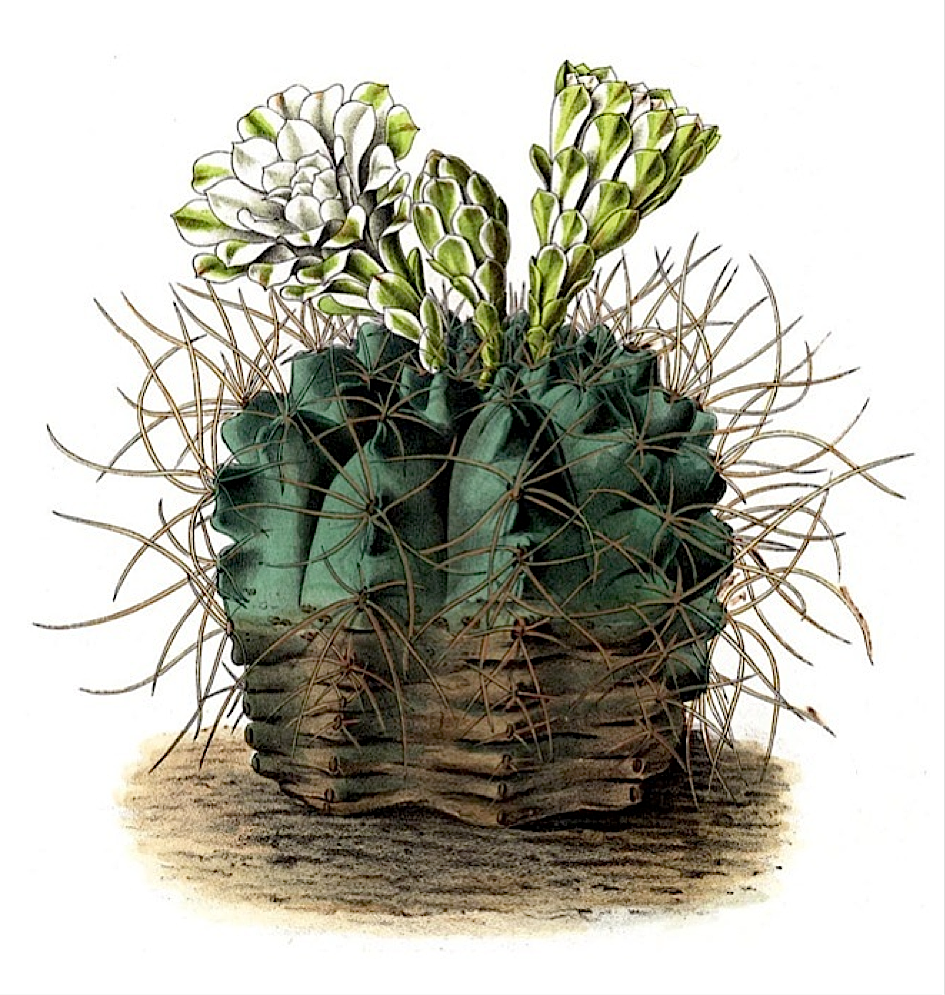


Moon cactus (Gymnocalycium mihanovichii) belongs to the family Cactaceae. Its stem is spherical, with sharp ribs, transverse bands on the thickened areas, and curved radial spines.
Its natural range covers Paraguay, Bolivia, and Argentina. The species grows in sandy soils among low-growing vegetation, so in cultivation it does best in partial shade and a well-drained potting mix.
A distinctive feature of the species is its colored forms without chlorophyll. These cannot live on their own roots like a normal green cactus and need to be grafted onto another cactus.
How it differs from similar plants
Thanksgiving cactus Schlumbergera truncata
- Schlumbergera is easy to distinguish by its flat green segments with sharp teeth and tubular flowers at the tips of the shoots, while no leaves are listed in the description of moon cactus.
Bunny ears cactus Opuntia microdasys
- Opuntia is recognizable by its flat oval segments with small yellow areoles and its size of up to 1 m, while moon cactus reaches only 5–6 cm in diameter indoors.
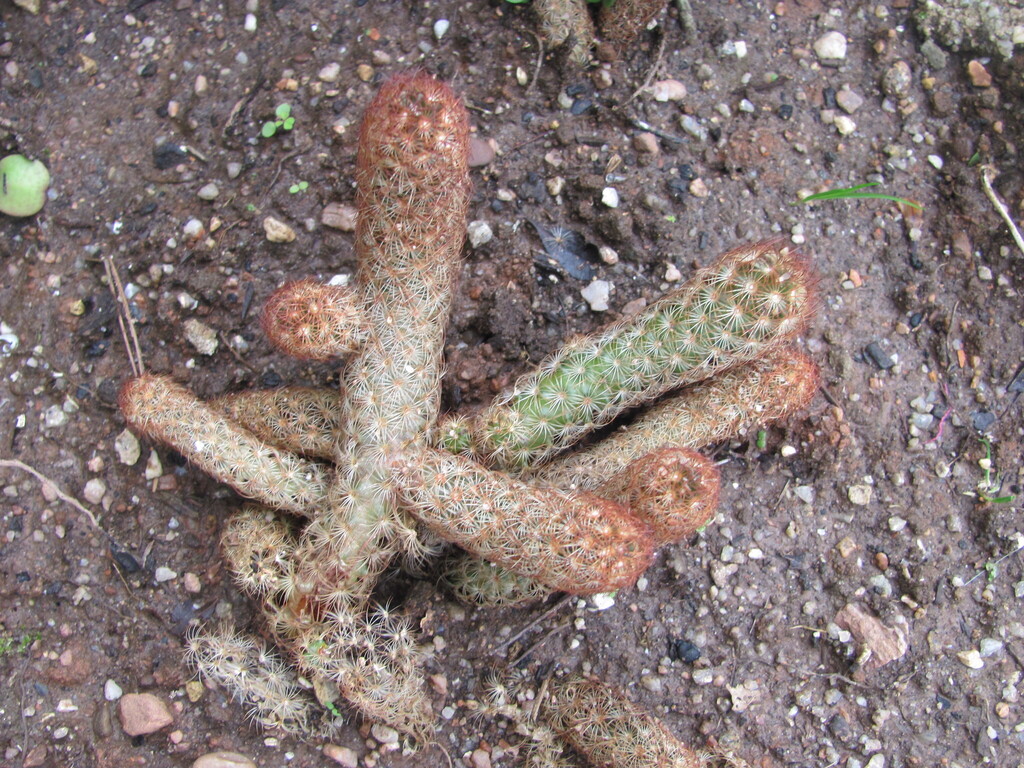 Ladyfinger cactus
Mammillaria elongata
Ladyfinger cactus
Mammillaria elongata- Mammillaria forms dense clumps of elongated cylindrical stems up to 60 cm in diameter, while moon cactus stays compact at 5–6 cm.
Frequently asked questions
- Is moon cactus safe for cats and dogs?
- Yes, the plant is safe for cats and dogs. The spines can still injure their mouths or paws.
- Why is the colored cactus grafted?
- Colored forms without chlorophyll cannot sustain their own growth. They are kept on a green rootstock that nourishes the scion.
- What light does it need?
- Partial shade or bright indirect light is best. In the wild, the plant grows sheltered by grasses, shrubs, and palms.
- How should I water it in winter?
- In winter, it needs cool temperatures around +10 °C and a potting mix that is not completely dry. Water carefully during this time.
- Does it flower indoors?
- Yes, it flowers. Typical flowers are yellowish-green or greenish-olive; different forms can also have white, pink, and yellow flowers.
