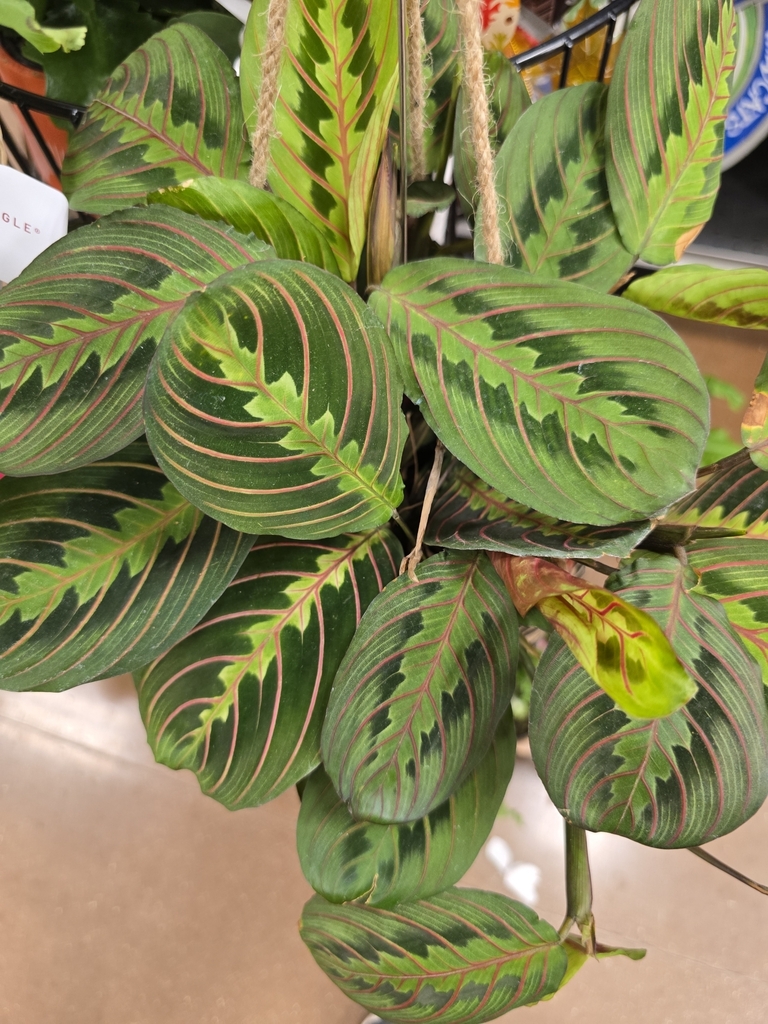
Zebra calathea
Velvety leaves with dark green and light green stripes are the defining feature of zebra calathea (Goeppertia zebrina). Their undersides have a reddish-purple tint, and the leaves rise in the evening.


Leaves and daily movement
The broad leaves are held almost horizontally on long leaf stalks—it is these stalks, rather than the stem, that give the clump its shape. A mature plant reaches 30-90 cm tall with a spread of 30-60 cm.
In the evening, the leaves rise and partially fold. This is not a sign of insufficient water, but a natural daily movement characteristic of the Marantaceae family; it often continues indoors.
Origin and forest conditions
The species' natural range is eastern and southern Brazil, from Bahia to Santa Catarina. It grows in warm, humid places where direct sunlight is usually filtered by the tree canopy.
Indoors, this means it needs stability rather than bright sun: gentle light, warm air, and moist potting mix without waterlogging. Sudden changes in conditions quickly affect the leaf edges and firmness.
Light and placement
Bright indirect light or light partial shade is best. Direct rays can damage the leaves, while deep shade makes the pattern less distinct and slows growth.
- a spot near a window with filtered light
- protection from midday sun
- distance from a hot radiator
- no cold drafts
- even lighting around the plant
If the leaf pattern loses contrast, move the plant to a brighter spot, but keep it out of direct sun. Make changes gradually, as plants in the Marantaceae family respond noticeably to changes in humidity and light.
Watering and potting mix
Watering should keep the potting mix moderately moist, but not wet. The top layer can dry slightly between waterings; water constantly sitting around the roots increases the risk of rot.
- soft, filtered water at room temperature
- a light, peat-based potting mix
- added perlite or sand
- a pot with a drainage hole
- emptying excess water from the saucer
Hard water and very dry air often have the same result: brown leaf edges. Assess the problem as a whole: the condition of the potting mix, water quality, and humidity all matter at the same time.
Temperature, humidity, and leaves
During the growing season, a warm range of +18…+24 °C is suitable. This plant is not suited to cold windowsills: falling temperatures combined with moist potting mix are especially dangerous for the roots.
| Sign | Likely cause | What to do |
|---|---|---|
| Brown edges | dry air or hard water | increase humidity and change the water you use |
| Fading color | too little indirect light | move to a brighter spot |
| Wilting in wet potting mix | risk of root rot | let the potting mix dry out and check the roots |
Misting should not replace adequate humidity. Avoid leaving streams of water on the velvety surface: maintain humidity around the plant instead, without soaking the leaves.
Repotting and propagation
Repot about every two years or when the roots fill the pot. Too much potting mix stays wet longer after repotting, so the new pot should suit the size of the root system.
- remove the clump from the pot
- divide the rhizome into sections
- leave roots and leaves on each section
- plant at the same depth
- place in a warm spot with indirect light
Propagate by dividing the clump, preferably in late spring during active growth. The young divisions root slowly, so warmth, moderately moist potting mix, and high humidity are important after division.
Flowering and naming
Flowering is rare indoors. In nature, the species produces small white or purple flower clusters, but in cultivation it is usually grown for its leaves rather than its buds.
The name Calathea zebrina remains in use in the trade and in older descriptions because many species in this group were previously classified as calatheas. The species' current botanical name is Goeppertia zebrina; the change reflects a revision of the genus boundaries.
- Light
- indirect light
- Difficulty
- moderate
- Cats and dogs
- safe
- Leaves indoors
- broad, velvety
- Native range
- eastern and southern Brazil (from Bahia to Santa Catarina)
Care
Zebra calathea grows best in stable conditions: warmth, indirect light, humid air, and a moderately moist potting mix. The most common problems stem not from a lack of fertilizer, but from dry air, hard water, or water sitting around the roots.
- Light
- Provide indirect light. Bright filtered light or light partial shade works well. Direct sun can damage the leaves.
- Temperature
- Keep at +18…+24 °C. This is the range for the growing season. A cold windowsill combined with wet potting mix increases the risk of root problems.
- Watering
- Water moderately without waterlogging. Keep the potting mix slightly moist. Water with soft, room-temperature water after the top layer has dried slightly.
- Soil
- Use a light, loose potting mix. A peat-based mix with perlite or sand is suitable. Good drainage and a drainage hole in the pot are important.
- Feeding
- Feed once a month during the growing season. Feed with a balanced liquid fertilizer from spring through fall. The plant is less active in winter.
- Support
- No support needed. The plant forms a clump of leaves on long leaf stalks and does not grow as a vine. A stable pot of a suitable size is enough.
- Leaves
- Remove damaged leaves. Cut off only dry, diseased, or badly damaged leaves. Avoid leaving water on the velvety leaf surface.
- Repotting
- Repot every two years. Repot about every two years or when the roots fill the pot. Propagate by dividing the clump at the same time.
Botany
- Family
- Marantaceae
- Genus
- Goeppertia
- Species
- Goeppertia zebrina
- Author and year
- (Sims) Nees
Zebra calathea belongs to the family Marantaceae and the genus Goeppertia. It is a foliage plant with leaves on long leaf stalks, held mostly horizontally to form a broad clump.
The genus Goeppertia originates in the New World tropics and includes 243 accepted species. The genus was named after Heinrich Göppert, a German botanist and paleontologist.
Daily leaf movements are characteristic of the Marantaceae family. They are clearly visible in this species: the leaves are more open during the day and rise in the evening, helping distinguish a natural response from wilting.
Frequently asked questions
- Is it safe for cats and dogs?
- Yes, the plant is safe for cats and dogs.
- Why are the leaf edges drying out?
- Most often because of dry air or hard water. Soft water and higher humidity around the plant help.
- Why do the leaves fold in the evening?
- This is a natural daily leaf movement characteristic of the Marantaceae family. If the leaves are not limp, it is not a sign of disease.
- How often should I repot it?
- As a guide, repot every two years or when the roots fill the pot. Repotting is a convenient time to divide the clump.
- Can I put it in direct sun?
- No, direct rays can damage the leaves. Indirect light or light partial shade is better.