String of pearls
The most common mistake with string of pearls (Curio rowleyanus) is watering it like an ordinary leafy houseplant. This species stores water in its leaves, so constantly wet potting mix quickly damages its roots.


Name and classification
String of pearls belongs to the genus Curio and the family Asteraceae. Its Latin species name is Curio rowleyanus; this identifies it precisely and distinguishes it from other closely related houseplants with a similar appearance.
The Ukrainian common and trade name, meaning “necklace of pearls,” refers to the long trailing stems with round leaves arranged one after another; it is a descriptive name, not a botanical term.
| Feature | Value |
|---|---|
| Family | Asteraceae |
| Genus | Curio |
| Native range | South Africa |
| Safety for cats and dogs | toxic |
Origin and growing conditions
The species is native to South Africa. This does not mean it can be kept in any dry corner of an apartment: indoors, it needs light, ventilation, and controlled watering.
The main care mistake is treating it like a plant with thin, soft leaves. When the potting mix stays wet for a long time, the roots suffer before the stems and leaves show signs of trouble.
- a bright spot that does not get too hot
- a loose potting mix that drains well
- watering after the potting mix has dried noticeably
Light and placement
Bright indirect light is needed for compact growth. In low light, stems stretch, gaps between the leaves become more noticeable, and the plant loses its full appearance.
Direct sun can damage the leaf surfaces after an abrupt move. When changing its location, acclimate the plant gradually, especially after it has spent time farther inside the room.
- an east- or west-facing window
- a south-facing window with shade in hot weather
- a shelf with good supplemental lighting
Watering and potting mix
Water according to the condition of the potting mix, not the calendar. The top layer may dry quickly, but moisture stays inside the pot longer, especially in a dense mix.
After watering, excess water should not sit in the outer pot or saucer. This requires a pot with drainage holes and a light potting mix that lets air reach the roots.
- a dense all-purpose mix without amendments to loosen it
- a pot without drainage holes
- watering the surface in small amounts
- water left constantly in the saucer
- frequent misting instead of proper watering
Toxicity and placement at home
The plant is toxic to cats and dogs. The main danger comes from eating parts of the plant, so do not place the pot where a pet can easily reach the stems.
Fallen plant parts matter too: remove them promptly rather than leaving them on the floor or windowsill. This approach does not exaggerate the risk, but reduces the chance of accidental chewing.
- a hanging pot out of pets’ reach
- a stable shelf with stems that do not trail down to the floor
- regular removal of fallen plant parts
Common problems
Problems often take time to show: the leaves may still hold their shape while the roots are already suffering from excess moisture. Check not only the stems and leaves, but also the weight of the pot, the smell of the potting mix, and how quickly it dries.
An occasional yellow leaf does not always mean disease. But widespread discoloration, soft areas, or sudden shedding indicate that the growing conditions need to be reviewed.
| Symptom | Likely cause | What to change |
|---|---|---|
| Leaves turn yellow | excess moisture | let the potting mix dry out more deeply |
| Leaves shrivel | lack of water or damaged roots | check the roots and watering routine |
| Stems stretch | too little light | move the plant closer to the light |
Repotting and propagation
Repot when the plant outgrows its pot or the potting mix loses its structure. An oversized pot is not needed: it holds moisture longer than the root system can use it.
Vegetative propagation is done with cuttings. They root better in a light, airy medium; a wet, heavy mix increases the risk of rot.
- take a cutting from a healthy stem
- let the cut end dry
- lay the cutting on a light potting mix
- Light
- bright indirect light
- Watering
- after the potting mix dries out
- Soil
- light, well-drained potting mix
- Difficulty
- moderate
- Cats and dogs
- toxic
- Native range
- South Africa
Care
String of pearls responds better to consistent light, a light potting mix, and restrained watering than to frequent attention. The main risk indoors is waterlogged roots.
- Light
- Provide bright indirect light. Stems become stretched in low light. After moving the plant, acclimate it gradually to direct sun.
- Watering
- Water after the potting mix dries out. The danger is not an occasional missed watering, but constantly wet potting mix. Empty any water from the saucer.
- Soil
- Use a light, well-drained potting mix. The mix should let water and air pass through readily. Dense potting mix holds moisture around the roots for a long time.
- Feeding
- Feed moderately during the growing season. Feed only during active growth. Excess fertilizer does not make up for a lack of light.
- Support
- No support needed. The stems are usually allowed to trail. Keep them out of wet saucers and out of reach of pets.
- Leaves
- Avoid frequent misting. The plant takes up water through its roots. Constantly wetting the leaves is no substitute for proper watering.
- Repotting
- Repot when the plant fills its pot. Repot into a light potting mix and avoid an oversized pot, which can retain too much moisture.
Botany
3 ill.- Family
- Asteraceae
- Genus
- Curio
- Species
- Curio rowleyanus
- Author and year
- (H.Jacobsen) P.V.Heath


String of pearls is a member of the family Asteraceae, but as a houseplant it is recognized by its stems and leaves rather than its flower clusters. The genus Curio includes species well adapted to storing water in their aboveground parts.
The species is native to South Africa. For indoor growing, this geography is not a ready-made care guide, but a reminder: the plant tolerates brief drying better than constantly wet potting mix.
Its toxicity to cats and dogs must be considered when choosing a location. Trailing stems can attract pets’ attention, so it is safer to keep the pot higher up and remove fallen plant parts.
How it differs from similar plants
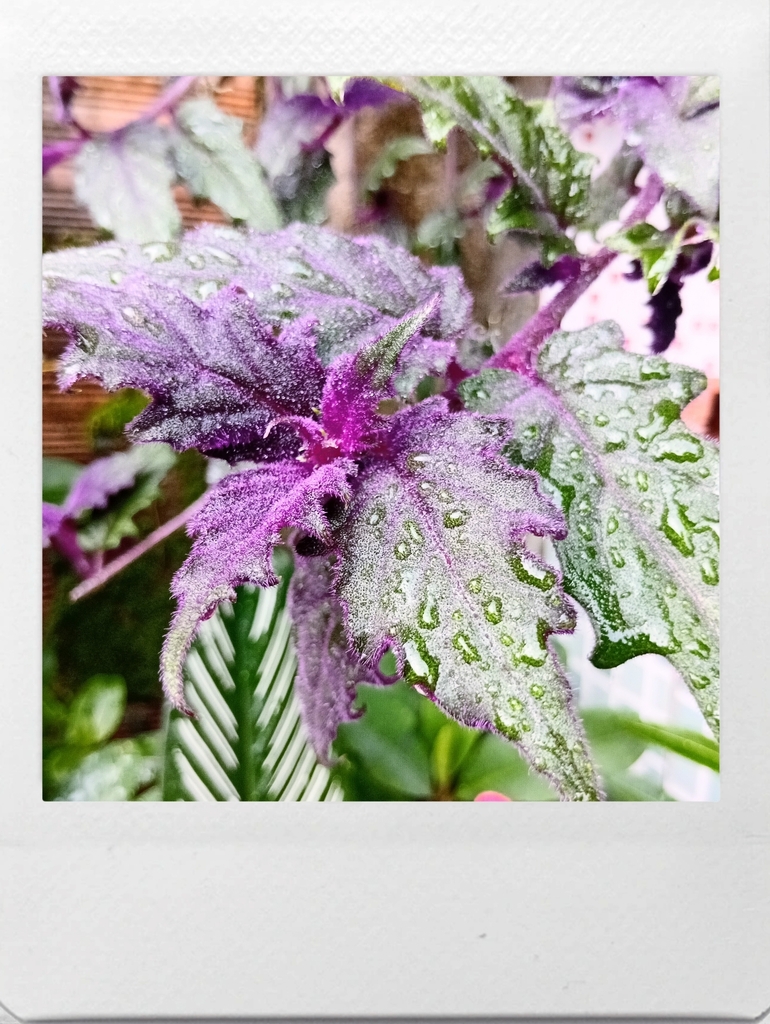 Purple velvet plant
Gynura aurantiaca
Purple velvet plant
Gynura aurantiaca- Gynura is distinguished by its fuzzy leaf blades, which turn purple in sufficient light.
Aloe vera Aloe vera
- Aloe needs bright sun and grows as a rosette with leaves up to 50 cm long, while string of pearls needs bright indirect light.
Flaming Katy Kalanchoe blossfeldiana
- Kalanchoe is recognized by its flat-topped flower clusters and compact size of 30–40 cm.
Frequently asked questions
- Why are the leaves turning yellow?
- The most common cause is overwatering or potting mix that does not dry out properly. Check the roots and water less often.
- Why are the leaves shriveling?
- This happens when the plant lacks water, but damaged roots can cause a similar appearance. First check the condition of the potting mix and root system.
- Can I keep it at home if I have a cat?
- The plant is toxic to cats. Place the pot where your cat cannot chew the stems or pick up fallen plant parts.
- Does it need misting?
- Regular misting is not needed. Light, an airy potting mix, and watering after the mix dries out are more important.
- How do I propagate it?
- Cuttings are usually used. Lay them on a light potting mix and avoid overwatering while they root.