Jade plant
Overwatering harms this succulent more often than a short drought: its fleshy leaves store water, while its roots quickly rot in constantly wet potting mix, especially in low light.


Structure and water storage
This succulent has thick, branching stems and fleshy, smooth leaves. The leaves grow in pairs, with each successive pair set roughly at right angles to the previous one, so the canopy looks dense even without many stems.
Young stems are usually green, close to the color of the leaves, but turn brown and woody with age. This can give the plant the appearance of a small tree, though its stability still depends on light, the weight of its canopy, and the condition of its roots.
The botanical name is Crassula ovata: the genus name refers to the thick, succulent leaves, while the specific epithet ovata refers to their egg-shaped form. The Ukrainian name meaning “fat plant” and the name “crassula” have become established in everyday use and the plant trade; the first describes the fleshy leaves, and the second is a rendering of the Latin genus name.
Origin and seasonal growth
The species is native to South Africa. In the wild, it is adapted to bright sun, rocky sites, and periods of uneven water availability, so its leaves and stems serve as water reserves.
This structure explains its main requirement indoors: the plant tolerates a gap between waterings better than constantly wet potting mix. To flower, it needs cooler, drier, darker conditions in winter, but flowering is uncommon indoors.
| In the wild | Indoors |
|---|---|
| Plenty of direct sun | A very bright window is the best spot |
| Water is available unevenly | Water after the potting mix dries out |
| A drier winter period | Reduce watering in winter |
Light and placement
Bright light keeps the canopy compact and the stems strong. In low light, stems stretch, leaves grow smaller, and thin branches may eventually break under their own weight.
In very bright sun, the leaf edges sometimes develop a reddish tint. A yellowish tone can also appear as protective pigments form, helping the leaves withstand intense sunlight.
- longer gaps between leaves and long, weak stems
- smaller leaves
- loss of a dense canopy
If these signs have already appeared, move the plant closer to the light gradually. An abrupt move from shade to direct sun can stress the leaves.
Watering and potting mix
The roots are sensitive to waterlogging, especially when low light and cool conditions occur together. The potting mix should dry out between waterings, and excess water should not remain in the saucer.
A fertile potting mix or a well-drained cactus mix is suitable. Choose a stable pot: a mature plant has a heavy canopy and woody stems, so a lightweight container can easily tip over.
- dense potting mix without drainage
- watering while the soil is still damp
- water left in the saucer after watering
- a cool spot with wet roots
- excessive feeding during dormancy
White specks on the leaves are not always pests. Hard water can leave mineral salts that reach the surface through hydathodes during guttation; these marks usually wipe off.
Shaping and propagation
Stems can be shortened if the canopy has become lopsided or the stems have stretched from a lack of light. Pruning helps reduce the load on weak branches, but without better light, new growth will be thin again.
The species readily regrows from vegetative parts. In the wild, pieces of stem or individual leaves can fall onto the soil and take root; sometimes aerial roots appear directly on branches below a leaf.
- Take a healthy cutting or detach a leaf
- Let the cut surface dry before planting
- Place it on the surface of the potting mix or insert it shallowly
- Moisten moderately without keeping the base wet
- Wait several weeks for roots to develop
When propagating from a leaf, a small new plant forms at its base. At first, it uses the water and nutrient reserves in the old leaf, then begins relying on its own roots.
Flowering and common problems
Flowering can occur in winter: the flower clusters consist of small, white or pink, star-shaped flowers. A cool, relatively dry, darker period is important for bud formation, so the plant often grows without flowering in a consistently warm room.
The most common problem is root rot after overwatering. The risk increases when the plant is in low light, the potting mix stays wet for a long time, and the temperature is lower than during active growth.
| Symptom | Likely cause | What to do |
|---|---|---|
| Soft stem, falling leaves | Waterlogged roots | Let the potting mix dry out and check the roots |
| Long, thin stems | Lack of light | Provide more light and shorten weak growth |
| White specks on the leaves | Mineral salts from hard water | Gently wipe off the deposits |
| Cottony clumps on the stems | Mealybugs | Isolate the plant and remove the pests |
| Small insects on young growth | Aphids | Rinse the stems and watch for their return |
The plant is mildly toxic to cats and dogs. Do not place it where a pet regularly chews the leaves, but keep the risk in perspective: the main risk at home comes from eating parts of the plant.
- Light
- bright light
- Temperature
- +18…+26 °C
- Watering
- after the potting mix dries out
- Soil
- fertile potting mix or cactus mix
- Difficulty
- easy
- Cats and dogs
- mildly toxic
- Size indoors
- 1-1.5 m
- Leaves indoors
- 20-30 × 10-18 mm
- Native range
- South Africa
Care
This succulent stores water in its leaves and stems, so the main requirements are plenty of light and careful watering. Constantly damp potting mix is more dangerous for it than a short drought.
- Light
- Provide bright light. In low light, stems stretch and leaves grow smaller. Acclimate the plant gradually to direct sun after shade.
- Temperature
- Keep at +18…+26 °C. This is the range for the growing season. Reduce watering in winter; cooler, drier conditions are more likely to encourage flowering.
- Watering
- Water after the potting mix dries out. Excess water, especially in cool conditions and low light, causes root rot. Empty the saucer.
- Soil
- Use a well-drained cactus mix. A fertile potting mix or cactus mix is suitable. Water needs to drain quickly through the pot.
- Feeding
- Feed moderately in spring and summer. Feed only during active growth. Excess fertilizer does not make up for a lack of light and can weaken the roots.
- Support
- Prune as needed. Shorten weak, stretched stems to reduce the weight of the canopy. Without bright light, the plant will lose its shape again.
- Leaves
- Inspect and wipe the leaves. White specks may be salts from hard water and wipe off easily. Check cottony clumps in the leaf axils for pests.
- Repotting
- Repot into a stable pot. Repot into a container with drainage when the roots are cramped or the potting mix drains poorly. A mature plant has a heavy canopy.
Botany
4 ill.- Family
- Crassulaceae
- Genus
- Crassula
- Species
- Crassula ovata
- Author and year
- (Mill.) Druce
- Life form
- succulent


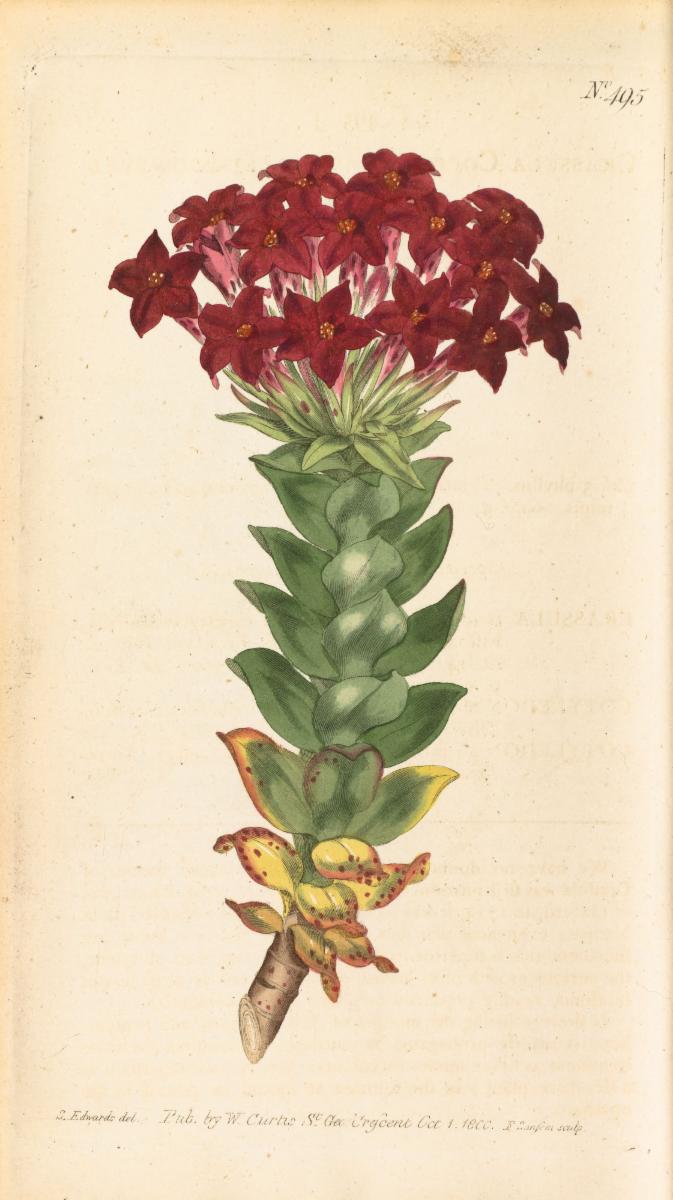
Jade plant (Crassula ovata) belongs to the family Crassulaceae. It is a succulent with fleshy, oval leaves, thick stems, and older stems that become woody.
The leaves are usually green, sometimes with a reddish edge in strong sun. The leaf pairs are arranged at right angles to one another, helping the canopy receive light from different sides.
The species is native to South Africa and is adapted to uneven water availability. Indoors, this means it needs bright light, well-drained potting mix, and careful watering.
Popular cultivars
3- Hummel's Sunset
- yellowish leaves with a red edge
- MonstruosaMonstruosa
- monstrose growth form; also listed in the source with the synonyms Cristata, Gollum, and Hobbit
- TricolorTricolor
- three-colored foliage
How it differs from similar plants
Flaming Katy Kalanchoe blossfeldiana
- Kalanchoe is shorter — 30–40 cm — and is grown for its flat-topped flower clusters, while jade plant reaches 1–1.5 m indoors and has smaller, fleshy leaves.
Burro's tail Sedum morganianum
- Burro's tail is recognizable by its trailing, brittle stems measuring 30–120 cm, while jade plant is described as a much taller houseplant at 1–1.5 m, with leaves measuring 20–30 mm.
Mexican snowball Echeveria elegans
- Echeveria has a dense rosette of light green leaves with a bluish-white waxy coating and a stem up to 5 cm long; jade plant grows to 1–1.5 m, with fleshy leaves measuring 20–30 mm.
Frequently asked questions
- Why are the leaves falling off?
- Most often because of overwatering, cold and wet potting mix, or a lack of light. First check the roots and watering conditions.
- Why isn't the plant flowering?
- Flowering is uncommon indoors. A cool, drier, darker winter period encourages it.
- Can I keep it on a windowsill?
- Yes, but the spot must be very bright. In low light, stems stretch and the canopy becomes less dense.
- Is the plant safe for cats and dogs?
- The plant is mildly toxic to cats and dogs, so do not let pets chew the leaves or stems.
- How do I propagate the plant?
- Let the cut surface of a cutting or leaf dry, then place it on well-drained potting mix. Roots usually appear after several weeks.